



 Chat with AI
Exam 13: Analysis of Financial Statements

Exam 1: Accounting in Business285 Questions
Exam 2: Accounting for Business Transactions251 Questions
Exam 3: Adjusting Accounts for Financial Statements403 Questions
Exam 4: Accounting for Merchandising Operations252 Questions
Exam 5: Inventories and Cost of Sales238 Questions
Exam 6: Cash,fraud,and Internal Controls228 Questions
Exam 7: Accounting for Receivables219 Questions
Exam 8: Accounting for Long-Term Assets258 Questions
Exam 9: Accounting for Current Liabilities219 Questions
Exam 10: Accounting for Long-Term Liabilities231 Questions
Exam 11: Corporate Reporting and Analysis247 Questions
Exam 12: Reporting Cash Flows247 Questions
Exam 13: Analysis of Financial Statements245 Questions
Exam 14: Managerial Accounting Concepts and Principles252 Questions
Exam 15: Job Order Costing and Analysis215 Questions
Exam 16: Process Costing and Analysis225 Questions
Exam 17: Activity-Based Costing and Analysis223 Questions
Exam 18: Cost Behavior and Cost-Volume-Profit Analysis247 Questions
Exam 19: Variable Costing and Analysis202 Questions
Exam 20: Master Budgets and Performance Planning224 Questions
Exam 21: Flexible Budgets and Standard Costs223 Questions
Exam 22: Performance Measurement and Responsibility Accounting210 Questions
Exam 23: Relevant Costing for Managerial Decisions149 Questions
Exam 24: Capital Budgeting and Investment Analysis161 Questions
Exam 25: Time Value of Money84 Questions
Exam 26: Investments217 Questions
Exam 27: Lean Principles and Accounting30 Questions
Select questions type


The percent change of a comparative financial statement item is computed by subtracting the base period amount from the analysis period amount,dividing the result by the base period amount and multiplying that result by 100.
(True/False)
4.9/5  (73)
(73) Identify the financial analysis building block most appropriately associated with each ratio listed below by placing the letter of the building block a through d beside each ratio 1 through 10.Each building block may be used more than once.
A.Liquidity and Efficiency
B.Solvency
C.Profitability
D.Market Prospects
________ (1)Price Earnings Ratio
________ (2)Dividend Yield
________ (3)Accounts Receivable Turnover
________ (4)Days' Sales in Inventory
________ (5)Return on Total Assets
________ (6)Equity Ratio
________ (7)Debt Ratio
________ (8)Inventory Turnover
________ (9)Basic Earnings per Share
________ (10)Times Interest Earned
(Essay)
4.8/5 (96)
(96) Net sales divided by average accounts receivable,net is the:
(Multiple Choice)
4.8/5 (78)
(78) Stark Company's most recent balance sheet reported total assets of $1.9 million,total liabilities of $0.8 million,and total equity of $1.1 million.Its Debt to equity ratio is:
(Multiple Choice)
4.9/5 (70)
(70) ________ is a method of analysis used to evaluate individual financial statement items or groups of items in terms of a specific base amount.
(Short Answer)
4.8/5 (82)
(82) A company's sales in Year 1 were $280,000,and its sales in Year 2 were $341,600.Using Year 1 as the base year,what is the sales trend percent for Year 2?
(Short Answer)
4.8/5 (69)
(69) The income level most likely to continue into the future is commonly referred to as ________.
(Short Answer)
4.7/5 (81)
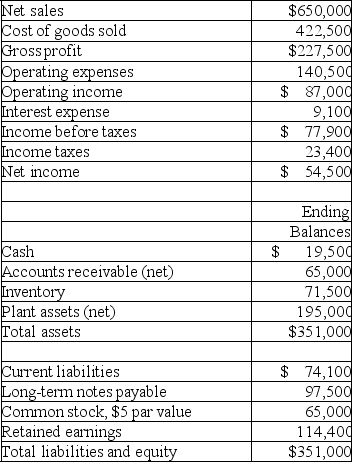
(81) A company's calendar-year financial data are shown below.The company had total assets of $339,000 and total equity of $144,400 for the prior year.No additional shares of common stock were issued during the year.The December 31 market price per share is $49.50.Cash dividends of $19,500 were paid during the year.Calculate the following ratios for the company:
(a)debt ratio
(b)equity ratio
(c)debt-to-equity ratio
(d)times interest earned
(e)total asset turnover
(Essay)
4.7/5 (81)
(81) The executive summary of a financial statement analysis report includes the evidential matter,assumptions,and inferences for the report.
(True/False)
4.8/5 (84)
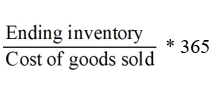
(84) Match each of the appropriate formulas with correct term.
-
(Multiple Choice)
4.9/5 (83)
(83) How long a company holds inventory before selling it can be measured by dividing cost of goods sold by the average inventory balance to determine the:
(Multiple Choice)
5.0/5 (81)
(81) Standards for comparisons in financial statement analysis do not include:
(Multiple Choice)
4.9/5 (77)
(77) Refer to the following selected financial information from Phantom Corp.
 -Compute the company's inventory turnover for Year 2.
 (Multiple Choice)
4.7/5 (69)
(69) Match each of the appropriate formulas with correct term.
-
(Multiple Choice)
5.0/5 (65)
(65) The following information is available for the Starr Corporation:
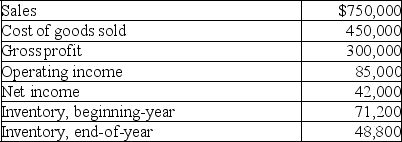 Calculate the company's inventory turnover and its days' sales in inventory.
 (Essay)
4.9/5 (90)
(90) Comparative financial statements in which each individual financial statement amount is expressed as a percentage of a base amount are called:
(Multiple Choice)
4.8/5 (90)
(90) Comparative financial statements are reports that show financial amounts in side by side columns on a single statement for analysis purposes.
(True/False)
4.8/5 (79)
(79) Dividing Accounts receivable,net by Net sales and multiplying the result by 365 is the:
(Multiple Choice)
4.8/5 (72)
(72) What are the four standards for comparisons in financial analysis? Give an example of each.
(Essay)
4.8/5 (95)
(95) 
Filters
- Essay(0)
- Multiple Choice(0)
- Short Answer(0)
- True False(0)
- Matching(0)