



 Chat with AI
Exam 23: Chemistry of the Nonmetals

Exam 1: Units of Measurement for Physical and Chemical Change173 Questions
Exam 2: Atoms and Elements161 Questions
Exam 3: Molecules,compounds,and Nomenclature172 Questions
Exam 4: Chemical Reactions and Stoichiometry247 Questions
Exam 5: Gases146 Questions
Exam 6: Thermochemistry145 Questions
Exam 7: The Quantum-Mechanical Model of the Atom164 Questions
Exam 8: Periodic Properties of the Elements129 Questions
Exam 9: Chemical Bonding I: Lewis Theory136 Questions
Exam 10: Chemical Bonding II: Molecular Shapes, valence Bond Theory, and Molecular Orbital Theory158 Questions
Exam 11: Liquids, solids, and Intermolecular Forces127 Questions
Exam 12: Solutions153 Questions
Exam 13: Chemical Kinetics156 Questions
Exam 14: Chemical Equilibrium124 Questions
Exam 15: Acids and Bases141 Questions
Exam 16: Aqueous Ionic Equilibrium159 Questions
Exam 17: Gibbs Energy and Thermodynamics119 Questions
Exam 18: Electrochemistry107 Questions
Exam 19: Radioactivity and Nuclear Chemistry108 Questions
Exam 20: Organic Chemistry I: Structures103 Questions
Exam 21: Organic Chemistry II: Reactions93 Questions
Exam 22: Biochemistry49 Questions
Exam 23: Chemistry of the Nonmetals45 Questions
Exam 24: Metals and Metallurgy42 Questions
Exam 25: Transition Metals and Coordination Compounds50 Questions
Select questions type


Write the balanced equation that represents the formation of hydrofluoric acid from the reaction of calcium fluoride with sulfuric acid.
(Multiple Choice)
4.8/5  (68)
(68) 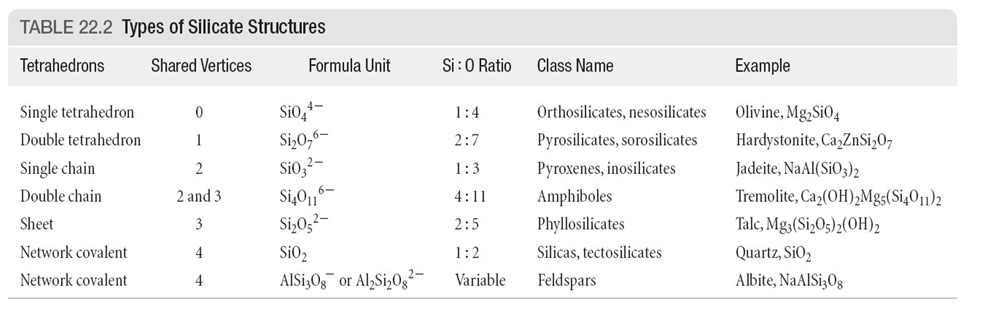 -Refer to the above table.Predict the silicate structure for KAl(SiO3)2.
 (Multiple Choice)
4.9/5 (77)
(77) Determine the number of vertices and faces in the closo-Borane B12H122-.
(Multiple Choice)
4.8/5 (68)
(68) 
Filters
- Essay(0)
- Multiple Choice(0)
- Short Answer(0)
- True False(0)
- Matching(0)