



 Chat with AI
Exam 12: Managing Production Across the Supply Chain

Exam 1: Introduction to Operations and Supply Chain Management83 Questions
Exam 2: Operations and Supply Chain Strategies85 Questions
Exam 3: Process Choice and Layout Decisions in Manufacturing and Services100 Questions
Exam 4: Business Processes83 Questions
Exam 5: Managing Quality66 Questions
Exam 6: Managing Capacity71 Questions
Exam 6: S: Advanced Waiting Line Theory and Simulation Modeling70 Questions
Exam 7: Supply Management92 Questions
Exam 8: Logistics90 Questions
Exam 9: Forecasting79 Questions
Exam 10: Sales and Operations Planning Aggregate Planning80 Questions
Exam 11: Managing Inventory Throughout the Supply Chain78 Questions
Exam 12: Managing Production Across the Supply Chain96 Questions
Exam 12: S: Supply Chain Information Systems62 Questions
Exam 13: Jitlean Production75 Questions
Exam 14: Managing Projects65 Questions
Exam 15: Developing Products and Services88 Questions
Select questions type


Consider the product structure tree shown below: 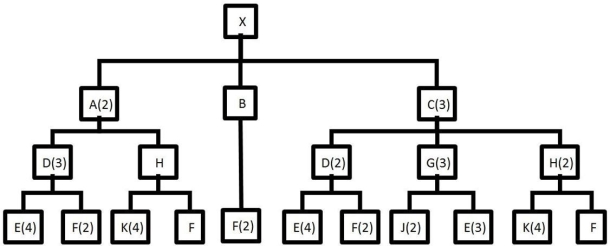 With a beginning inventory of twenty for all components on level one, five for all components on level two, and zero for all components on level three and finished items, how many more K's than F's are needed to produce 25 product X's?
 (Multiple Choice)
4.8/5  (74)
(74) Using this MRP record and a lead time of 3 weeks, what should the planned orders be in week 1? 1 2 3 4 5 Gross Requirements 400 500 300 Scheduled receipts 0 0 0 0 0 Projected ending Inventory 100 100 Net Requirements Planned Receipts 300 Planned Orders
(Multiple Choice)
4.8/5 (80)
(80) Which step in the top down model of manufacturing planning and control system comes after sales and operations planning?
(Multiple Choice)
4.7/5 (78)
(78) Gross requirements in an MRP record can be met by inventory from previous weeks, scheduled receipts, or planned receipts.
(True/False)
5.0/5 (85)
(85) ________ translates the master schedule for final products into detailed material requirements.
(Short Answer)
4.9/5 (80)
(80) There are 50 units in inventory at the start of week 1 for this company, which runs a lot-for-lot MRP system. There is a one week lead time for all shipping and production quantities regardless of volume. What are the quantities of the planned orders for this item for the first six weeks? 1 2 3 4 5 6 7 8 Gross Requirements 50 20 30 40 Scheduled receipts Projected ending Inventory Net Requirements Planned Receipts Planned Orders
(Multiple Choice)
4.9/5 (78)
(78) With an inventory as shown in the table, how many assembly E's should be produced or purchased to produce 15 product X's with this product structure tree? 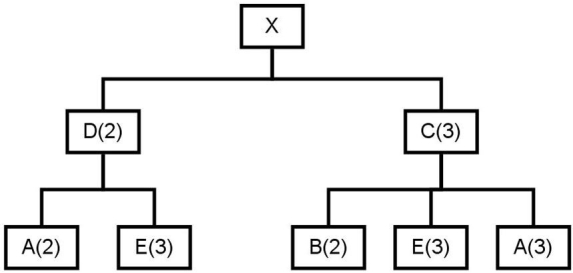 Item Inventory 5 15 20 8 6 17
 (Multiple Choice)
4.8/5 (77)
(77) Determine a schedule for these jobs using the critical ratio criterion and calculate the average lateness. Then develop an earliest due date sequence and calculate average lateness.
Job Process Time Due Date Job 1 15 23 Job 2 7 15 Job 3 12 34 Job 4 17 28 Job 5 11 27
(Essay)
4.9/5 (73)
(73) 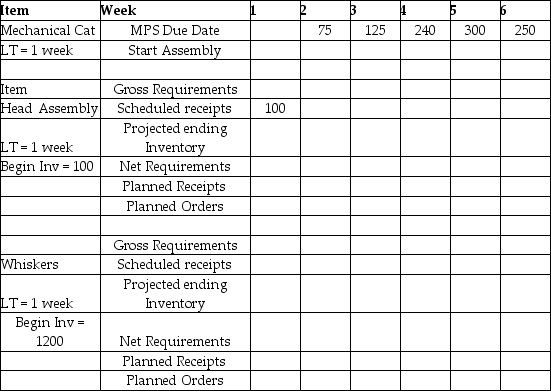 -According to the table above.What is the planned order for whiskers in Week 2?
 (Essay)
4.9/5 (80)
(80) Which of these correctly explains the relationship between available to promise inventory and the master production schedule for any week beyond the first week of the schedule when production is scheduled? Note that ATP is available to promise, MPS is master production schedule, EI is ending inventory, and OB is orders booked.
(Multiple Choice)
4.8/5 (88)
(88) The table shows a master schedule for end item Z that is produced according to the product structure tree shown below. Beginning inventories and lead times for components of Z are given in the table. The lot sizes for A, B, and C are 100 units and an L4L rule for E. Complete a materials requirement plan for components A, B, and C.
Period 1 2 3 4 5 6 MPS Qty 0 0 0 250 275 275 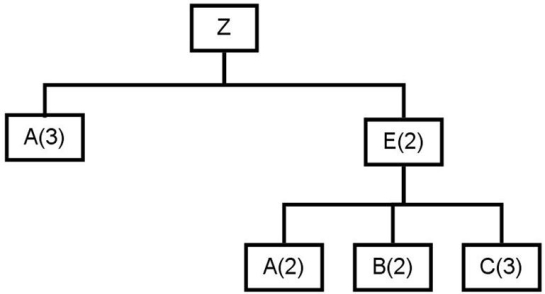 Component A B C D E Lead Time 1 2 2 2 1 Beginning Inv 50 75 100 15 40
 (Essay)
4.9/5 (74)
(74) 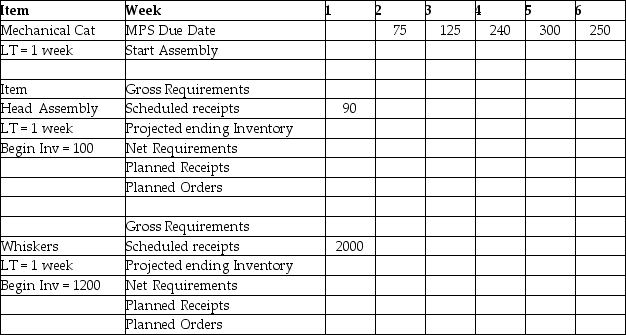 -According to the table above.What are the net requirements Front Leg Assemblies in Week 4
 (Essay)
5.0/5 (74)
(74) There are six jobs that are awaiting processing at a machining center. The jobs are shown in the table with their processing time and scheduled completion time. Schedule the jobs by earliest due date and the critical ratio rule and calculate average lateness for all the jobs. Which scheduling technique performs BEST?
Job Process Time Due Time A 12 25 B 8 32 C 15 40 D 10 15 E 20 27 F 17 46
(Essay)
4.9/5 (63)
(63) Given the forecast and booked orders shown in the table, and a beginning inventory of 0, what is the available to promise inventory for period 3? There are no LOT quantity constraints. Period 1 2 3 4 Forecasted Demand 100 100 90 90 Booked Orders 103 87 54 21 Projected ending inventory Master production schedule Available to Promise
(Multiple Choice)
4.9/5 (80)
(80) A time-phased planning approach that uses planned orders at the point of demand to determine forecasted demand at the source level is:
(Multiple Choice)
4.9/5 (68)
(68) Consider the product structure tree shown below: 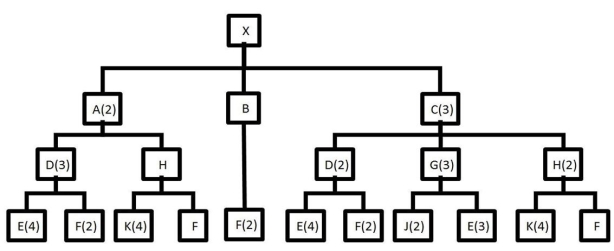 With a beginning inventory of ten for all components on level one, five for all components on level two, and zero for all components on level three and finished items, how many assembly E's are needed to produce 20 product X's?
 (Multiple Choice)
4.9/5 (90)
(90) 
Filters
- Essay(0)
- Multiple Choice(0)
- Short Answer(0)
- True False(0)
- Matching(0)