



 Chat with AI
Exam 28: Quantum Physics

Exam 1: Representing Motion113 Questions
Exam 2: Motion in One Dimension174 Questions
Exam 3: Vectors and Motion in Two Dimensions183 Questions
Exam 4: Forces and Newtons Laws of Motion64 Questions
Exam 5: Applying Newtons Laws82 Questions
Exam 6: Gravity96 Questions
Exam 7: Rotational Motion95 Questions
Exam 8: Equilibrium Ad Elasticity73 Questions
Exam 9: Momentum103 Questions
Exam 10: Energy and Work223 Questions
Exam 11: Using Energy106 Questions
Exam 12: Thermal Properties of Matter220 Questions
Exam 13: Fluids115 Questions
Exam 14: Oscillations105 Questions
Exam 15: Traveling Waves and Sound94 Questions
Exam 16: Superposition and Standing Waves66 Questions
Exam 17: Wave Optics129 Questions
Exam 18: Ray Optics155 Questions
Exam 19: Optical Instruments137 Questions
Exam 20: Electric Fields and Forces95 Questions
Exam 21: Electric Potential144 Questions
Exam 22: Current and Resistance125 Questions
Exam 23: Circuits157 Questions
Exam 24: Magnetic Fields and Forces168 Questions
Exam 25: EM Induction and Em Waves185 Questions
Exam 26: AC Electricity122 Questions
Exam 27: Relativity126 Questions
Exam 28: Quantum Physics86 Questions
Exam 29: Atoms and Molecules105 Questions
Exam 30: Nuclear Physics175 Questions
Select questions type


A proton and an electron are both accelerated to the same final kinetic energy. If λp is the de Broglie wavelength of the proton and λe is the de Broglie wavelength of the electron, then
(Multiple Choice)
4.8/5  (71)
(71) A crystal is irradiated with x-rays with a wavelength of 0.120 nm. The atomic planes in the crystal are separated by 0.21 nm. At what angles of incidence with respect to the normal will the x-rays reflect from the crystal?
(Multiple Choice)
4.8/5 (80)
(80) For what wavelength does a 100-mW laser beam deliver 1.6 × 10¹⁷ photons in one second? (c = 3.0 × 10⁸ m/s, h = 6.626 × 10⁻³⁴ J ∙ s)
(Multiple Choice)
4.9/5 (85)
(85) An electron is accelerated from rest through a potential difference. After acceleration the electron has a wavelength of 880 nm. What is the potential difference responsible for the acceleration of the electron? (h = 6.626 × 10⁻³⁴ J ∙ s, melectron = 9.11 × 10⁻³¹ kg, e = 1.6 10-19 C)
(Multiple Choice)
4.9/5 (74)
(74) A metal has a work function of 4.50 eV. Find the maximum kinetic energy of the photoelectrons if light of wavelength 250 nm shines on the metal. (1 eV = 1.60 × 10⁻¹⁹ J, c = 3.00 × 10⁸ m/s, h = 6.626 × 10⁻³⁴ J ∙ s)
(Multiple Choice)
5.0/5 (87)
(87) Find the de Broglie wavelength of a 1.30-kg missile moving at (h = 6.626 × 10⁻³⁴ J ∙ s)
(Multiple Choice)
4.7/5 (71)
(71) If an electron has a wavelength of 0.123 nm, what is its kinetic energy, in electron-volts? This energy is not in the relativistic region. (melectron = 9.11 × 10⁻³¹ kg, 1 eV = 1.60 × 10⁻¹⁹ J, h = 6.626 × 10⁻³⁴ J ∙ s)
(Multiple Choice)
4.9/5 (65)
(65) If the work function of a metal surface is 2.20 eV, what frequency of incident light would give a maximum kinetic energy of 0.25 eV to the photoelectrons ejected from this surface? (1 eV = 1.60 × 10⁻¹⁹ J, h = 6.626 × 10⁻³⁴ J ∙ s)
(Multiple Choice)
4.9/5 (79)
(79) A photocathode having a work function of 2.4 eV is illuminated with monochromatic light whose photon energy is 3.4 eV. What is maximum kinetic energy of the photoelectrons produced?(c = 3.00 × 10⁸ m/s, h = 6.626 × 10⁻³⁴ J ∙ s, 1 eV = 1.60 × 10⁻¹⁹ J)
(Multiple Choice)
4.8/5 (83)
(83) Light with a frequency of 8.70 × 10¹⁴ Hz is incident on a metal that has a work function of 2.80 eV. What is the maximum kinetic energy that a photoelectron ejected in this process can have? (1 eV = 1.60 × 10⁻¹⁹ J, h = 6.626 × 10⁻³⁴ J ∙ s)
(Multiple Choice)
4.9/5 (85)
(85) Monochromatic light is incident on a metal surface, and the ejected electrons give rise to a current in the circuit shown in the figure. The maximum kinetic energy of the ejected electrons is determined by applying a reverse ('stopping') potential, sufficient to reduce the current in the ammeter to zero. If the intensity of the incident light is increased, how will the required stopping potential change? 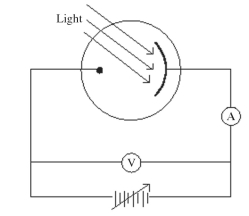
(Multiple Choice)
4.8/5 (81)
(81) An electron is moving with the speed of 1780 m/s. What is its de Broglie wavelength? (melectron = 9.11 × 10⁻³¹ kg, h = 6.626 × 10⁻³⁴ J ∙ s)
(Multiple Choice)
4.7/5 (81)
(81) A laser emits a pulse of light that lasts 10 ns. The light has a wavelength of 690 nm, and each pulse has an energy of 480 mJ. How many photons are emitted in each pulse? (c = 3.0 × 10⁸ m/s, h = 6.626 × 10⁻³⁴ J ∙ s)
(Multiple Choice)
4.9/5 (90)
(90) A monochromatic light beam is incident on the surface of a metal having a work function of 2.50 eV. If a 1.0-V stopping potential is required to make the electron current zero, what is the wavelength of light? (c = 3.00 × 10⁸ m/s, h = 6.626 × 10⁻³⁴ J ∙ s, 1 eV = 1.60 × 10⁻¹⁹ J)
(Multiple Choice)
4.9/5 (77)
(77) If an electron has the same de Broglie wavelength as the wavelength of a 390-nm photon in vacuum, what is the speed of the electron? (melectron = 9.11 × 10⁻³¹ kg, c = 3.0 × 10⁸ m/s, h = 6.626 × 10⁻³⁴ J ∙ s)
(Multiple Choice)
4.8/5 (79)
(79) A crystal diffracts a beam of electrons, like a diffraction grating, as they hit it perpendicular to its surface. The crystal spacing is 0.18 nm, and the first maximum scattering occurs at 80° relative to the normal to the surface. (e = 1.60 × 10⁻¹⁹ C, melectron = 9.11 × 10⁻¹³ kg, h = 6.626 × 10⁻³⁴ J ∙ s)
(a) What is the wavelength of the electrons?
(b) What potential difference accelerated the electrons if they started from rest?
(Short Answer)
5.0/5 (80)
(80) In her physics laboratory, Mathilda shines electromagnetic radiation on a material and collects photoelectric data to determine Planck's constant. She measures a stopping potential of 5.82 V for radiation of wavelength 100 nm, and 17.99 V for radiation of wavelength 50.0 nm. (1 eV = 1.60 × 10⁻¹⁹ J, c = 3.00 × 10⁸ m/s)
(a) Using Mathilda's data, what value does she determine for Planck's constant?
(b) What is the work function of the material Mathilda is using, in electron-volts?
(Short Answer)
4.9/5 (88)
(88) Light with a wavelength of 310 nm is incident on a metal that has a work function of 3.80 eV. What is the maximum kinetic energy that a photoelectron ejected in this process can have? (1 eV = 1.60 × 10⁻¹⁹ J, c = 3.00 × 10⁸ m/s, h = 6.626 × 10⁻³⁴ J ∙ s)
(Multiple Choice)
4.9/5 (76)
(76) Electrons emerge from an electron gun with a speed of 2.0 × 10⁶ m/s and then pass through a double-slit apparatus. Interference fringes with spacing of 2.7 mm are detected on a screen far from the double slit. What would the fringe spacing be if the electrons were replaced by neutrons with the same speed? (h = 6.626 × 10⁻³⁴ J ∙ s, melectron = 9.11 × 10⁻³¹ kg, mneutron = 1.675 × 10⁻²⁷ kg)
(Multiple Choice)
4.8/5 (89)
(89) Atoms in crystals are typically separated by distances of 0.10 nm. What kinetic energy must a nonrelativistic electron have, in electron-volts, in order to have a wavelength of 0.10 nm? (melectron = 9.11 × 10⁻³¹ kg, 1 eV = 1.60 × 10⁻¹⁹ J, h = 6.626 × 10⁻³⁴ J ∙ s)
(Short Answer)
4.7/5 (88)
(88) 
Filters
- Essay(0)
- Multiple Choice(0)
- Short Answer(0)
- True False(0)
- Matching(0)