



 Chat with AI
Exam 23: Circuits

Exam 1: Representing Motion113 Questions
Exam 2: Motion in One Dimension174 Questions
Exam 3: Vectors and Motion in Two Dimensions183 Questions
Exam 4: Forces and Newtons Laws of Motion64 Questions
Exam 5: Applying Newtons Laws82 Questions
Exam 6: Gravity96 Questions
Exam 7: Rotational Motion95 Questions
Exam 8: Equilibrium Ad Elasticity73 Questions
Exam 9: Momentum103 Questions
Exam 10: Energy and Work223 Questions
Exam 11: Using Energy106 Questions
Exam 12: Thermal Properties of Matter220 Questions
Exam 13: Fluids115 Questions
Exam 14: Oscillations105 Questions
Exam 15: Traveling Waves and Sound94 Questions
Exam 16: Superposition and Standing Waves66 Questions
Exam 17: Wave Optics129 Questions
Exam 18: Ray Optics155 Questions
Exam 19: Optical Instruments137 Questions
Exam 20: Electric Fields and Forces95 Questions
Exam 21: Electric Potential144 Questions
Exam 22: Current and Resistance125 Questions
Exam 23: Circuits157 Questions
Exam 24: Magnetic Fields and Forces168 Questions
Exam 25: EM Induction and Em Waves185 Questions
Exam 26: AC Electricity122 Questions
Exam 27: Relativity126 Questions
Exam 28: Quantum Physics86 Questions
Exam 29: Atoms and Molecules105 Questions
Exam 30: Nuclear Physics175 Questions
Select questions type


Determine the current in the 8.0-Ω resistor for the circuit shown in the figure. Assume that the batteries are ideal and that all numbers are accurate to two significant figures. 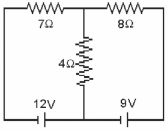
(Multiple Choice)
4.8/5  (82)
(82) A 5-µF, a 7-µF, and an unknown capacitor CX are connected in series between points a and b. What do you know about the equivalent capacitance Cab between a and b? (There could be more than one correct choice.)
(Multiple Choice)
4.7/5 (77)
(77) When two or more different capacitors are connected in series across a potential source, which of the following statements must be true? (There could be more than one correct choice.)
(Multiple Choice)
4.8/5 (87)
(87) A circuit contains a 2.0-MΩ resistor in series with an uncharged capacitor. When this combination is connected across an ideal battery, the capacitor reaches 25% of its maximum charge in 1.5 s. What is its capacitance?
(Short Answer)
4.9/5 (86)
(86) A 8.0-μF uncharged capacitor is connected in series with a 6.0-kΩ resistor, an ideal 20-V dc source, and an open switch. If the switch is closed at time t = 0.0 s, what is the charge on the capacitor at t = 9.0 ms?
(Multiple Choice)
4.8/5 (85)
(85) What different resistances can be obtained by using two 2.0-Ω resistors and one 4.0-Ω resistor? You must use all three of them in each possible combination.
(Short Answer)
4.9/5 (72)
(72) What is the equivalent resistance in the circuit shown in the figure? 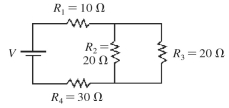
(Multiple Choice)
4.7/5 (85)
(85) A group of 1.0-μF, 2.0-μF, and 3.0-μF capacitors is connected in parallel across a 24-V potential difference (a battery). How much energy is stored in this three-capacitor combination when the capacitors are fully charged?
(Multiple Choice)
4.8/5 (72)
(72) If V = 20 V and the battery is ideal, what is the current through R3 in the figure? 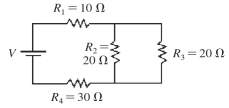
(Multiple Choice)
4.8/5 (84)
(84) A resistor is made out of a wire having a length L. When the ends of the wire are attached across the terminals of an ideal battery having a constant voltage V0 across its terminals, a current I flows through the wire. If the wire were cut in half, making two wires of length L/2, and both wires were attached across the terminals of the battery (the right ends of both wires attached to one terminal, and the left ends attached to the other terminal), how much current would the battery put out?
(Multiple Choice)
4.7/5 (80)
(80) The network shown is assembled with uncharged capacitors X , Y, and Z, with
CX=3.0 F, CY=5.0 F and CZ=1.0 F The switches S1 and S2 are initially open, and a potential difference Vab = 120 V is applied between points a and b. After the network is assembled, switch S1 is then closed, but switch S2 is kept open. What is the final potential difference across capacitor Z? 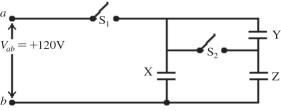
(Multiple Choice)
4.8/5 (74)
(74) When two or more different capacitors are connected in parallel across a potential source (battery), which of the following statements must be true? (There could be more than one correct choice.)
(Multiple Choice)
4.8/5 (80)
(80) The capacitor shown in the circuit in the figure is initially uncharged when the switch S is suddenly closed, and the battery is ideal. After one time constant has gone by, find (a) the current through the resistor and (b) the charge on the capacitor. Assume that the numbers shown are all accurate to two significant figures. 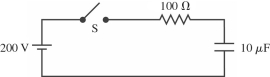
(Short Answer)
4.9/5 (80)
(80) A 4.0-Ω resistor is connected to a 12-Ω resistor and this combination is connected to an ideal dc power supply with voltage V as shown in the figure. If the total current in this circuit is I = 2.0 A, what is the value of voltage V? 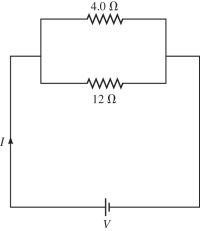
(Multiple Choice)
4.8/5 (79)
(79) A 4.0-µF capacitor and an 8.0-µF capacitor are connected together. What is the equivalent capacitance of the combination if they are connected (a) in series or (b) in parallel?
(Short Answer)
4.8/5 (85)
(85) For the circuit shown in the figure, write the Kirchhoff current equation for the node labeled A. Notice the directions of the currents! 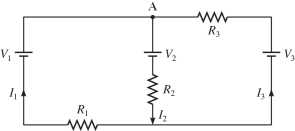
(Short Answer)
4.9/5 (85)
(85) A potential difference of V = 100 V is applied across two capacitors in series, as shown in the figure. If = and the voltage drop across it is 75 V, what is the capacitance of C2? 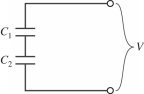
(Multiple Choice)
4.9/5 (94)
(94) 
Filters
- Essay(0)
- Multiple Choice(0)
- Short Answer(0)
- True False(0)
- Matching(0)