



 Chat with AI
Exam 23: Circuits

Exam 1: Representing Motion113 Questions
Exam 2: Motion in One Dimension174 Questions
Exam 3: Vectors and Motion in Two Dimensions183 Questions
Exam 4: Forces and Newtons Laws of Motion64 Questions
Exam 5: Applying Newtons Laws82 Questions
Exam 6: Gravity96 Questions
Exam 7: Rotational Motion95 Questions
Exam 8: Equilibrium Ad Elasticity73 Questions
Exam 9: Momentum103 Questions
Exam 10: Energy and Work223 Questions
Exam 11: Using Energy106 Questions
Exam 12: Thermal Properties of Matter220 Questions
Exam 13: Fluids115 Questions
Exam 14: Oscillations105 Questions
Exam 15: Traveling Waves and Sound94 Questions
Exam 16: Superposition and Standing Waves66 Questions
Exam 17: Wave Optics129 Questions
Exam 18: Ray Optics155 Questions
Exam 19: Optical Instruments137 Questions
Exam 20: Electric Fields and Forces95 Questions
Exam 21: Electric Potential144 Questions
Exam 22: Current and Resistance125 Questions
Exam 23: Circuits157 Questions
Exam 24: Magnetic Fields and Forces168 Questions
Exam 25: EM Induction and Em Waves185 Questions
Exam 26: AC Electricity122 Questions
Exam 27: Relativity126 Questions
Exam 28: Quantum Physics86 Questions
Exam 29: Atoms and Molecules105 Questions
Exam 30: Nuclear Physics175 Questions
Select questions type


A multiloop circuit is shown in the figure. Find the emf ε1 if the batteries are ideal. (It is not necessary to solve the entire circuit.) 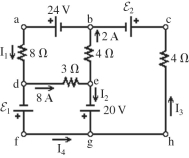
(Multiple Choice)
4.8/5  (89)
(89) Four resistors are connected across an ideal dc source of V = 8.0 V, as shown in the figure. Assume all resistances shown are accurate to two significant figures. What is the current through the 9.0-Ω resistor? 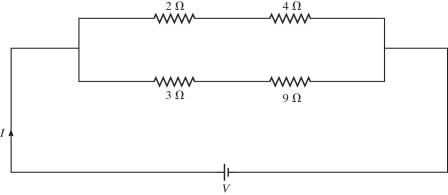
(Multiple Choice)
4.9/5 (83)
(83) Two 100-W light bulbs of fixed resistance are to be connected to an ideal 120-V source. What are the current, potential difference, and dissipated power for each bulb when they are connected
(a) in parallel (the normal arrangement)?
(b) in series?
(Essay)
4.9/5 (78)
(78) Three capacitors are arranged as shown in the figure, with a voltage source connected across the combination. C1 has a capacitance of has a capacitance of and has a capacitance of Find the potential drop across the entire arrangement if the potential drop across C2 is 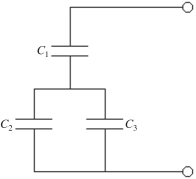
(Multiple Choice)
4.8/5 (92)
(92) What resistance must be connected in parallel with a 633-Ω resistor to produce an equivalent resistance of 205 Ω?
(Short Answer)
5.0/5 (94)
(94) A 4.0-Ω resistor is connected with a 12-Ω resistor and both of these are connected across an ideal dc power supply with voltage V as shown in the figure. If the total current in this circuit is I = 2.0 A, what is the current through the 4.0-Ω resistor? 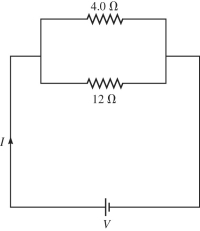
(Multiple Choice)
4.9/5 (75)
(75) A certain 20-A circuit breaker trips when the current in it equals 20 A. What is the maximum number of 100-W light bulbs you can connect in parallel in an ideal 120-V dc circuit without tripping this circuit breaker?
(Multiple Choice)
4.7/5 (90)
(90) In the circuit shown in the figure, all the capacitors are initially uncharged when the switch S is suddenly closed, and the battery is ideal. Find (a) the maximum reading of the ammeter and (b) the maximum charge on the 5.00-µF capacitor. 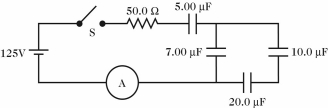
(Short Answer)
4.7/5 (74)
(74) An uncharged capacitor is connected in series with a resistor, a dc battery, and an open switch. At time t = 0 s, the switch is closed. Which of the graphs below best describes the current I through the resistor as a function of time t?
(Multiple Choice)
4.8/5 (80)
(80) In the circuit shown in the figure, the resistor R has a variable resistance. As R is decreased, what happens to the currents? 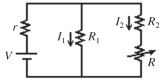
(Multiple Choice)
4.8/5 (74)
(74) Four 16-μF capacitors are connected in combination. What is the equivalent capacitance of this combination if they are connected
(a) in series?
(b) in parallel?
(c) such that two of them are in parallel with each other and that combination is in series with the remaining two capacitors?
(Short Answer)
4.9/5 (65)
(65) What is the equivalent resistance of the circuit shown in the figure? The battery is ideal and all resistances are accurate to 3 significant figures. 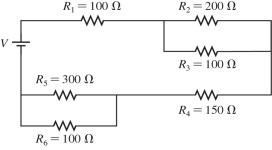
(Multiple Choice)
4.8/5 (78)
(78) Three identical capacitors are connected in parallel to a potential source (battery). If a charge of Q flows into this combination, how much charge does each capacitor carry?
(Multiple Choice)
4.8/5 (85)
(85) A system of four capacitors is connected across a 90-V voltage source as shown in the figure.
(a) What is the potential difference across the plates of the 6.0-µF capacitor?
(b) What is the charge on the 3.0-µF capacitor? 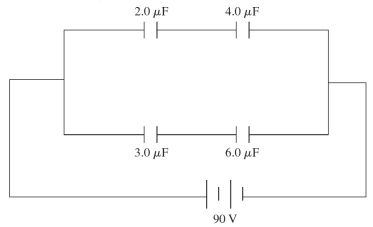
(Short Answer)
4.9/5 (83)
(83) A multiloop circuit is shown in the figure, but some quantities are not labeled. Find the current I1 if the batteries are ideal. (It is not necessary to solve the entire circuit.) 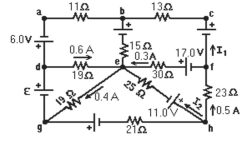
(Multiple Choice)
4.9/5 (78)
(78) What is the magnitude of the potential difference between points B and C for the circuit shown in the figure? The battery is ideal, and all the numbers are accurate to two significant figures. 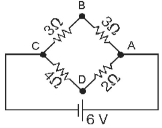
(Multiple Choice)
4.9/5 (81)
(81) Two resistors with resistances of 5.0 Ω and 9.0 Ω are connected in parallel. A 4.0-Ω resistor is then connected in series with this parallel combination. An ideal 6.0-V battery is then connected across the series-parallel combination. What is the current through (a) the 4.0-Ω resistor and (b) the 5.0-Ω resistor?
(Short Answer)
5.0/5 (95)
(95) A 22-A current flows into a parallel combination of 4.0-Ω, 6.0-Ω, and 12-Ω resistors. What current flows through the 12-Ω resistor?
(Multiple Choice)
4.8/5 (80)
(80) Two 4.0-Ω resistors are connected in parallel, and this combination is connected in series with 3.0 Ω. What is the equivalent resistance of this system?
(Multiple Choice)
4.9/5 (80)
(80) For the circuit shown in the figure, calculate the emf's ε1 and ε3, assuming that the batteries are ideal. Note that two currents are shown. 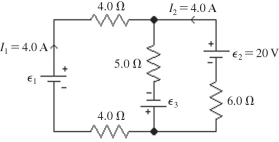
(Short Answer)
5.0/5 (70)
(70) 
Filters
- Essay(0)
- Multiple Choice(0)
- Short Answer(0)
- True False(0)
- Matching(0)