



 Chat with AI
Exam 9: Momentum

Exam 1: Representing Motion113 Questions
Exam 2: Motion in One Dimension174 Questions
Exam 3: Vectors and Motion in Two Dimensions183 Questions
Exam 4: Forces and Newtons Laws of Motion64 Questions
Exam 5: Applying Newtons Laws82 Questions
Exam 6: Gravity96 Questions
Exam 7: Rotational Motion95 Questions
Exam 8: Equilibrium Ad Elasticity73 Questions
Exam 9: Momentum103 Questions
Exam 10: Energy and Work223 Questions
Exam 11: Using Energy106 Questions
Exam 12: Thermal Properties of Matter220 Questions
Exam 13: Fluids115 Questions
Exam 14: Oscillations105 Questions
Exam 15: Traveling Waves and Sound94 Questions
Exam 16: Superposition and Standing Waves66 Questions
Exam 17: Wave Optics129 Questions
Exam 18: Ray Optics155 Questions
Exam 19: Optical Instruments137 Questions
Exam 20: Electric Fields and Forces95 Questions
Exam 21: Electric Potential144 Questions
Exam 22: Current and Resistance125 Questions
Exam 23: Circuits157 Questions
Exam 24: Magnetic Fields and Forces168 Questions
Exam 25: EM Induction and Em Waves185 Questions
Exam 26: AC Electricity122 Questions
Exam 27: Relativity126 Questions
Exam 28: Quantum Physics86 Questions
Exam 29: Atoms and Molecules105 Questions
Exam 30: Nuclear Physics175 Questions
Select questions type


A 0.140-kg baseball is dropped and reaches a speed of 1.20 m/s just before it hits the ground and bounces. It rebounds with an upward velocity of 1.00 m/s. What is the change of the ball's momentum during the bounce?
(Multiple Choice)
4.8/5  (78)
(78) A golf club exerts an average horizontal force of 1000 N on a 0.045-kg golf ball that is initially at rest on the tee. The club is in contact with the ball for 1.8 ms. What is the speed of the golf ball just as it leaves the tee?
(Multiple Choice)
4.9/5 (86)
(86) A 0.17-kg baseball is thrown with a speed of 38 m/s and it is hit straight back toward the pitcher with a speed of 62 m/s. What is the magnitude of the impulse exerted upon the ball by the bat?
(Short Answer)
4.8/5 (94)
(94) A 0.140-kg baseball is dropped from rest. It has a speed of 1.20 m/s just before it hits the ground, and it rebounds with an upward speed of 1.00 m/s. The ball is in contact with the ground for 0.0140 s. What is the average force exerted by the ground on the ball during the time of contact?
(Multiple Choice)
4.8/5 (80)
(80) Initially, a small 2.0-kg rock is whirling at the end of a very thin string in a circular path of radius 0.75 m on a horizontal frictionless surface, as shown in the figure. The initial tangential speed of the rock was 5.0 m/s. The string has been slowly winding around a vertical rod, and a few seconds later the length of the string has shortened to 0.25 m. What is the instantaneous speed of the mass at the moment the string reaches a length of 0.25 m? 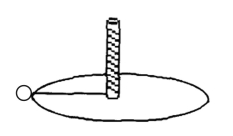
(Multiple Choice)
4.8/5 (84)
(84) A uniform, solid, cylindrical flywheel of radius 1.4 m and mass 15 kg rotates at What is the magnitude of the flywheel's angular momentum?
(Multiple Choice)
4.9/5 (76)
(76) A car (of mass 1500 kg) and a small truck (of mass 2000 kg) collide suddenly at right angles at an icy intersection. The car was originally traveling eastward at 20.0 m/s and the truck was traveling northward at 20.0 m/s just before the collision took place. What is the speed of the combined wreck just after the collision if the vehicles become enmeshed?
(Short Answer)
4.8/5 (72)
(72) A tiger is running in a straight line. If we double both the mass and speed of the tiger, the magnitude of its momentum will increase by what factor?
(Multiple Choice)
4.8/5 (83)
(83) A 600-kg car makes a 90° turn. Its speed before the turn is 21.0 m/s and after the turn it is 24.0 m/s. What is the magnitude of the change in the car's momentum during the turn?
(Multiple Choice)
4.9/5 (76)
(76) A rubber ball and a lump of clay have equal mass. They are thrown with equal speed against a wall. The ball bounces back with nearly the same speed with which it hit. The clay sticks to the wall. Which one of these objects experiences the greater momentum change?
(Multiple Choice)
4.9/5 (84)
(84) A 1000-kg whale swims horizontally to the right at a speed of 6.0 m/s. It suddenly collides directly with a stationary seal of mass 200 kg. The seal grabs onto the whale and holds fast. What is the speed of these two sea creatures just after their collision? You can neglect any drag effects of the water during the collision.
(Multiple Choice)
4.9/5 (82)
(82) In a police ballistics test, 2.00-g bullet traveling at 700 m/s suddenly hits and becomes embedded in a stationary 5.00-kg wood block. What is the speed of the block immediately after the bullet has stopped moving relative to the block?
(Short Answer)
4.9/5 (88)
(88) Jennifer hits a stationary 0.20-kg ball, and it leaves her racket at 40 m/s. Time-lapse photography shows that the ball was in contact with the racket for 40 ms.
(a) What average force did the ball exert on the racket?
(b) What is the ratio of this force to the weight of the ball?
(Short Answer)
4.9/5 (80)
(80) A block of mass m = 34 kg and speed V is behind a block of mass M = 81 kg and speed of as shown in the figure. The surface is frictionless and the blocks collide and couple. After the collision, the blocks have a common speed of What is the magnitude of the impulse on the 34-kg block due to the collision? 
(Multiple Choice)
4.8/5 (76)
(76) A small car meshes with a large truck in a head-on collision. Which of the following statements concerning the momentum during the collision are correct? (There could be more than one correct choice.)
(Multiple Choice)
4.8/5 (81)
(81) A batter hits a foul ball. The 0.14-kg baseball that was approaching him at 40 m/s leaves the bat at 30 m/s in a direction perpendicular to the line between the batter and the pitcher. What is the magnitude of the impulse delivered to the baseball?
(Multiple Choice)
4.9/5 (82)
(82) A force of 5.3 N is needed to hold on to an umbrella in a strong wind. If the air molecules each have a mass of 4.7 ×10⁻²⁶ kg, and each one strikes the umbrella (without rebounding) with a speed of 2.0 m/s in the same direction, how many atoms strike the umbrella each second? Assume that the wind blows horizontally so that the gravity can be neglected.
(Short Answer)
4.9/5 (84)
(84) A 900-kg car traveling east at 15.0 m/s suddenly collides with a 750-kg car traveling north at 20.0 m/s. The cars stick together after the collision. In what direction does the wreckage move just after the collision?
(Multiple Choice)
4.8/5 (80)
(80) A 5-kg ball collides inelastically head-on with a 10-kg ball, which is initially stationary. Which of the following statements is true? (There could be more than one correct choice.)
(Multiple Choice)
4.8/5 (78)
(78) 
Filters
- Essay(0)
- Multiple Choice(0)
- Short Answer(0)
- True False(0)
- Matching(0)