



 Chat with AI
Exam 9: Momentum

Exam 1: Representing Motion113 Questions
Exam 2: Motion in One Dimension174 Questions
Exam 3: Vectors and Motion in Two Dimensions183 Questions
Exam 4: Forces and Newtons Laws of Motion64 Questions
Exam 5: Applying Newtons Laws82 Questions
Exam 6: Gravity96 Questions
Exam 7: Rotational Motion95 Questions
Exam 8: Equilibrium Ad Elasticity73 Questions
Exam 9: Momentum103 Questions
Exam 10: Energy and Work223 Questions
Exam 11: Using Energy106 Questions
Exam 12: Thermal Properties of Matter220 Questions
Exam 13: Fluids115 Questions
Exam 14: Oscillations105 Questions
Exam 15: Traveling Waves and Sound94 Questions
Exam 16: Superposition and Standing Waves66 Questions
Exam 17: Wave Optics129 Questions
Exam 18: Ray Optics155 Questions
Exam 19: Optical Instruments137 Questions
Exam 20: Electric Fields and Forces95 Questions
Exam 21: Electric Potential144 Questions
Exam 22: Current and Resistance125 Questions
Exam 23: Circuits157 Questions
Exam 24: Magnetic Fields and Forces168 Questions
Exam 25: EM Induction and Em Waves185 Questions
Exam 26: AC Electricity122 Questions
Exam 27: Relativity126 Questions
Exam 28: Quantum Physics86 Questions
Exam 29: Atoms and Molecules105 Questions
Exam 30: Nuclear Physics175 Questions
Select questions type


A 1500-kg car traveling at 90 km/h toward the east suddenly collides with a 3000-kg car traveling at 60 km/h toward the south. The two cars stick together after the collision. What is the direction of motion of the cars after collision?
(Multiple Choice)
4.8/5  (79)
(79) A 40.0-kg child running at 3.00 m/s suddenly jumps onto a stationary playground merry-go-round at a distance 1.50 m from the axis of rotation of the merry-go-round. The child is traveling tangential to the edge of the merry-go-round just before jumping on. The moment of inertia about its axis of rotation is 600 kg ∙ m2 and very little friction at its rotation axis. What is the angular speed of the merry-go-round just after the child has jumped onto it?
(Multiple Choice)
4.8/5 (86)
(86) Three cars, car X, car Y, and car Z, begin accelerating from rest at the same time. Car X is more massive than car Y, which is more massive than car Z. The net accelerating force exerted on each car is identical. After 10 seconds, which car has the most amount of momentum?
(Multiple Choice)
4.9/5 (86)
(86) A 1000-kg whale swims horizontally to the right at a speed of 6.0 m/s. It suddenly collides directly with a stationary seal of mass 200 kg. The seal grabs onto the whale and holds fast. What is the momentum of these two sea creatures just after their collision? You can neglect any drag effects of the water during the collision.
(Multiple Choice)
4.7/5 (66)
(66) A car heading north suddenly collides at an intersection with a truck of the same mass heading east. If they lock together and travel at at 15° north of east just after the collision, how fast was the car initially traveling?
(Multiple Choice)
5.0/5 (72)
(72) A person sits on a freely spinning lab stool that has no friction in its axle. When this person extends her arms,
(Multiple Choice)
4.8/5 (94)
(94) A small car meshes with a large truck in a head-on collision. Which of the following statements concerning the magnitude of the average force during the collision is correct?
(Multiple Choice)
5.0/5 (81)
(81) A 900-kg car traveling 30.0° south of east at 12.0 m/s suddenly collides with a 750-kg car traveling north at 17.0 m/s. The cars stick together after colliding. What is the speed of the wreckage just after the collision?
(Multiple Choice)
5.0/5 (85)
(85) A 0.330-kg volleyball is thrown vertically downward with a speed of 0.150 m/s in a place where g = 9.81 m/s2. It takes it 0.0655 s to reach the ground. What is the magnitude of its momentum just before it hits the ground?
(Multiple Choice)
4.8/5 (76)
(76) A very small 51-g steel ball is released from rest and falls vertically onto a steel plate. The ball strikes the plate and is in contact with it for 0.50 ms. The ball rebounds elastically and returns to its original height. The total time interval for a round trip is 3.00 s. What is the magnitude of the average force exerted on the ball by the plate during contact with the plate?
(Multiple Choice)
4.8/5 (66)
(66) A block of mass m = 5.6 kg, moving on a frictionless surface with a velocity of to the right, collides with a block of mass M at rest, as shown in the figure. After the collision, the 5.6-kg block recoils with a velocity of to the left. If the blocks are in contact for 0.20 s, what is the magnitude of the average force on the 5.6-kg block, while the two blocks are in contact? 
(Multiple Choice)
4.7/5 (67)
(67) A uniform 135-g meter stick rotates about an axis perpendicular to the stick passing through its center with an angular speed of 3.50 rad/s. What is the magnitude of the angular momentum of the stick?
(Multiple Choice)
4.8/5 (79)
(79) You are standing on a skateboard, initially at rest. A friend throws a very heavy ball towards you. You have two choices about what to do with the ball: either catch the ball or deflect it back toward your friend with the same speed as it was originally thrown. Which choice should you make in order to maximize your speed on the skateboard?
(Multiple Choice)
4.9/5 (82)
(82) A 1200-kg car moving at suddenly collides with a stationary car of mass If the two vehicles lock together, what is their combined velocity immediately after the collision?
(Multiple Choice)
4.8/5 (85)
(85) An ice skater has a moment of inertia of 5.0 kg ∙ m2 when her arms are outstretched, and at this time she is spinning at 3.0 rev/s. If she pulls in her arms and decreases her moment of inertia to 2.0 kg ∙ m2, how fast will she be spinning?
(Multiple Choice)
4.8/5 (87)
(87) A solid, uniform, horizontal disk with a diameter of 2.0 m and a mass of 4.0 kg freely rotates at 36 rpm about a vertical axis through its center. A small 0.50-kg stone is suddenly dropped onto the disk and sticks to the disk at a distance of 80 cm from the axis of rotation. The figure shows before and after views.
(a) Before the stone fell, what was the moment of inertia of the disk about its central axis?
(b) After the stone stuck, what was the moment of inertia of the system about the same axis?
(c) What is the angular velocity of the disk (in rpm) after the stone fell onto the disk? 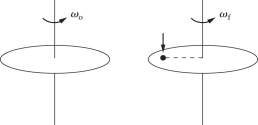
(Short Answer)
4.8/5 (71)
(71) A 0.140-kg baseball is thrown with a velocity of It is struck by the bat with an average force of 5000 N, which results in a velocity of 37.0 m/s in the opposite direction from the original velocity. How long were the bat and ball in contact?
(Multiple Choice)
4.9/5 (76)
(76) A super dart of mass 20 g, traveling at 350 m/s, strikes a steel plate at an angle of 30° with the plane of the plate, as shown in the figure. It bounces off the plate at the same angle but at a speed of 320 m/s. What is the magnitude of the impulse that the plate gives to the bullet? 
(Multiple Choice)
5.0/5 (84)
(84) Find the magnitude and direction of the net momentum of the system shown in the figure. Express the direction by giving the angle the net momentum makes with the +x-axis. 
(Short Answer)
4.8/5 (84)
(84) 
Filters
- Essay(0)
- Multiple Choice(0)
- Short Answer(0)
- True False(0)
- Matching(0)