



 Chat with AI
Exam 2: Motion in One Dimension

Exam 1: Representing Motion113 Questions
Exam 2: Motion in One Dimension174 Questions
Exam 3: Vectors and Motion in Two Dimensions183 Questions
Exam 4: Forces and Newtons Laws of Motion64 Questions
Exam 5: Applying Newtons Laws82 Questions
Exam 6: Gravity96 Questions
Exam 7: Rotational Motion95 Questions
Exam 8: Equilibrium Ad Elasticity73 Questions
Exam 9: Momentum103 Questions
Exam 10: Energy and Work223 Questions
Exam 11: Using Energy106 Questions
Exam 12: Thermal Properties of Matter220 Questions
Exam 13: Fluids115 Questions
Exam 14: Oscillations105 Questions
Exam 15: Traveling Waves and Sound94 Questions
Exam 16: Superposition and Standing Waves66 Questions
Exam 17: Wave Optics129 Questions
Exam 18: Ray Optics155 Questions
Exam 19: Optical Instruments137 Questions
Exam 20: Electric Fields and Forces95 Questions
Exam 21: Electric Potential144 Questions
Exam 22: Current and Resistance125 Questions
Exam 23: Circuits157 Questions
Exam 24: Magnetic Fields and Forces168 Questions
Exam 25: EM Induction and Em Waves185 Questions
Exam 26: AC Electricity122 Questions
Exam 27: Relativity126 Questions
Exam 28: Quantum Physics86 Questions
Exam 29: Atoms and Molecules105 Questions
Exam 30: Nuclear Physics175 Questions
Select questions type


Suppose that a car traveling to the west (-x direction) begins to slow down as it approaches a traffic light. Which statement concerning its acceleration must be correct?
(Multiple Choice)
4.9/5  (92)
(92) To determine the height of a flagpole, Abby throws a ball straight up and times it. She sees that the ball goes by the top of the pole after 0.50 s and then reaches the top of the pole again after a total elapsed time of 4.1 s. How high is the pole above the point where the ball was launched? Neglect air resistance.
(Multiple Choice)
5.0/5 (84)
(84) A car is moving with a speed of 32.0 m/s. The driver sees an accident ahead and slams on the brakes, causing the car to slow down with a uniform acceleration of magnitude 3.50 m/s2. How far does the car travel after the driver put on the brakes until it comes to a stop?
(Multiple Choice)
4.7/5 (74)
(74) To determine the height of a bridge above the water, a person drops a stone and measures the time it takes for it to hit the water. If the height of the bridge is 41 m, how long will it take for the stone to hit the water? Neglect air resistance.
(Multiple Choice)
4.8/5 (88)
(88) A baseball is hit with a bat and, as a result, its direction is completely reversed and its speed is doubled. If the actual contact with the bat lasts 0.45 s, what is the ratio of the magnitude of the average acceleration of the ball to its original speed?
(Multiple Choice)
4.8/5 (71)
(71) A bicyclist starts a timed race at In order to win, he must average Assuming constant acceleration from the start, how fast must he be traveling at the end of the race?
(Multiple Choice)
4.8/5 (74)
(74) A train starts from rest and accelerates uniformly until it has traveled 2.1 km and acquired a forward velocity of The train then moves at a constant velocity of for 400 s. The train then slows down uniformly at until it is brought to a halt. The distance traveled by the train while slowing down is closest to
(Multiple Choice)
4.8/5 (82)
(82) A rock is thrown directly upward from the edge of a flat roof of a building that is 56.3 meters tall. The rock misses the building on its way down, and is observed to strike the ground 4.00 seconds after being thrown. Take the acceleration due to gravity to have magnitude and neglect any effects of air resistance. With what speed was the rock thrown?
(Short Answer)
4.8/5 (75)
(75) A racing car accelerates uniformly from rest along a straight track. This track has markers spaced at equal distances along it from the start, as shown in the figure. The car reaches a speed of 140 km/h as it passes marker 2.  Where on the track was the car when it was traveling at half this speed, that is at 70 km/h?
 (Multiple Choice)
4.8/5 (84)
(84) An object is moving with constant non-zero acceleration in the +x direction. The velocity versus time graph of this object is
(Multiple Choice)
4.9/5 (80)
(80) A car is traveling at 26.0 m/s when the driver suddenly applies the brakes, causing the car to slow down with constant acceleration. The car comes to a stop in a distance of 120 m. How fast was the car moving when it was 60.0 m past the point where the brakes were applied?
(Multiple Choice)
4.9/5 (75)
(75) The motions of a car and a truck along a straight road are represented by the velocity-time graphs in the figure. The two vehicles are initially alongside each other at time t = 0.  At time T, what is true of the distances traveled by the vehicles since time t = 0?
 (Multiple Choice)
4.8/5 (80)
(80) Which of the following graphs represent an object at rest? (There could be more than one correct choice.) (a)
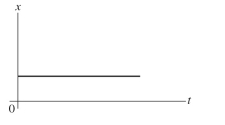 (b)
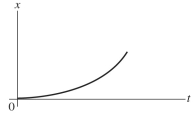 (c)
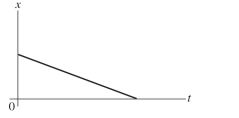 (d)
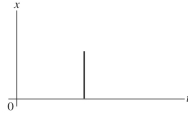 (e)
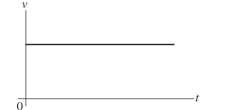
(b)
(c)
(d)
(e)
(Multiple Choice)
4.7/5 (74)
(74) The graph in the figure shows the position of an object as a function of time. The letters H-L represent particular moments of time.  (a) At which moment in time is the speed of the object the greatest?
(b) At which moment in time is the speed of the object equal to zero?
(a) At which moment in time is the speed of the object the greatest?
(b) At which moment in time is the speed of the object equal to zero? (Short Answer)
4.9/5 (79)
(79) A train starts from rest and accelerates uniformly until it has traveled 5.6 km and acquired a forward velocity of The train then moves at a constant velocity of for 420 s. The train then slows down uniformly at until it is brought to a halt. The acceleration during the first 5.6 km of travel is closest to which of the following?
(Multiple Choice)
4.9/5 (85)
(85) Suppose that an object travels from one point in space to another. Make a comparison between the magnitude of the displacement and the distance traveled by this object.
(Multiple Choice)
4.9/5 (80)
(80) Which of the following graphs represent an object having zero acceleration?
(a)
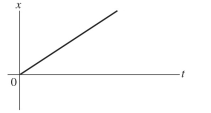 (b)
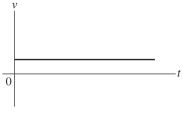 (c)
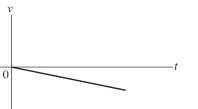 (d)
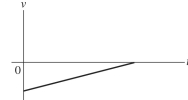
(b)
(c)
(d)
(Multiple Choice)
4.9/5 (71)
(71) If the velocity versus time graph of an object is a straight line making an angle of +30° (counter clockwise) with the time axis, the object is
(Multiple Choice)
4.9/5 (86)
(86) A race car circles 10 times around a circular 8.0-km track in 20 min. Using SI units
(a) what is its average speed for the ten laps?
(b) what is its average velocity for the ten laps?
(Short Answer)
4.8/5 (80)
(80) An astronaut stands by the rim of a crater on the Moon, where the acceleration of gravity is 1.62 m/s2 and there is no air. To determine the depth of the crater, she drops a rock and measures the time it takes for it to hit the bottom. If the depth of the crater is 120 m, how long does it take for the rock to fall to the bottom of the crater?
(Multiple Choice)
4.8/5 (72)
(72) 
Filters
- Essay(0)
- Multiple Choice(0)
- Short Answer(0)
- True False(0)
- Matching(0)