



 Chat with AI
Exam 2: Motion in One Dimension

Exam 1: Representing Motion113 Questions
Exam 2: Motion in One Dimension174 Questions
Exam 3: Vectors and Motion in Two Dimensions183 Questions
Exam 4: Forces and Newtons Laws of Motion64 Questions
Exam 5: Applying Newtons Laws82 Questions
Exam 6: Gravity96 Questions
Exam 7: Rotational Motion95 Questions
Exam 8: Equilibrium Ad Elasticity73 Questions
Exam 9: Momentum103 Questions
Exam 10: Energy and Work223 Questions
Exam 11: Using Energy106 Questions
Exam 12: Thermal Properties of Matter220 Questions
Exam 13: Fluids115 Questions
Exam 14: Oscillations105 Questions
Exam 15: Traveling Waves and Sound94 Questions
Exam 16: Superposition and Standing Waves66 Questions
Exam 17: Wave Optics129 Questions
Exam 18: Ray Optics155 Questions
Exam 19: Optical Instruments137 Questions
Exam 20: Electric Fields and Forces95 Questions
Exam 21: Electric Potential144 Questions
Exam 22: Current and Resistance125 Questions
Exam 23: Circuits157 Questions
Exam 24: Magnetic Fields and Forces168 Questions
Exam 25: EM Induction and Em Waves185 Questions
Exam 26: AC Electricity122 Questions
Exam 27: Relativity126 Questions
Exam 28: Quantum Physics86 Questions
Exam 29: Atoms and Molecules105 Questions
Exam 30: Nuclear Physics175 Questions
Select questions type


The captain orders his starship to accelerate from rest at a rate of "1 g" (1 g = 9.8 m/s2). How many days does it take the starship to reach 10% the speed of light? (Light travels at 3.0 × 10⁸ m/s.)
(Short Answer)
4.9/5  (86)
(86) Suppose that a car traveling to the east (+x direction) begins to slow down as it approaches a traffic light. Which statement concerning its acceleration must be correct?
(Multiple Choice)
4.9/5 (89)
(89) An object is moving with constant non-zero velocity in the +x direction. The position versus time graph of this object is
(Multiple Choice)
4.9/5 (71)
(71) Under what condition is average velocity equal to the average of the object's initial and final velocity?
(Multiple Choice)
4.7/5 (83)
(83) A runner ran the marathon (approximately 42.0 km) in 2 hours and 57 min. What was the average speed of the runner in m/s?
(Multiple Choice)
4.8/5 (65)
(65) The area under a curve in a velocity versus time graph gives
(Multiple Choice)
5.0/5 (80)
(80) An object is moving in a straight line with constant acceleration. Initially it is traveling at 16 m/s. Three seconds later it is traveling at 10 m/s. How far does it move during this time?
(Multiple Choice)
4.9/5 (79)
(79) Abby throws a ball straight up and times it. She sees that the ball goes by the top of a flagpole after 0.50 s and reaches the level of the top of the pole after a total elapsed time of 4.1 s. What was the speed of the ball at launch? Neglect air resistance.
(Multiple Choice)
4.9/5 (72)
(72) The figure shows the velocity-versus-time graph for a basketball player traveling up and down the court in a straight-line path. Find the displacement of the player
(a) during the first two seconds.
(b) between t = 4 s and t = 8 s. 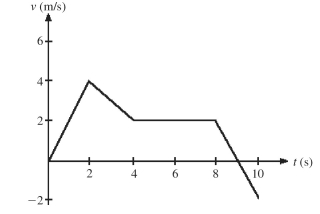
(Short Answer)
4.7/5 (67)
(67) A ball is projected upward at time t = 0 s, from a point on a flat roof 90 m above the ground. The ball rises and then falls with insignificant air resistance, missing the roof, and strikes the ground. The initial velocity of the ball is Consider all quantities as positive in the upward direction. The vertical velocity of the ball when it is above the ground is closest to
(Multiple Choice)
4.8/5 (75)
(75) If a car accelerates at a uniform 4.0 m/s2, how long will it take to reach a speed of 80 km/hr, starting from rest?
(Short Answer)
4.8/5 (79)
(79) The figure shows a graph of the position x of two cars, C and D, as a function of time t.  According to this graph, which statements about these cars must be true? (There could be more than one correct choice.)
 (Multiple Choice)
4.9/5 (71)
(71) You are driving home on a weekend from school at 55 mi/h for 110 miles. It then starts to snow and you slow to 35 mi/h. You arrive home after driving 4 hours and 15 minutes. How far is your hometown from school?
(Multiple Choice)
4.7/5 (85)
(85) If you run a complete loop around an outdoor track of length 400 m in 100 s, find your
(a) average velocity and (b) average speed.
(Short Answer)
4.7/5 (69)
(69) A runner runs around a track consisting of two parallel lines 96 m long connected at the ends by two semicircles with a radius of 49 m. She completes one lap in 100 seconds. What is her average speed?
(Multiple Choice)
4.7/5 (81)
(81) An object is thrown upwards with a speed of 16 m/s. How long does it take it to reach a height of 7.0 m on the way up? Neglect air resistance.
(Multiple Choice)
4.9/5 (77)
(77) A rock from a volcanic eruption is launched straight up into the air with no appreciable air resistance. Which one of the following statements about this rock while it is in the air is correct?
(Multiple Choice)
4.9/5 (73)
(73) A ball is projected upward at time t = 0 s, from a point on a flat roof 10 m above the ground. The ball rises and then falls with insignificant air resistance, missing the roof, and strikes the ground. The initial velocity of the ball is Consider all quantities as positive in the upward direction. At time , the vertical velocity of the ball is closest to
(Multiple Choice)
4.8/5 (79)
(79) An object is dropped from a bridge. A second object is thrown downwards 1.0 s later. They both reach the water 20 m below at the same instant. What was the initial speed of the second object? Neglect air resistance.
(Multiple Choice)
4.9/5 (83)
(83) 
Filters
- Essay(0)
- Multiple Choice(0)
- Short Answer(0)
- True False(0)
- Matching(0)