



 Chat with AI
Exam 6: Job-Costing Systems

Exam 1: Management Accounting and Management Decisions90 Questions
Exam 2: Cost Behaviour and Cost-Volume Relationships96 Questions
Exam 3: Measurement of Cost Behaviour97 Questions
Exam 4: Cost Management Systems134 Questions
Exam 5: Cost Allocation and Activity-Based Costing Systems128 Questions
Exam 6: Job-Costing Systems88 Questions
Exam 7: Process-Costing Systems82 Questions
Exam 8: Relevant Information and Decision Making: Marketing Decisions100 Questions
Exam 9: Relevant Information and Decision Making: Production Decisions111 Questions
Exam 10: Capital Budgeting Decisions116 Questions
Exam 11: The Master Budget112 Questions
Exam 12: Flexible Budgets and Variance Analysis106 Questions
Exam 13: Management Control Systems, the Balanced Scorecard, and Responsibility Accounting94 Questions
Exam 14: Management Control in Decentralized Organizations103 Questions
Select questions type


Reed Company incurred actual overhead costs of $640,000 for the year. A budgeted factory-overhead rate of 210 percent of direct-labour cost was determined at the beginning of the year. Budgeted factory overhead was $630,000, and budgeted direct-labour cost was $300,000. Actual direct-labour cost was $320,000 for the year. The disposition of the variance, assuming a material amount, would include a
(Multiple Choice)
4.8/5  (78)
(78) Witty, Inc. uses a job-order cost system and had the following data available for 20X1.
 -The journal entry to record the factory overhead costs incurred would include a
 (Multiple Choice)
4.8/5 (83)
(83) Harnack Company had the following information:
 Budgeted cost driver activity levels:
 Actual cost driver activity levels:
 -The budgeted factory-overhead rate using direct-labour costs as the cost driver is
Budgeted cost driver activity levels:
Actual cost driver activity levels:
-The budgeted factory-overhead rate using direct-labour costs as the cost driver is (Multiple Choice)
4.7/5 (84)
(84) The overhead costs of a given period might appear in all of the following EXCEPT
(Multiple Choice)
4.8/5 (82)
(82) Witty, Inc. uses a job-order cost system and had the following data available for 20X1.
 -The ending inventory of work in process is
 (Multiple Choice)
4.9/5 (84)
(84) A variance that results when the actual overhead cost incurred is greater than applied overhead
(Short Answer)
4.8/5 (78)
(78) A company that produces less than its planned volume for a year will
(Multiple Choice)
4.7/5 (77)
(77) Reed Company incurred actual overhead costs of $640,000 for the year. A budgeted factory-overhead rate of 210 percent of direct-labour cost was determined at the beginning of the year. Budgeted factory overhead was $630,000, and budgeted direct-labour cost was $300,000. Actual direct-labour cost was $320,000 for the year. The disposition of the variance, assuming an immaterial amount, would include a
(Multiple Choice)
4.8/5 (75)
(75) Bombast Industries identified the following budgeted overhead activities and drivers: 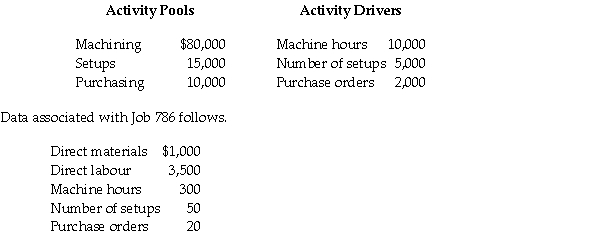 a. Calculate a unit-based overhead rate using machine hours.
b. What is the total cost of Job 786 using the above rate?
c. Calculate three activity-based overhead rates.
d. What is the cost of Job 786 using the above three activity rates?
e. Which method of overhead application (activity-based rates or budgeted factory overhead rate) is more accurate?
a. Calculate a unit-based overhead rate using machine hours.
b. What is the total cost of Job 786 using the above rate?
c. Calculate three activity-based overhead rates.
d. What is the cost of Job 786 using the above three activity rates?
e. Which method of overhead application (activity-based rates or budgeted factory overhead rate) is more accurate? (Essay)
4.8/5 (94)
(94) Harnack Company had the following information:
Budgeted cost driver activity levels:
Actual cost driver activity levels:
-The budgeted factory-overhead rate using machine hours as the cost driver is
Budgeted cost driver activity levels:
Actual cost driver activity levels:
-The budgeted factory-overhead rate using machine hours as the cost driver is (Multiple Choice)
4.9/5 (73)
(73) In the immediate write-off approach, overapplied overhead is regarded as
(Multiple Choice)
4.8/5 (72)
(72) Which of the following is NOT a contributory cause of overhead variances?
(Multiple Choice)
5.0/5 (87)
(87) Witty, Inc. uses a job-order cost system and had the following data available for 20X1.
-The ending inventory of finished goods is
-The ending inventory of finished goods is (Multiple Choice)
4.8/5 (90)
(90) Harnack Company had the following information:
Budgeted cost driver activity levels:
Actual cost driver activity levels:
-The following information was gathered for Barton Company for the year ended December 31, 20X1.  Assume that direct-labour hours is the cost driver. What is the budgeted factory-overhead rate?
Budgeted cost driver activity levels:
Actual cost driver activity levels:
-The following information was gathered for Barton Company for the year ended December 31, 20X1. Assume that direct-labour hours is the cost driver. What is the budgeted factory-overhead rate? (Multiple Choice)
5.0/5 (78)
(78) IIF Industries uses a job-order costing system and applies overhead on the basis of direct labour hours.
At the beginning of 2006, management estimated that 200,000 direct labour hours would be worked and $600,000 of overhead costs would be incurred.
During the year, the company actually worked 220,000 direct labour hours and incurred the following manufacturing costs:  a. Calculate the budgeted factory overhead application rate for 2006.
b. Determine the amount of manufacturing overhead applied to work in process during 2006.
c. Determine the amount of underapplied or overapplied overhead for the year.
d. If goods with a cost of $1,500,000 were completed and transferred to finished goods during 2006, determine the cost of work in process at the end of the period.
e. Prepare the journal entry to close underapplied or overapplied overhead to cost of goods sold.
a. Calculate the budgeted factory overhead application rate for 2006.
b. Determine the amount of manufacturing overhead applied to work in process during 2006.
c. Determine the amount of underapplied or overapplied overhead for the year.
d. If goods with a cost of $1,500,000 were completed and transferred to finished goods during 2006, determine the cost of work in process at the end of the period.
e. Prepare the journal entry to close underapplied or overapplied overhead to cost of goods sold. (Essay)
4.7/5 (71)
(71) Which of the following industries is most likely to NOT use a process costing system?
(Multiple Choice)
4.9/5 (88)
(88) A cost accumulation method that accumulates costs by processes or departments.
(Short Answer)
4.8/5 (91)
(91) A job-order cost system is especially appropriate for situations where basically similar units flow through production on a fairly continuous basis.
(True/False)
4.7/5 (82)
(82) 
Filters
- Essay(0)
- Multiple Choice(0)
- Short Answer(0)
- True False(0)
- Matching(0)