



 Chat with AI
Exam 6: Job-Costing Systems

Exam 1: Management Accounting and Management Decisions90 Questions
Exam 2: Cost Behaviour and Cost-Volume Relationships96 Questions
Exam 3: Measurement of Cost Behaviour97 Questions
Exam 4: Cost Management Systems134 Questions
Exam 5: Cost Allocation and Activity-Based Costing Systems128 Questions
Exam 6: Job-Costing Systems88 Questions
Exam 7: Process-Costing Systems82 Questions
Exam 8: Relevant Information and Decision Making: Marketing Decisions100 Questions
Exam 9: Relevant Information and Decision Making: Production Decisions111 Questions
Exam 10: Capital Budgeting Decisions116 Questions
Exam 11: The Master Budget112 Questions
Exam 12: Flexible Budgets and Variance Analysis106 Questions
Exam 13: Management Control Systems, the Balanced Scorecard, and Responsibility Accounting94 Questions
Exam 14: Management Control in Decentralized Organizations103 Questions
Select questions type


The FSR Company uses a budgeted factory overhead rate to apply manufacturing overhead to production. The rate is based on direct labour hours. Estimates for the year 2006 are given below:  During 2006 the Paine Company used 60,000 direct labour hours. At the end of 2006, the company's records revealed the following information:
 a. Calculate the budgeted overhead rate for 2006.
b. Determine the amount of underapplied or overapplied overhead for 2006.
c. If underapplied or overapplied overhead is treated as an adjustment to cost of goods sold, determine the cost of goods sold that would appear on the company's income statement.
During 2006 the Paine Company used 60,000 direct labour hours. At the end of 2006, the company's records revealed the following information: a. Calculate the budgeted overhead rate for 2006.
b. Determine the amount of underapplied or overapplied overhead for 2006.
c. If underapplied or overapplied overhead is treated as an adjustment to cost of goods sold, determine the cost of goods sold that would appear on the company's income statement. (Essay)
4.8/5  (79)
(79) As managers seek more accurate product costing, overhead application solely on the basis of direct-labour hours or direct-labour cost is certain to
(Multiple Choice)
4.9/5 (82)
(82) Witty, Inc. uses a job-order cost system and had the following data available for 20X1.
 -The journal entry to record the application of the factory overhead would include a
 (Multiple Choice)
4.9/5 (84)
(84) The excess of actual overhead over the overhead applied to products is called
(Multiple Choice)
4.9/5 (78)
(78) The most widely used approach in disposing of an overhead variance is proration.
(True/False)
4.9/5 (88)
(88) Reed Company incurred actual overhead costs of $640,000 for the year. A budgeted factory-overhead rate of 210 percent of direct-labour cost was determined at the beginning of the year. Budgeted factory overhead was $630,000, and budgeted direct-labour cost was $300,000. Actual direct-labour cost was $320,000 for the year. The factory overhead variance for the year was
(Multiple Choice)
4.9/5 (74)
(74) Fulton Company incurred actual overhead costs of $160,000 for the year. A budgeted factory-overhead rate of 210 percent of direct-labour cost was determined at the beginning of the year. Budgeted factory overhead was $157,500, and budgeted direct-labour cost was $75,000. Actual direct-labour cost was $80,000 for the year. The disposition of the variance, assuming a material amount, would include a
(Multiple Choice)
4.7/5 (69)
(69) Dentlinger Company uses a job-order cost system and had the following data available for 20X2.
 -The journal entry to record the application of the factory overhead would include a
 (Multiple Choice)
4.9/5 (72)
(72) The most widely used approach to disposing of overhead variances is
(Multiple Choice)
4.8/5 (76)
(76) Fulton Company incurred actual overhead costs of $160,000 for the year. A budgeted factory-overhead rate of 210 percent of direct-labour cost was determined at the beginning of the year. Budgeted factory overhead was $157,500, and budgeted direct-labour cost was $75,000. Actual direct-labour cost was $80,000 for the year. The disposition of the variance, assuming an immaterial amount, would include a
(Multiple Choice)
4.8/5 (83)
(83) Cowbell Incorporated uses a job-order costing system and a budgeted factory overhead rate based on machine hours. At the beginning of the year, Cowbell estimated manufacturing overhead for the year at $50,000. Machine hours were estimated at 8,000. The following information pertains to December of the current year: 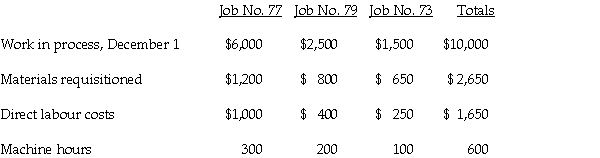 Actual manufacturing overhead costs incurred in December were $5,000 of which $1,000 was depreciation on the factory building and $500 was depreciation on the production equipment.
a. Compute the budgeted factory overhead application rate.
b. Prepare the journal entries to record the activity for the month of December.
c. Determine the cost associated with each job.
d. If Job No. 77 was completed during December, what is the balance of Work in Process as at December 31?
e. If there was no balance in the Overhead Control account on December 1, what is the balance as at December 31?
f. Prepare the journal entry to close underapplied or overapplied overhead to cost of goods sold.
Actual manufacturing overhead costs incurred in December were $5,000 of which $1,000 was depreciation on the factory building and $500 was depreciation on the production equipment.
a. Compute the budgeted factory overhead application rate.
b. Prepare the journal entries to record the activity for the month of December.
c. Determine the cost associated with each job.
d. If Job No. 77 was completed during December, what is the balance of Work in Process as at December 31?
e. If there was no balance in the Overhead Control account on December 1, what is the balance as at December 31?
f. Prepare the journal entry to close underapplied or overapplied overhead to cost of goods sold. (Essay)
4.7/5 (89)
(89) Sanford Company applies overhead based upon machine hours. Budgeted factory overhead was $532,800 and budgeted machine hours were 37,000. Actual factory overhead was $575,840 and actual machine hours were 38,100. Before disposition of under/overapplied overhead, the cost of goods sold was $1,120,000 and ending inventories were as follows:  Required:
a. Determine the budgeted factory-overhead rate per machine hour.
b. Compute the over/underapplied overhead.
c. Assuming the variance is immaterial, give the journal entry to dispose of the variance.
d. Assuming the variance is material, give the journal entry to dispose of the variance using proration.
Required:
a. Determine the budgeted factory-overhead rate per machine hour.
b. Compute the over/underapplied overhead.
c. Assuming the variance is immaterial, give the journal entry to dispose of the variance.
d. Assuming the variance is material, give the journal entry to dispose of the variance using proration. (Essay)
4.9/5 (81)
(81) Product costs appear as cost of goods sold in income statements and as finished-goods inventory values in balance sheets.
(True/False)
4.9/5 (90)
(90) Witty, Inc. uses a job-order cost system and had the following data available for 20X1.
-The journal entry to record the cost of goods completed would include a
-The journal entry to record the cost of goods completed would include a (Multiple Choice)
4.8/5 (82)
(82) The following information was gathered for Larsen Company for the year ended December 31, 20X1.
 -Assume that direct-labour hours is the cost driver.What is the amount of over/underapplied overhead?
 (Multiple Choice)
4.9/5 (87)
(87) Harnack Company had the following information:
 Budgeted cost driver activity levels:
 Actual cost driver activity levels:
 -The budgeted factory-overhead rate using production setups as the cost driver is
Budgeted cost driver activity levels:
Actual cost driver activity levels:
-The budgeted factory-overhead rate using production setups as the cost driver is (Multiple Choice)
4.9/5 (88)
(88) 
Filters
- Essay(0)
- Multiple Choice(0)
- Short Answer(0)
- True False(0)
- Matching(0)