



 Chat with AI
Exam 12: Nervous Tissue

Exam 1: An Introduction to the Human Body74 Questions
Exam 2: The Chemical Level of Organization75 Questions
Exam 3: The Cellular Level of Organization76 Questions
Exam 4: The Tissue Level of Organization75 Questions
Exam 5: The Integumentary System Unit Ii: Principles of Support and Movement74 Questions
Exam 6: The Skeletal System: Bone Tissue75 Questions
Exam 7: The Skeletal System: the Axial Skeleton75 Questions
Exam 8: The Skeletal System: the Appendicular Skeleton75 Questions
Exam 9: Joints75 Questions
Exam 10: Muscle Tissue75 Questions
Exam 11: The Muscular System Unit Iii: Control Systems of the Human Body75 Questions
Exam 12: Nervous Tissue75 Questions
Exam 13: The Spinal Cord and Spinal Nerves75 Questions
Exam 14: The Brain and Cranial Nerves75 Questions
Exam 15: The Autonomic Nervous System75 Questions
Exam 16: Sensory, Motor and Integrative Systems75 Questions
Exam 17: The Special Senses75 Questions
Exam 18: The Endocrine System Unit Iv: Maintenance of the Human Body75 Questions
Exam 19: The Cardiovascular System: the Blood74 Questions
Exam 20: The Cardiovascular System: the Heart74 Questions
Exam 21: The Cardiovascular System: Blood Vessels and Hemodynamics75 Questions
Exam 22: The Lymphatic System, Nonspecific Resistance to Disease, and Immunity75 Questions
Exam 23: The Respiratory System75 Questions
Exam 24: The Digestive System75 Questions
Exam 25: Metabolism73 Questions
Exam 26: The Urinary System73 Questions
Exam 27: Fluid, Electrolyte, and Acid-Base Homeostasis Unit V: Continuity48 Questions
Exam 28: The Reproductive Systems74 Questions
Exam 29: Development and Inheritance75 Questions
Select questions type


List the three major factors that contribute to the creation of the resting membrane potential in excitable cells.
(Essay)
4.8/5  (65)
(65) Which of the types of circuits is commonly used to send sensory signals to multiple areas of the brain?
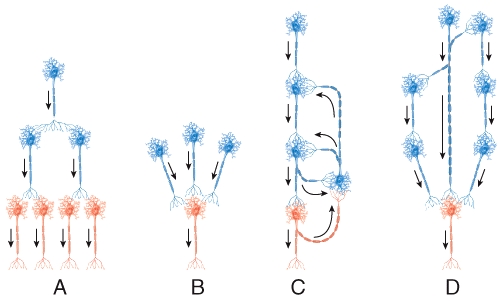
(Multiple Choice)
4.9/5 (94)
(94) This structure electrically insulates the axon of a neuron to increase the speed of nerve impulse conduction.
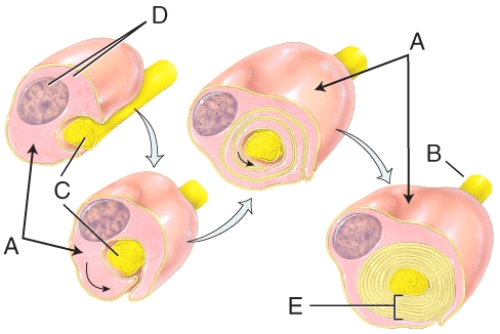
(Multiple Choice)
4.7/5 (83)
(83) What specific type of unipolar neuron is shown in the diagram labeled B?
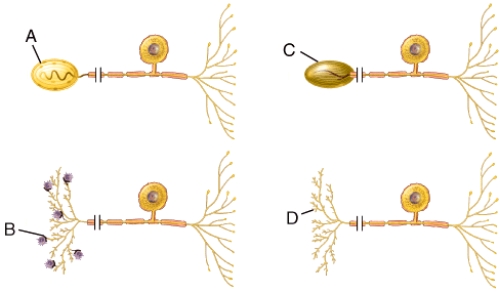
(Multiple Choice)
4.9/5 (85)
(85) List the three ways that neurotransmitters can be removed from a synapse.
(Essay)
5.0/5 (84)
(84) Which of the following structures is labeled B in the diagram?
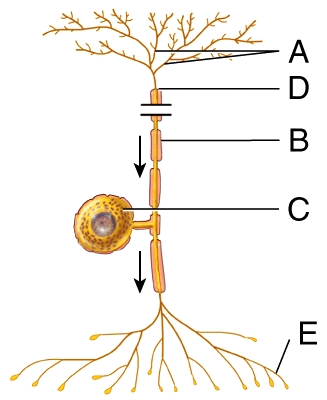
(Multiple Choice)
4.9/5 (81)
(81) Which of the following types of neurons have one axon and one dendrite emerging from the cell body and are found in the retina of the eye,inner ear,and olfactory region of the brain?
(Multiple Choice)
4.8/5 (72)
(72) Name the type of membrane channel that opens in response to chemical binding and is found in dendrites of some sensory receptors like pain receptors,and in the dendrites and cell bodies of interneurons and motor neurons.
(Multiple Choice)
4.7/5 (76)
(76) In the process of spatial summation,_____ are added together and _____ are subtracted from that total to determine whether _____ will be created at the trigger zone of the postsynaptic neuron.
(Multiple Choice)
4.9/5 (74)
(74) Which type of circuit is involved in solving mathematical problems?
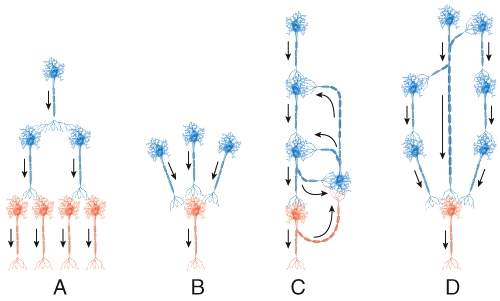
(Multiple Choice)
4.8/5 (89)
(89) During the resting state of a voltage-gated Na+ channel,
1)the inactivation gate is open.
2)the activation gate is closed.
3)the channel is permeable to Na+.
(Multiple Choice)
4.8/5 (77)
(77) This part of a neuron contains the nucleus and cytoplasm of the Schwann's cell that has formed a myelin sheath around the axon.
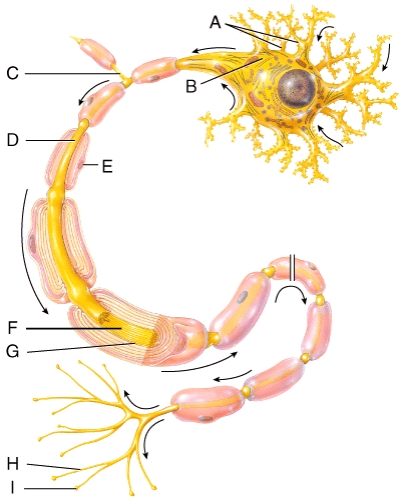
(Multiple Choice)
4.8/5 (84)
(84) Which of the labeled cells in the diagram is a neuroglial cell that forms and maintains the myelin sheath around CNS axons?
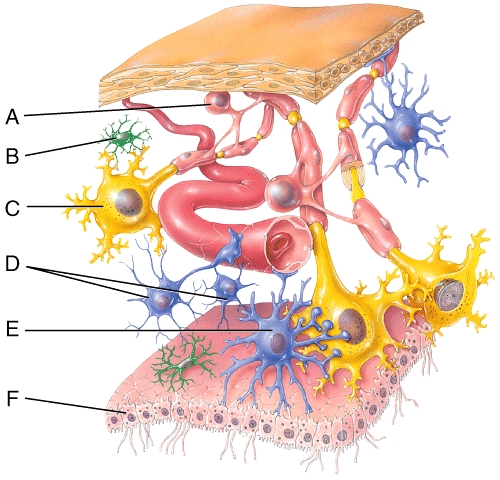
(Multiple Choice)
4.8/5 (73)
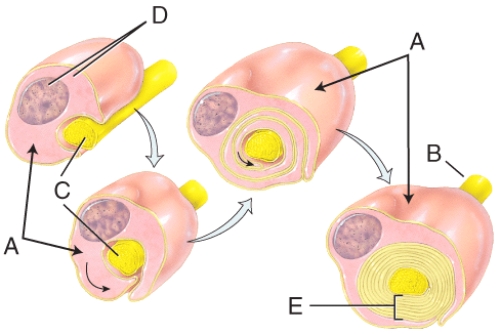
(73) 

Filters
- Essay(0)
- Multiple Choice(0)
- Short Answer(0)
- True False(0)
- Matching(0)