



 Chat with AI
Exam 12: Nervous Tissue

Exam 1: An Introduction to the Human Body74 Questions
Exam 2: The Chemical Level of Organization75 Questions
Exam 3: The Cellular Level of Organization76 Questions
Exam 4: The Tissue Level of Organization75 Questions
Exam 5: The Integumentary System Unit Ii: Principles of Support and Movement74 Questions
Exam 6: The Skeletal System: Bone Tissue75 Questions
Exam 7: The Skeletal System: the Axial Skeleton75 Questions
Exam 8: The Skeletal System: the Appendicular Skeleton75 Questions
Exam 9: Joints75 Questions
Exam 10: Muscle Tissue75 Questions
Exam 11: The Muscular System Unit Iii: Control Systems of the Human Body75 Questions
Exam 12: Nervous Tissue75 Questions
Exam 13: The Spinal Cord and Spinal Nerves75 Questions
Exam 14: The Brain and Cranial Nerves75 Questions
Exam 15: The Autonomic Nervous System75 Questions
Exam 16: Sensory, Motor and Integrative Systems75 Questions
Exam 17: The Special Senses75 Questions
Exam 18: The Endocrine System Unit Iv: Maintenance of the Human Body75 Questions
Exam 19: The Cardiovascular System: the Blood74 Questions
Exam 20: The Cardiovascular System: the Heart74 Questions
Exam 21: The Cardiovascular System: Blood Vessels and Hemodynamics75 Questions
Exam 22: The Lymphatic System, Nonspecific Resistance to Disease, and Immunity75 Questions
Exam 23: The Respiratory System75 Questions
Exam 24: The Digestive System75 Questions
Exam 25: Metabolism73 Questions
Exam 26: The Urinary System73 Questions
Exam 27: Fluid, Electrolyte, and Acid-Base Homeostasis Unit V: Continuity48 Questions
Exam 28: The Reproductive Systems74 Questions
Exam 29: Development and Inheritance75 Questions
Select questions type


Which of the following types of neurons is exclusively found in the cerebellum?
(Multiple Choice)
4.9/5  (72)
(72) Which of these types of channels is involved in leaking sodium and potassium ions across the membrane in order to establish the resting potential of a cell?
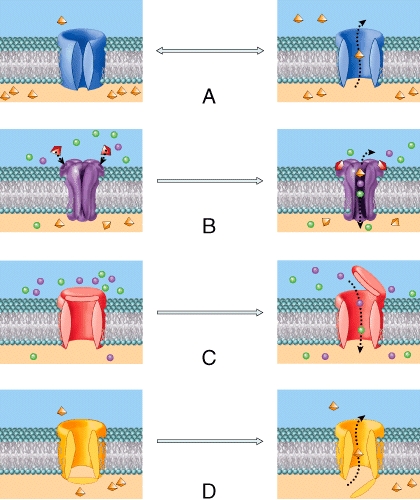
(Multiple Choice)
4.8/5 (80)
(80) Describe four ways drugs can modify the effects of neurotransmitters.
(Essay)
4.8/5 (74)
(74) Which of the following types of neurons is the most common type of neuron found in the brain and spinal cord?
(Multiple Choice)
4.8/5 (79)
(79) Which of the following types of cells display the property of electrical excitability?
(Multiple Choice)
4.9/5 (94)
(94) 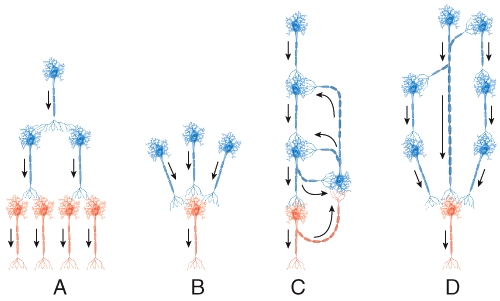
A postsynaptic neuron responds to neurotransmitters released by a presynaptic neuron by creating
(Multiple Choice)
4.8/5 (71)
(71) 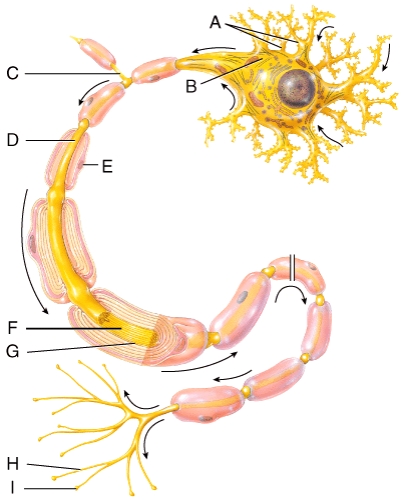
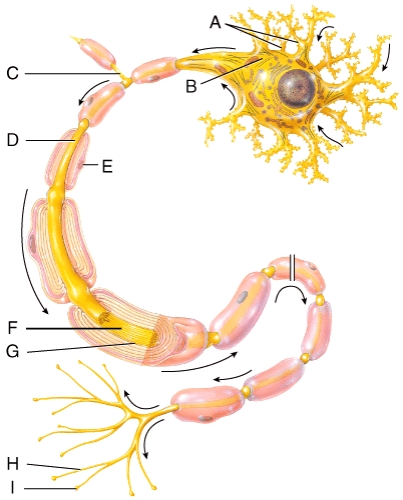
Hearing your cell phone ring in an otherwise quiet lecture hall is an example of which of the following types of nervous system functions?
(Multiple Choice)
4.8/5 (83)
(83) What is the structural classification of the neuron labeled B?
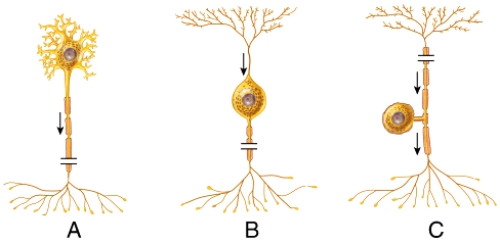
(Multiple Choice)
4.8/5 (69)
(69) Which type of depression results in an individual with a manic-depressive illness.
(Multiple Choice)
4.9/5 (80)
(80) Which of the labeled cells in the figure is NOT a neuroglial cell?
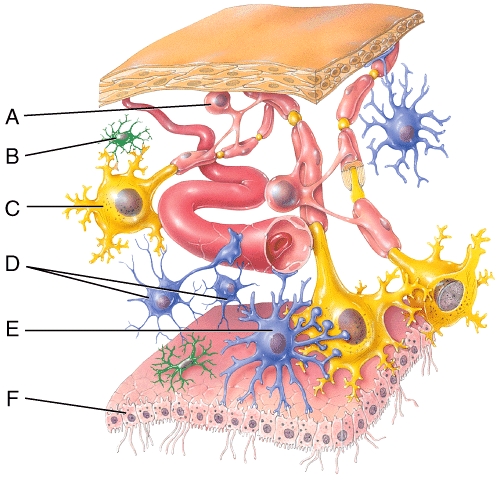
(Multiple Choice)
4.9/5 (76)
(76) When a depolarizing graded potential makes the axon membrane depolarize to threshold,
(Multiple Choice)
4.9/5 (79)
(79) Which of the following is NOT a function of the nervous system?
(Multiple Choice)
4.9/5 (85)
(85) Which of the labeled cells in the diagram is a neuroglial cell that produces and assists in the circulation of cerebrospinal fluid?
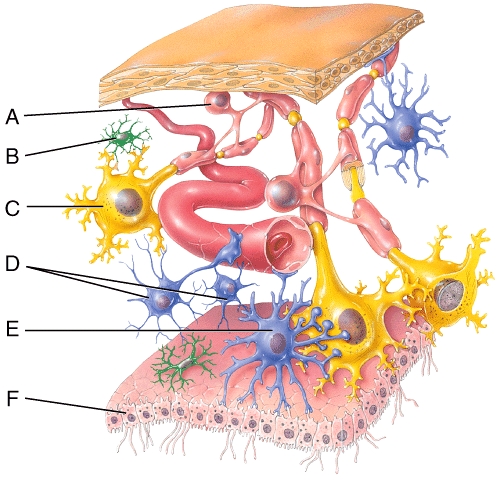
(Multiple Choice)
4.8/5 (89)
(89) This type of neuron has one dendrite and one axon emerging from the cell body.
(Multiple Choice)
4.7/5 (87)
(87) Which of the channels shown in the figure opens and closes randomly?
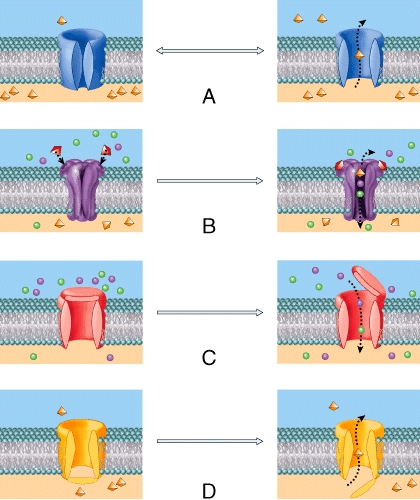
(Multiple Choice)
4.8/5 (84)
(84) 
Filters
- Essay(0)
- Multiple Choice(0)
- Short Answer(0)
- True False(0)
- Matching(0)