



 Chat with AI
Exam 9: Joints

Exam 1: An Introduction to the Human Body74 Questions
Exam 2: The Chemical Level of Organization75 Questions
Exam 3: The Cellular Level of Organization76 Questions
Exam 4: The Tissue Level of Organization75 Questions
Exam 5: The Integumentary System Unit Ii: Principles of Support and Movement74 Questions
Exam 6: The Skeletal System: Bone Tissue75 Questions
Exam 7: The Skeletal System: the Axial Skeleton75 Questions
Exam 8: The Skeletal System: the Appendicular Skeleton75 Questions
Exam 9: Joints75 Questions
Exam 10: Muscle Tissue75 Questions
Exam 11: The Muscular System Unit Iii: Control Systems of the Human Body75 Questions
Exam 12: Nervous Tissue75 Questions
Exam 13: The Spinal Cord and Spinal Nerves75 Questions
Exam 14: The Brain and Cranial Nerves75 Questions
Exam 15: The Autonomic Nervous System75 Questions
Exam 16: Sensory, Motor and Integrative Systems75 Questions
Exam 17: The Special Senses75 Questions
Exam 18: The Endocrine System Unit Iv: Maintenance of the Human Body75 Questions
Exam 19: The Cardiovascular System: the Blood74 Questions
Exam 20: The Cardiovascular System: the Heart74 Questions
Exam 21: The Cardiovascular System: Blood Vessels and Hemodynamics75 Questions
Exam 22: The Lymphatic System, Nonspecific Resistance to Disease, and Immunity75 Questions
Exam 23: The Respiratory System75 Questions
Exam 24: The Digestive System75 Questions
Exam 25: Metabolism73 Questions
Exam 26: The Urinary System73 Questions
Exam 27: Fluid, Electrolyte, and Acid-Base Homeostasis Unit V: Continuity48 Questions
Exam 28: The Reproductive Systems74 Questions
Exam 29: Development and Inheritance75 Questions
Select questions type


A suture joint fits into which functional joint classification?
(Multiple Choice)
4.8/5  (90)
(90) Which of the joints shown in the figure is classified as a monaxial joint?
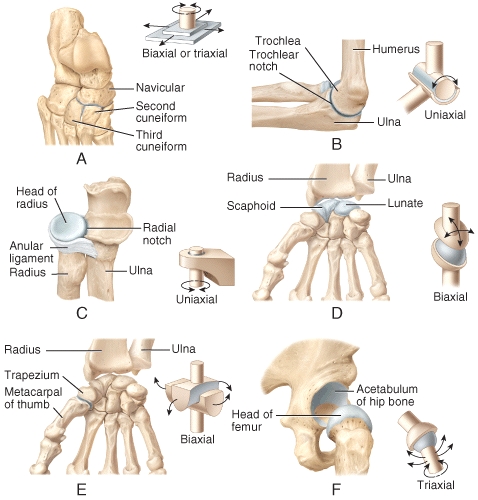
(Multiple Choice)
4.8/5 (74)
(74) Disuse of a limb,like would occur when the limb is in a cast,leads to muscular atrophy and _____ of the affected joint.
(Multiple Choice)
4.7/5 (73)
(73) The epiphyseal plate in a long bone is an example of which type of joint?
(Multiple Choice)
4.8/5 (65)
(65) Which of the following is NOT a common characteristic of synovial joints?
(Multiple Choice)
4.9/5 (70)
(70) Which ligament limits hyperextension of the knee and prevents the anterior sliding of the tibia on the femur?
(Multiple Choice)
4.9/5 (68)
(68) Which functional class of joints contains joints that are freely movable?
1)Synarthrosis
2)Amphiarthrosis
3)Diarthrosis
(Multiple Choice)
4.8/5 (81)
(81) Which of the following labeled panels in the figure shows hyperextension?
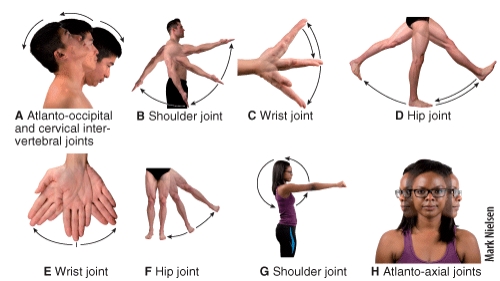
(Multiple Choice)
4.9/5 (73)
(73) Which of the following is not considered a "special movement" that occurs at only certain joints?
(Multiple Choice)
4.9/5 (81)
(81) Which of the joints shown in the figure is classified as a biaxial joint?
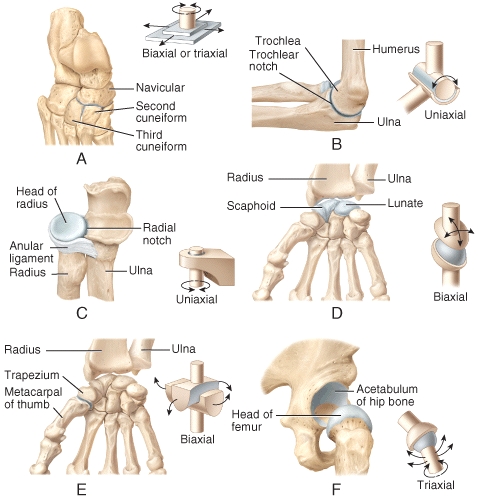
(Multiple Choice)
4.8/5 (79)
(79) Which special movement involves moving your thumb across the palm to touch the tips of the fingers on the same hand?
(Multiple Choice)
4.8/5 (85)
(85) Which of the following is NOT a factor affecting range of motion of a joint?
(Multiple Choice)
4.9/5 (73)
(73) A condition in which a muscle or muscle and tendon is stretched or partially torn is called
(Multiple Choice)
4.8/5 (69)
(69) What unique characteristics would a person who is "double-jointed" possess?
(Essay)
4.8/5 (84)
(84) 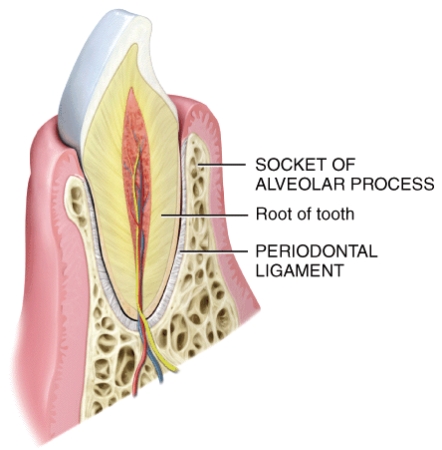
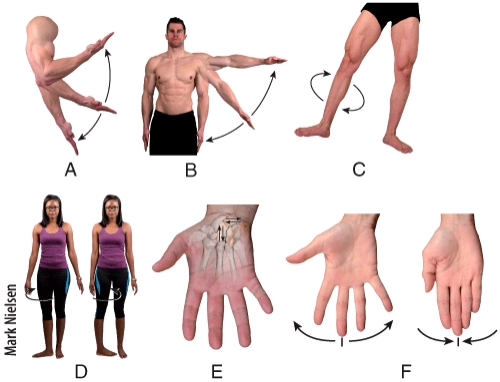
Which diagram shows a movement of a distal end of a body part in a circle,in a continuous
(Multiple Choice)
4.8/5 (90)
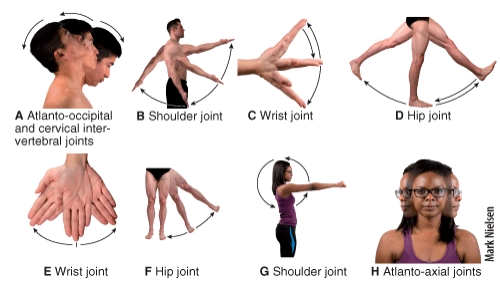
(90) Which of the following labeled panels in the figure shows flexion?
(Multiple Choice)
4.9/5 (94)
(94) Which of the following is NOT a factor that influences the type of movement and range of motion possible at a synovial joint?
(Multiple Choice)
4.9/5 (73)
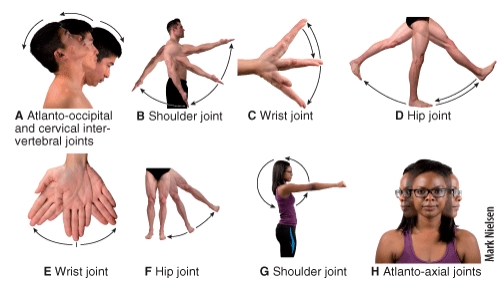
(73) Which of the following labeled panels in the figure shows extension?
(Multiple Choice)
4.9/5 (71)
(71) 
Filters
- Essay(0)
- Multiple Choice(0)
- Short Answer(0)
- True False(0)
- Matching(0)