



 Chat with AI
Exam 9: Joints

Exam 1: An Introduction to the Human Body74 Questions
Exam 2: The Chemical Level of Organization75 Questions
Exam 3: The Cellular Level of Organization76 Questions
Exam 4: The Tissue Level of Organization75 Questions
Exam 5: The Integumentary System Unit Ii: Principles of Support and Movement74 Questions
Exam 6: The Skeletal System: Bone Tissue75 Questions
Exam 7: The Skeletal System: the Axial Skeleton75 Questions
Exam 8: The Skeletal System: the Appendicular Skeleton75 Questions
Exam 9: Joints75 Questions
Exam 10: Muscle Tissue75 Questions
Exam 11: The Muscular System Unit Iii: Control Systems of the Human Body75 Questions
Exam 12: Nervous Tissue75 Questions
Exam 13: The Spinal Cord and Spinal Nerves75 Questions
Exam 14: The Brain and Cranial Nerves75 Questions
Exam 15: The Autonomic Nervous System75 Questions
Exam 16: Sensory, Motor and Integrative Systems75 Questions
Exam 17: The Special Senses75 Questions
Exam 18: The Endocrine System Unit Iv: Maintenance of the Human Body75 Questions
Exam 19: The Cardiovascular System: the Blood74 Questions
Exam 20: The Cardiovascular System: the Heart74 Questions
Exam 21: The Cardiovascular System: Blood Vessels and Hemodynamics75 Questions
Exam 22: The Lymphatic System, Nonspecific Resistance to Disease, and Immunity75 Questions
Exam 23: The Respiratory System75 Questions
Exam 24: The Digestive System75 Questions
Exam 25: Metabolism73 Questions
Exam 26: The Urinary System73 Questions
Exam 27: Fluid, Electrolyte, and Acid-Base Homeostasis Unit V: Continuity48 Questions
Exam 28: The Reproductive Systems74 Questions
Exam 29: Development and Inheritance75 Questions
Select questions type


Bending the trunk forward at the intervertebral discs is an example of what type of angular movement?
(Multiple Choice)
4.8/5  (83)
(83) Which of the following is NOT a structural category of synovial joints?
(Multiple Choice)
4.9/5 (90)
(90) What type of special movement occurs in your clavicles at your acromioclavicular and sternoclavicular joints when you cross your arms in front of your body?
(Multiple Choice)
4.8/5 (64)
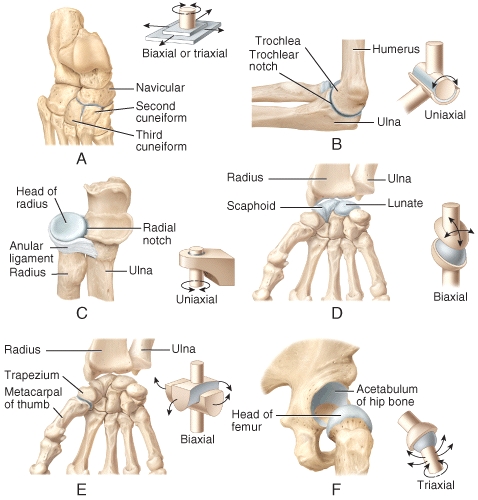
(64) Which of the joints shown in the figure only permits back-and-forth and side-to-side movements between the articulating bones?
(Multiple Choice)
4.8/5 (81)
(81) Which of the following is a type of fibrous joint composed of a thin layer of dense irregular fibrous connective tissue found between the bones of the skull?
1)Syndesmoses
2)Gomphosis
3)Suture
(Multiple Choice)
4.9/5 (84)
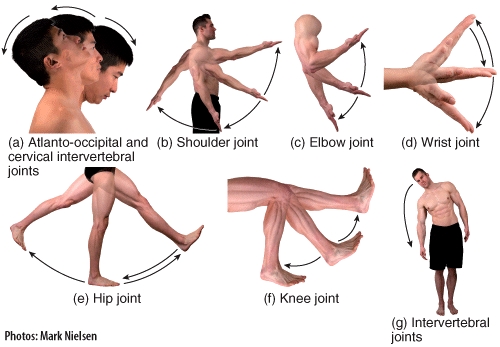
(84) Which of the panels in the figure shows a movement called lateral flexion?
(Multiple Choice)
5.0/5 (63)
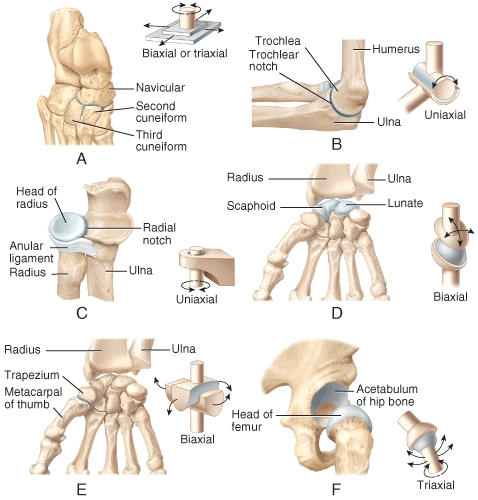
(63) Which of the joints shown in the figure is classified as a multiaxial joint?
(Multiple Choice)
4.9/5 (85)
(85) Moving the humerus laterally at the shoulder joint is an example of which type of movement?
(Multiple Choice)
5.0/5 (76)
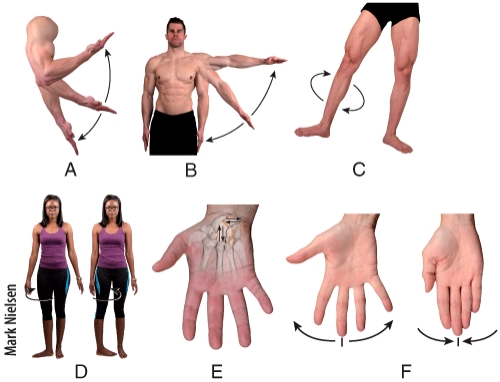
(76) Which two panels in the figure show a movement of a bone away from the midline of the body?
(Multiple Choice)
4.8/5 (82)
(82) Bursae are saclike structures that are commonly found between bone and
(Multiple Choice)
4.9/5 (79)
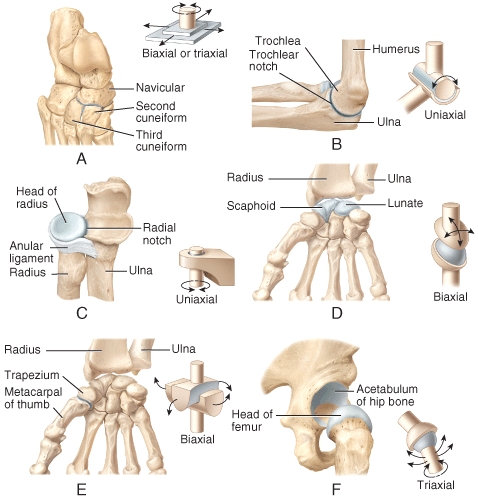
(79) Which of the joints shown in the figure only permits back-and-forth and side-to-side movements between the articulating bones?
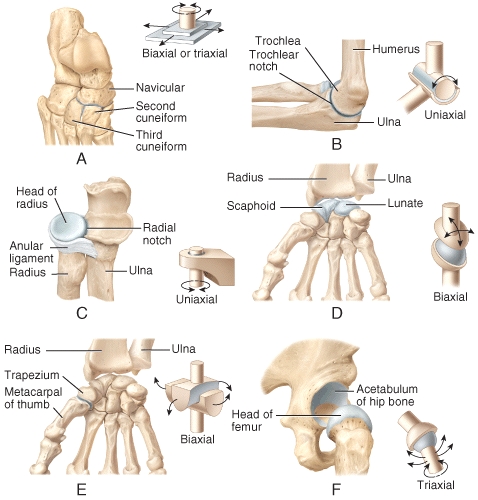
(Multiple Choice)
4.8/5 (71)
(71) 
List the three structural categories of joints and briefly describe the criteria used for structural classification of joints.
(Essay)
4.8/5 (84)
(84) In which type of synovial joint does a rounded or pointed surface on one bone articulate with a ring formed partly by another bone and partly by a ligament?
(Multiple Choice)
4.9/5 (77)
(77) Which type of movement involves a continuous sequence of flexion,abduction,extension,and adduction resulting in a distal body part moving in a circle?
(Multiple Choice)
4.9/5 (84)
(84) Which of the following is an autoimmune disease that affects the joints?
(Multiple Choice)
4.9/5 (84)
(84) Briefly describe what is happening when a person "cracks their knuckles".
(Essay)
4.7/5 (76)
(76) 
Filters
- Essay(0)
- Multiple Choice(0)
- Short Answer(0)
- True False(0)
- Matching(0)