



 Chat with AI
Exam 4: The Tissue Level of Organization

Exam 1: An Introduction to the Human Body74 Questions
Exam 2: The Chemical Level of Organization75 Questions
Exam 3: The Cellular Level of Organization76 Questions
Exam 4: The Tissue Level of Organization75 Questions
Exam 5: The Integumentary System Unit Ii: Principles of Support and Movement74 Questions
Exam 6: The Skeletal System: Bone Tissue75 Questions
Exam 7: The Skeletal System: the Axial Skeleton75 Questions
Exam 8: The Skeletal System: the Appendicular Skeleton75 Questions
Exam 9: Joints75 Questions
Exam 10: Muscle Tissue75 Questions
Exam 11: The Muscular System Unit Iii: Control Systems of the Human Body75 Questions
Exam 12: Nervous Tissue75 Questions
Exam 13: The Spinal Cord and Spinal Nerves75 Questions
Exam 14: The Brain and Cranial Nerves75 Questions
Exam 15: The Autonomic Nervous System75 Questions
Exam 16: Sensory, Motor and Integrative Systems75 Questions
Exam 17: The Special Senses75 Questions
Exam 18: The Endocrine System Unit Iv: Maintenance of the Human Body75 Questions
Exam 19: The Cardiovascular System: the Blood74 Questions
Exam 20: The Cardiovascular System: the Heart74 Questions
Exam 21: The Cardiovascular System: Blood Vessels and Hemodynamics75 Questions
Exam 22: The Lymphatic System, Nonspecific Resistance to Disease, and Immunity75 Questions
Exam 23: The Respiratory System75 Questions
Exam 24: The Digestive System75 Questions
Exam 25: Metabolism73 Questions
Exam 26: The Urinary System73 Questions
Exam 27: Fluid, Electrolyte, and Acid-Base Homeostasis Unit V: Continuity48 Questions
Exam 28: The Reproductive Systems74 Questions
Exam 29: Development and Inheritance75 Questions
Select questions type


Name and briefly describe the different categories of epithelial tissues based on cell shape and number of layers of cells found in the tissue.
(Essay)
4.8/5  (83)
(83) Compare and contrast the functional and structural characteristics of the three types of muscle tissue.
(Essay)
4.9/5 (80)
(80) Which of the light micrographs in the figure below shows a pseudostratified columnar epithelium?
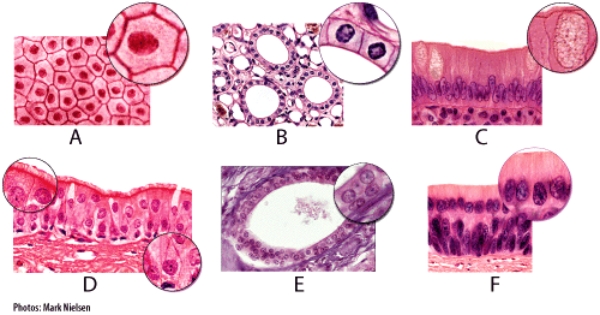
(Multiple Choice)
4.8/5 (79)
(79) Which of the following is NOT a common characteristic of epithelial tissues?
(Multiple Choice)
4.7/5 (87)
(87) Which of the light micrographs in the figure below shows a stratified cuboidal epithelium?
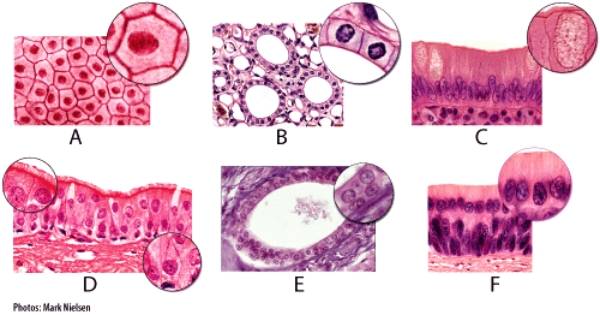
(Multiple Choice)
4.8/5 (77)
(77) In the figure shown,which light micrograph shows cardiac muscle?
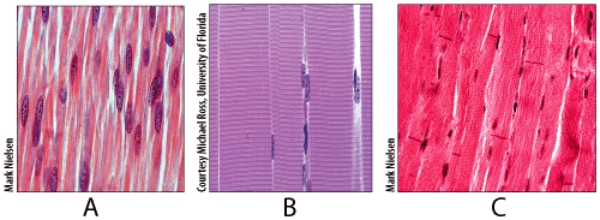
(Multiple Choice)
4.9/5 (91)
(91) Which of the light micrographs in the following figure shows a type of epithelial tissue whose functions include movement of mucus over their apical surface by ciliary action?
1 B
2 C
3 E
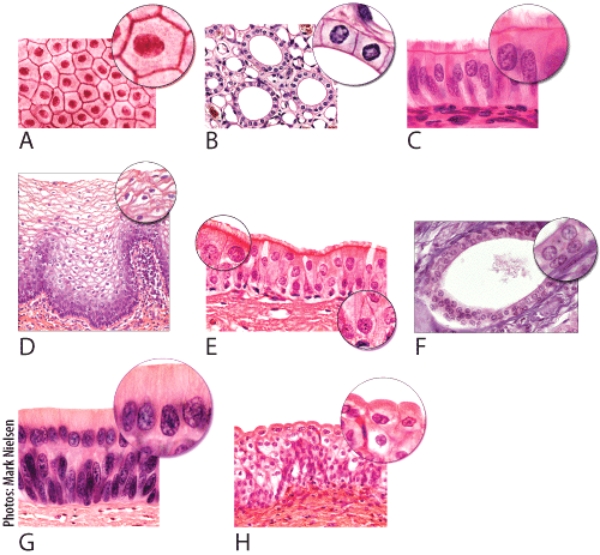
(Multiple Choice)
4.7/5 (94)
(94) Which of the following types of fibers are commonly found in the extracellular matrix of connective tissue?
(Multiple Choice)
4.9/5 (68)
(68) The thin extracellular layer,consisting of the basal and reticular lamina,that anchors epithelial cells to underlying connective tissue is called the
(Multiple Choice)
4.8/5 (87)
(87) Which of the following is a location where adipose tissue is commonly found?
(Multiple Choice)
4.9/5 (81)
(81) Which of the following figures shows tissue that is found in the trachea?
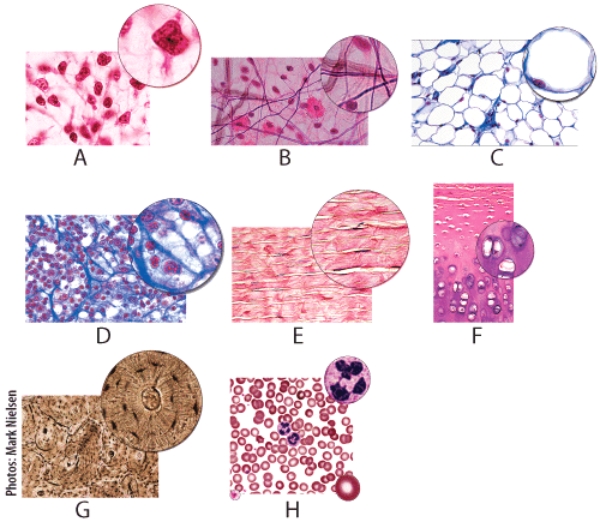
(Multiple Choice)
4.8/5 (80)
(80) In the figure shown,which light micrograph shows the type of connective tissue that contains the Hardest matrix of all connective tissues?
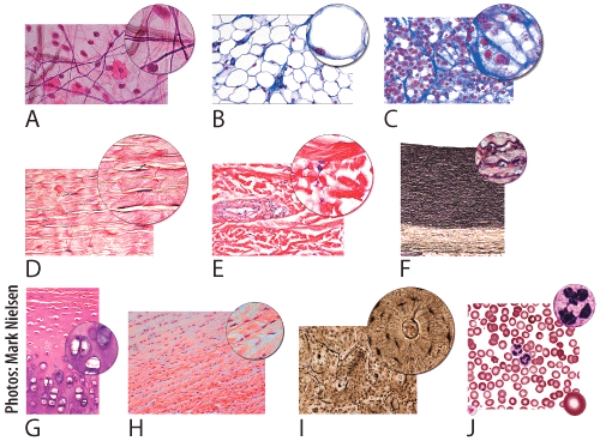
(Multiple Choice)
4.7/5 (69)
(69) Which of the light micrographs in the figure below shows a simple columnar epithelium?
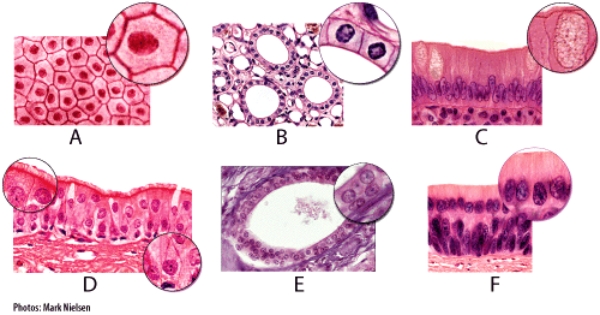
(Multiple Choice)
4.9/5 (74)
(74) Which of the light micrographs in the figure below shows the type of epithelial tissue whose functions include filtration,diffusion,osmosis,and secretion in serous membranes?
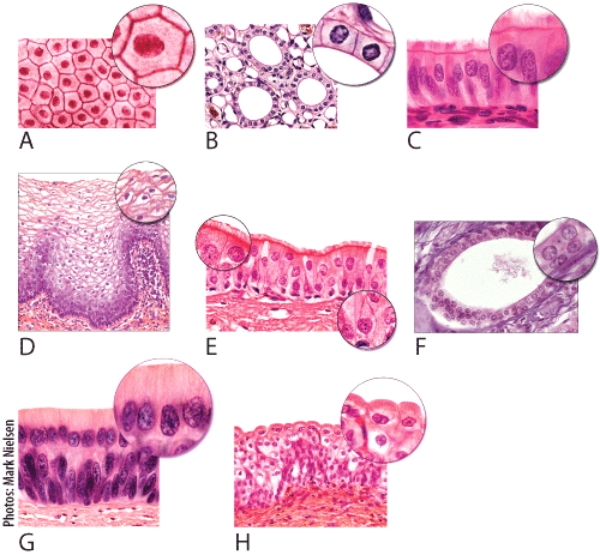
(Multiple Choice)
4.8/5 (74)
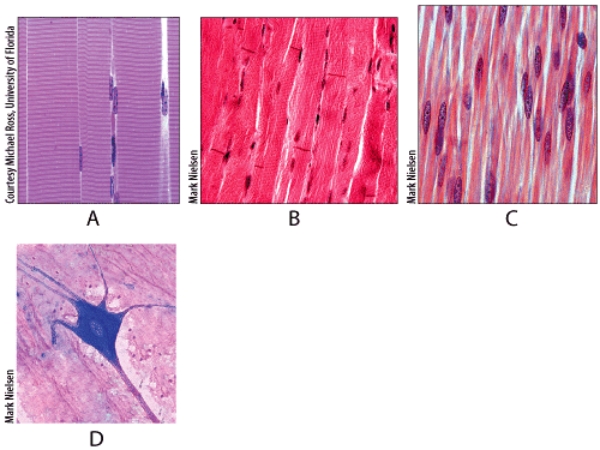
(74) 
In the diagram shown below,which cellular junction is a tight junction?
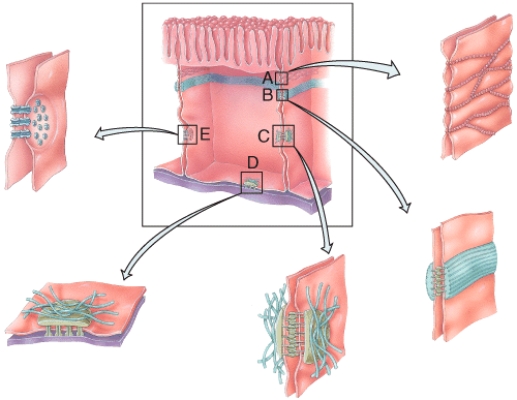
(Multiple Choice)
4.7/5 (75)
(75) Which of the following is NOT one of the main tissue types found in the human body?
(Multiple Choice)
4.9/5 (86)
(86) Which of the following types of membranes found in the human body does NOT contain epithelial tissue?
(Multiple Choice)
4.9/5 (80)
(80) Which of the light micrographs in the following figure shows the type of epithelial tissue whose structure allows it to be stretched or distended?
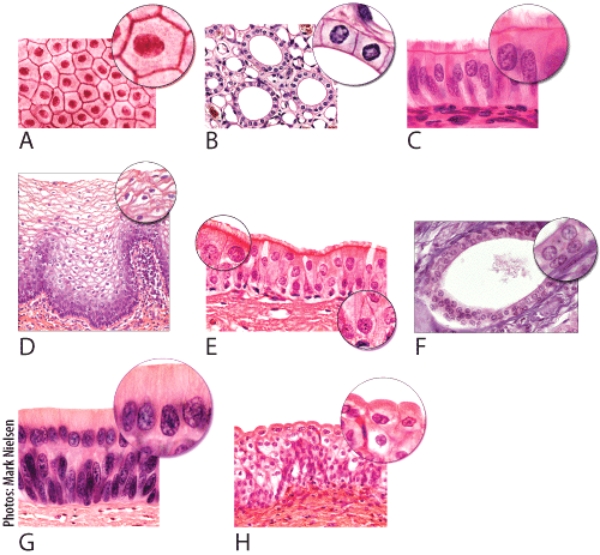
(Multiple Choice)
4.9/5 (77)
(77) 
Filters
- Essay(0)
- Multiple Choice(0)
- Short Answer(0)
- True False(0)
- Matching(0)