



 Chat with AI
Exam 23: The Respiratory System

Exam 1: An Introduction to the Human Body78 Questions
Exam 2: The Chemical Level of Organization81 Questions
Exam 3: The Cellular Level of Organization84 Questions
Exam 4: The Tissue Level of Organization64 Questions
Exam 5: The Integumentary System78 Questions
Exam 6: The Skeletal System: Bone Tissue77 Questions
Exam 7: The Skeletal System: the Axial Skeleton80 Questions
Exam 8: The Skeletal System: The Appendicular Skeleton82 Questions
Exam 9: Joints41 Questions
Exam 10: Muscular Tissue85 Questions
Exam 11: The Muscular System70 Questions
Exam 12: Nervous Tissue17 Questions
Exam 13: The Spinal Cord and Spinal Nerves74 Questions
Exam 14: The Brain and Cranial Nerves72 Questions
Exam 15: The Autonomic Nervous System64 Questions
Exam 16: Sensory, Motor, and Integrative Systems76 Questions
Exam 17: The Special Senses73 Questions
Exam 18: The Endocrine System84 Questions
Exam 19: The Cardiovascular System: the Blood83 Questions
Exam 20: The Cardiovascular System: the Heart82 Questions
Exam 21: The Cardiovascular System: Blood Vessels and Hemodynamics81 Questions
Exam 22: The Lymphatic System and Immunity80 Questions
Exam 23: The Respiratory System85 Questions
Exam 24: The Digestive System85 Questions
Exam 25: Metabolism and Nutrition85 Questions
Exam 26: The Urinary System84 Questions
Exam 27: Fluid, Electrolyte, and Acidbase Homeostasis57 Questions
Exam 28: The Reproductive Systems84 Questions
Exam 29: Development and Inheritance83 Questions
Select questions type


Which of the following is an inhalation followed by many short convulsive exhalations during which the rima glottidis remains open and the vocal folds vibrate,accompanied by characteristic facial expressions?
(Multiple Choice)
4.9/5  (85)
(85) When blood pH drops,the amount of oxyhemoglobin _____ and oxygen delivery to the tissue cells _____.
(Multiple Choice)
4.8/5 (85)
(85) Which structure is located anterior to the esophagus and carries air to the bronchi?
(Multiple Choice)
4.8/5 (78)
(78) Which of the following is the sum of the residual and the expiratory reserve volume?
(Multiple Choice)
4.8/5 (70)
(70) 
An individual suffers a blood clot in an artery that delivers blood to his leg.The leg begins to take on a blue hue,becomes colder than the rest of his body and he experiences numbness in the leg.He is most likely experiencing
(Multiple Choice)
4.9/5 (79)
(79) Which of the following are cells of the alveoli that produce surfactant?
(Multiple Choice)
4.8/5 (84)
(84) If each hemoglobin molecule has bound 3 oxygen molecules,the hemoglobin is considered to be saturated at what percentage?
(Multiple Choice)
4.9/5 (81)
(81) Which of the following is NOT a factor that determines the rate of pulmonary and systemic gas exchange?
(Multiple Choice)
4.9/5 (72)
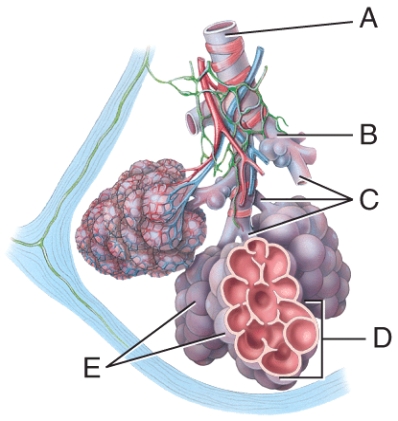
(72) Which letter represents the primary gas exchange structure?
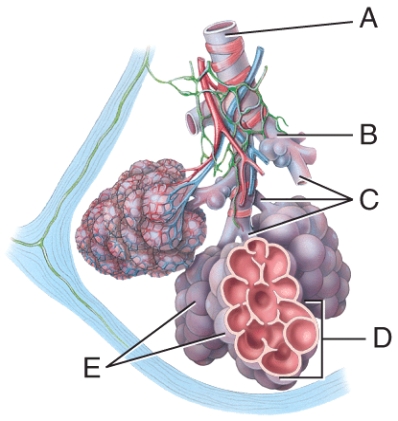
(Multiple Choice)
4.9/5 (77)
(77) Which area in the figure represents a very deep exhalation,much greater than the tidal volume?
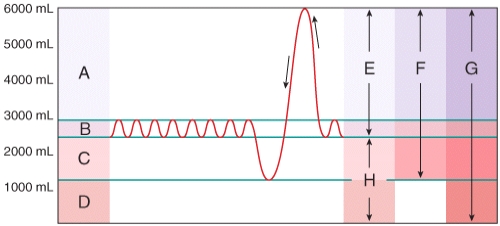
(Multiple Choice)
4.7/5 (87)
(87) Which area in the figure represents the volume of air remaining in the lungs after a deep exhalation?
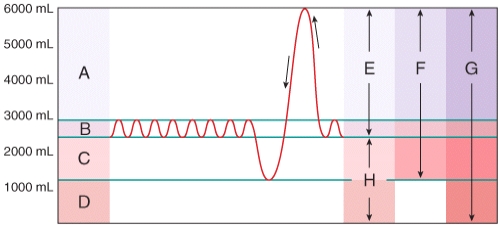
(Multiple Choice)
4.8/5 (91)
(91) Which of the following is NOT a factor that the rate of pulmonary and systemic gas exchange depends on?
(Multiple Choice)
4.8/5 (75)
(75) Which of the following is a deep inhalation through a widely opened mouth producing an exaggerated depression of the mandible,the precise cause of which is unknown?
(Multiple Choice)
4.7/5 (86)
(86) 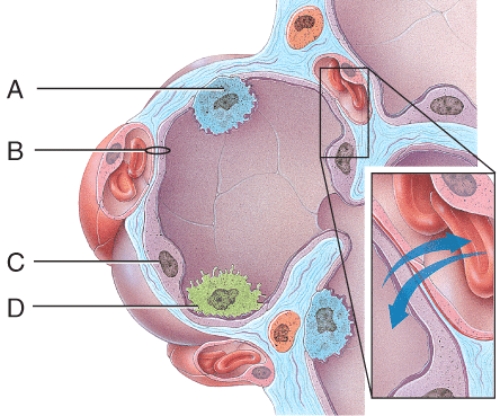
Which of the following is NOT part of the upper respiratory system?
(Multiple Choice)
4.9/5 (82)
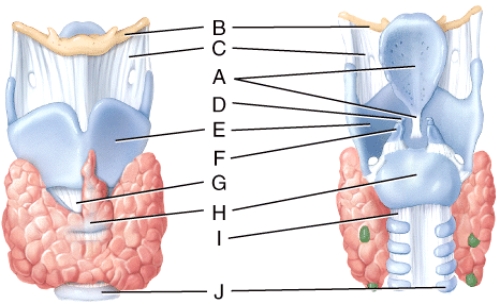
(82) 
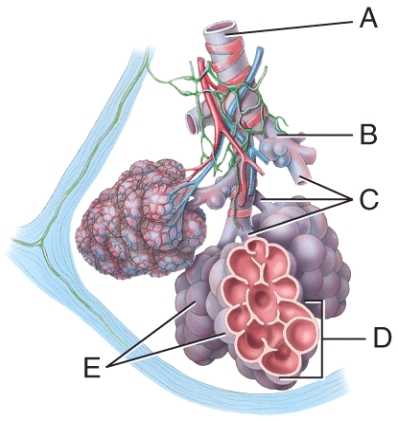
The point where the trachea divides into right and left primary bronchi is a ridge called
(Multiple Choice)
5.0/5 (80)
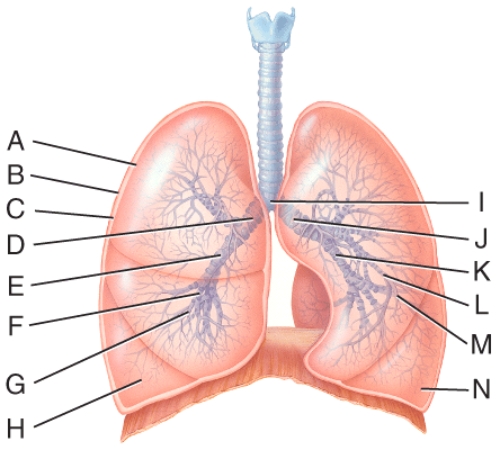
(80) 

Filters
- Essay(0)
- Multiple Choice(0)
- Short Answer(0)
- True False(0)
- Matching(0)