



 Chat with AI
Exam 20: The Cardiovascular System: the Heart

Exam 1: An Introduction to the Human Body78 Questions
Exam 2: The Chemical Level of Organization81 Questions
Exam 3: The Cellular Level of Organization84 Questions
Exam 4: The Tissue Level of Organization64 Questions
Exam 5: The Integumentary System78 Questions
Exam 6: The Skeletal System: Bone Tissue77 Questions
Exam 7: The Skeletal System: the Axial Skeleton80 Questions
Exam 8: The Skeletal System: The Appendicular Skeleton82 Questions
Exam 9: Joints41 Questions
Exam 10: Muscular Tissue85 Questions
Exam 11: The Muscular System70 Questions
Exam 12: Nervous Tissue17 Questions
Exam 13: The Spinal Cord and Spinal Nerves74 Questions
Exam 14: The Brain and Cranial Nerves72 Questions
Exam 15: The Autonomic Nervous System64 Questions
Exam 16: Sensory, Motor, and Integrative Systems76 Questions
Exam 17: The Special Senses73 Questions
Exam 18: The Endocrine System84 Questions
Exam 19: The Cardiovascular System: the Blood83 Questions
Exam 20: The Cardiovascular System: the Heart82 Questions
Exam 21: The Cardiovascular System: Blood Vessels and Hemodynamics81 Questions
Exam 22: The Lymphatic System and Immunity80 Questions
Exam 23: The Respiratory System85 Questions
Exam 24: The Digestive System85 Questions
Exam 25: Metabolism and Nutrition85 Questions
Exam 26: The Urinary System84 Questions
Exam 27: Fluid, Electrolyte, and Acidbase Homeostasis57 Questions
Exam 28: The Reproductive Systems84 Questions
Exam 29: Development and Inheritance83 Questions
Select questions type


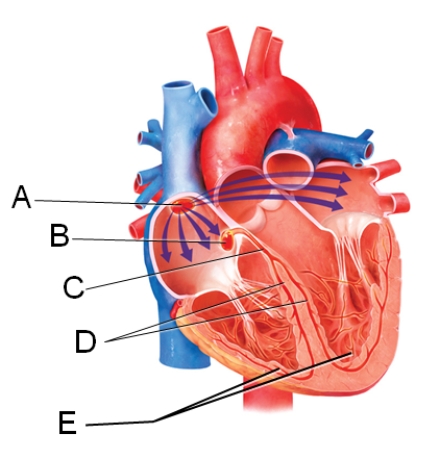

Trauma to the pericardium associated with bleeding into the pericardial cavity,might cause
(Multiple Choice)
4.8/5  (75)
(75) An increase in the carbon dioxide levels in the blood leads to a change in the chemical composition of the blood.This input would be received by which part of the brain that regulates heart rate?
(Multiple Choice)
4.8/5 (86)
(86) Which of the following blood vessels is used to distribute oxygenated blood to the myocardium?
(Multiple Choice)
4.7/5 (83)
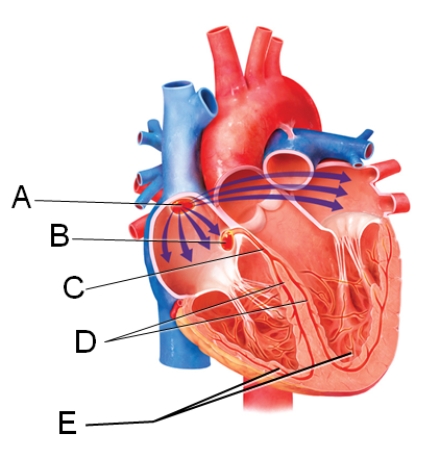
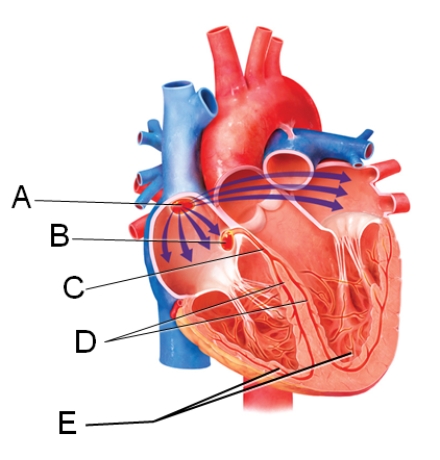
(83) Which labeled structure in the figure carries the cardiac action potential directly into the contractile fibers of the ventricular myocardium?
(Multiple Choice)
4.8/5 (98)
(98) Which of the following selections lists conditions that would lead to increased stroke volume?
(Multiple Choice)
4.8/5 (88)
(88) What is the relationship between an individual who is exercising strenuously causing his or her heart rate to exceed 160 beats/minute and the Frank-Starling law of the heart?
(Essay)
4.9/5 (67)
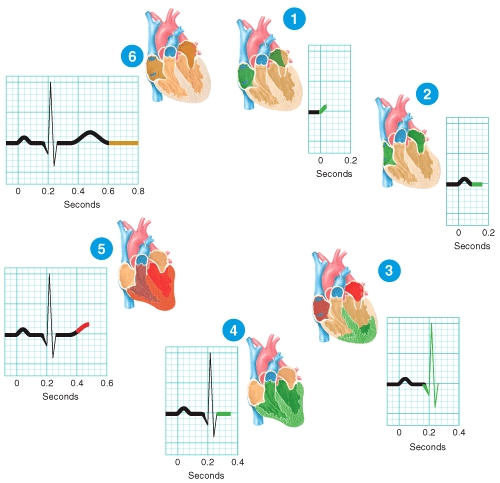
(67) Which phases of a heartbeat shown in the diagram involve depolarization of any of the heart's four chambers?
(Multiple Choice)
4.9/5 (89)
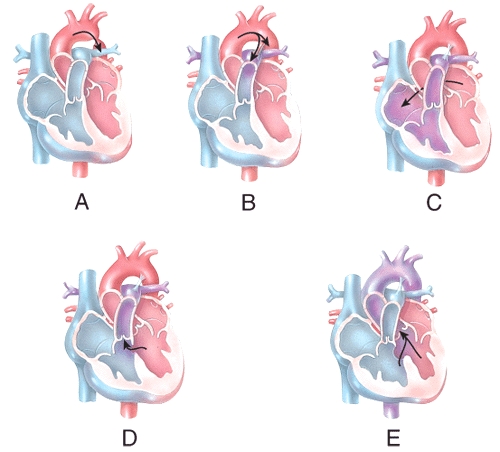
(89) Which of the labeled diagrams shows an atrial septal defect?
(Multiple Choice)
4.8/5 (76)
(76) Which labeled structure in the figure acts as the natural pacemaker of the heart?
(Multiple Choice)
4.9/5 (93)
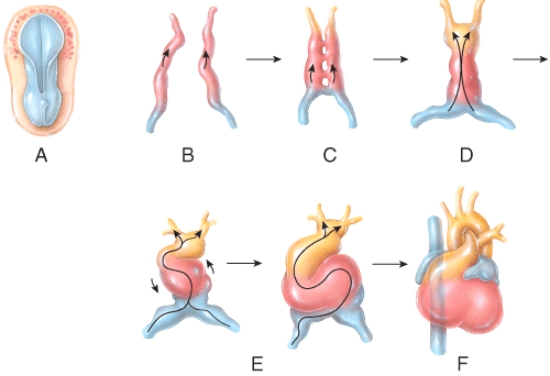
(93) Which of the labeled steps in the diagram represents formation of the primitive heart tube?
(Multiple Choice)
4.7/5 (77)
(77) Blood leaving the left ventricle passes through which of the following structures?
(Multiple Choice)
4.8/5 (79)
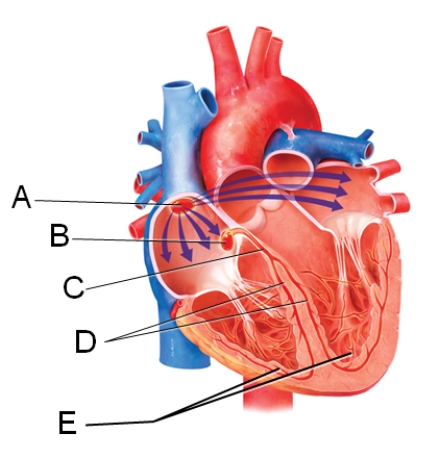
(79) Which labeled structure in the figure represents the only pathway for conducting action potentials from the atria to the ventricles?
(Multiple Choice)
4.8/5 (64)
(64) Cardiac muscle fibers are electrically connected to neighboring fibers by
(Multiple Choice)
4.9/5 (84)
(84) Briefly describe why cardiac tissue cannot repair itself after damage?
(Essay)
4.9/5 (81)
(81) Positive inotropic agents often promote inflow of which cation to increase contractility of the heart?
(Multiple Choice)
5.0/5 (84)
(84) The period of atrial systole lasts about [dropdown 1] while the period of ventricular systole lasts approximately [dropdown 2].
Dropdown 1 Choices:
0.4 second
0.3 second
0.1 second
0.6 second
Dropdown 2 Choices:
0.4 second
0.3 second
0.1 second
0.6 second
(Short Answer)
4.9/5 (74)
(74) 
Filters
- Essay(0)
- Multiple Choice(0)
- Short Answer(0)
- True False(0)
- Matching(0)