



 Chat with AI
Exam 19: The Cardiovascular System: the Blood

Exam 1: An Introduction to the Human Body78 Questions
Exam 2: The Chemical Level of Organization81 Questions
Exam 3: The Cellular Level of Organization84 Questions
Exam 4: The Tissue Level of Organization64 Questions
Exam 5: The Integumentary System78 Questions
Exam 6: The Skeletal System: Bone Tissue77 Questions
Exam 7: The Skeletal System: the Axial Skeleton80 Questions
Exam 8: The Skeletal System: The Appendicular Skeleton82 Questions
Exam 9: Joints41 Questions
Exam 10: Muscular Tissue85 Questions
Exam 11: The Muscular System70 Questions
Exam 12: Nervous Tissue17 Questions
Exam 13: The Spinal Cord and Spinal Nerves74 Questions
Exam 14: The Brain and Cranial Nerves72 Questions
Exam 15: The Autonomic Nervous System64 Questions
Exam 16: Sensory, Motor, and Integrative Systems76 Questions
Exam 17: The Special Senses73 Questions
Exam 18: The Endocrine System84 Questions
Exam 19: The Cardiovascular System: the Blood83 Questions
Exam 20: The Cardiovascular System: the Heart82 Questions
Exam 21: The Cardiovascular System: Blood Vessels and Hemodynamics81 Questions
Exam 22: The Lymphatic System and Immunity80 Questions
Exam 23: The Respiratory System85 Questions
Exam 24: The Digestive System85 Questions
Exam 25: Metabolism and Nutrition85 Questions
Exam 26: The Urinary System84 Questions
Exam 27: Fluid, Electrolyte, and Acidbase Homeostasis57 Questions
Exam 28: The Reproductive Systems84 Questions
Exam 29: Development and Inheritance83 Questions
Select questions type


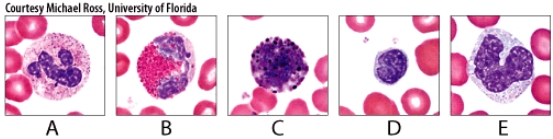
A high count of which of the white blood cells shown in the figure may indicate bacterial infection,stress,or inflammation?
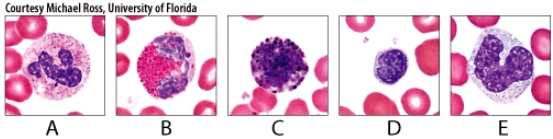
(Multiple Choice)
4.8/5  (78)
(78) A condition in which inadequate intake of vitamin B12 or folic acid causes production of large abnormal red blood cells is called
(Multiple Choice)
4.8/5 (83)
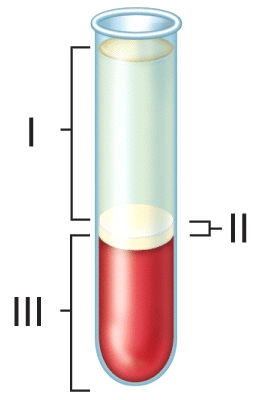
(83) Which of the following blood cell types normally comprises the highest percentage of the blood component labeled II in the figure?
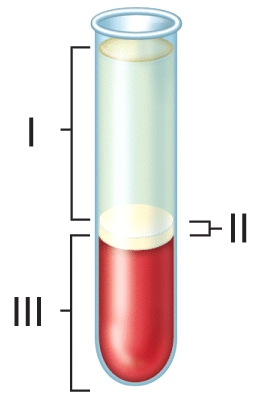
(Multiple Choice)
4.8/5 (65)
(65) Which of the cells in the diagram can be subdivided into categories of small and large versions of this cell type?
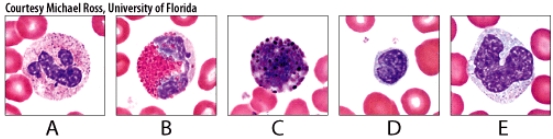
(Multiple Choice)
4.9/5 (81)
(81) List and briefly describe the three mechanisms used to reduce blood loss from a damaged blood vessel.
(Essay)
4.9/5 (73)
(73) Which of the following formed elements found in the blood are derived from reticulocytes?
(Multiple Choice)
4.7/5 (82)
(82) The hematocrit is a measure of the percentage of whole blood occupied by
(Multiple Choice)
5.0/5 (72)
(72) Which of the following clotting factors is involved in strengthening and stabilizing a blood clot?
(Multiple Choice)
4.8/5 (77)
(77) The average life span of an erythrocyte in the circulation is
(Multiple Choice)
4.9/5 (87)
(87) Which of the following blood types is a person whose blood cells were agglutinated by both anti-A serum and anti-B serum,but not by anti-Rh serum?
(Multiple Choice)
4.9/5 (85)
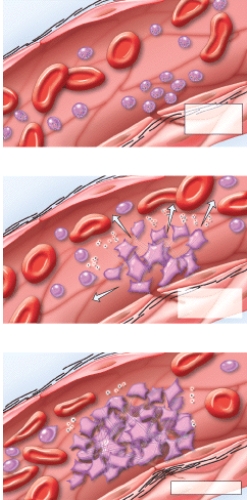
(85) 
A cord-blood transplant involves obtaining the stem cells to transplant into the diseased patient from
(Multiple Choice)
4.8/5 (69)
(69) When blood from a normal adult is centrifuged,as shown in the figure,which of the following components occupies the greatest volume?
(Multiple Choice)
4.8/5 (88)
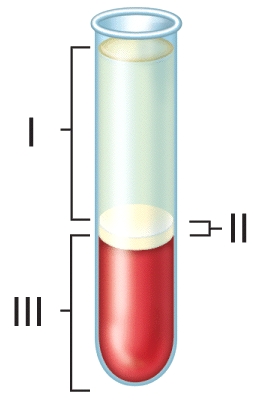
(88) Which of the following types of proteins is present at the highest percentage in the blood component labeled I in the figure?
(Multiple Choice)
4.8/5 (82)
(82) If type A blood is infused into a patient with type O blood,which of the following adverse reactions would you expect to observe in the patient?
(Multiple Choice)
4.9/5 (72)
(72) Approximately,how many hemoglobin molecules are found in each RBC?
(Multiple Choice)
4.7/5 (74)
(74) A high count of which of the white blood cells shown in the figure may indicate fungal infection?
(Multiple Choice)
4.8/5 (64)
(64) 
Filters
- Essay(0)
- Multiple Choice(0)
- Short Answer(0)
- True False(0)
- Matching(0)