



 Chat with AI
Exam 11: The Muscular System

Exam 1: An Introduction to the Human Body78 Questions
Exam 2: The Chemical Level of Organization81 Questions
Exam 3: The Cellular Level of Organization84 Questions
Exam 4: The Tissue Level of Organization64 Questions
Exam 5: The Integumentary System78 Questions
Exam 6: The Skeletal System: Bone Tissue77 Questions
Exam 7: The Skeletal System: the Axial Skeleton80 Questions
Exam 8: The Skeletal System: The Appendicular Skeleton82 Questions
Exam 9: Joints41 Questions
Exam 10: Muscular Tissue85 Questions
Exam 11: The Muscular System70 Questions
Exam 12: Nervous Tissue17 Questions
Exam 13: The Spinal Cord and Spinal Nerves74 Questions
Exam 14: The Brain and Cranial Nerves72 Questions
Exam 15: The Autonomic Nervous System64 Questions
Exam 16: Sensory, Motor, and Integrative Systems76 Questions
Exam 17: The Special Senses73 Questions
Exam 18: The Endocrine System84 Questions
Exam 19: The Cardiovascular System: the Blood83 Questions
Exam 20: The Cardiovascular System: the Heart82 Questions
Exam 21: The Cardiovascular System: Blood Vessels and Hemodynamics81 Questions
Exam 22: The Lymphatic System and Immunity80 Questions
Exam 23: The Respiratory System85 Questions
Exam 24: The Digestive System85 Questions
Exam 25: Metabolism and Nutrition85 Questions
Exam 26: The Urinary System84 Questions
Exam 27: Fluid, Electrolyte, and Acidbase Homeostasis57 Questions
Exam 28: The Reproductive Systems84 Questions
Exam 29: Development and Inheritance83 Questions
Select questions type


Due to the muscle attachments,a fracture to the ischial tuberosity would affect what lower limb movement?
(Multiple Choice)
4.9/5  (94)
(94) If one is stabbed on the lateral side of the abdomen,what abdominal muscles,in order from superficial to deep,will the knife go through?
(Multiple Choice)
4.7/5 (75)
(75) Which motions can be made by the upper limbs but NOT by the lower limbs?
(Multiple Choice)
4.9/5 (77)
(77) 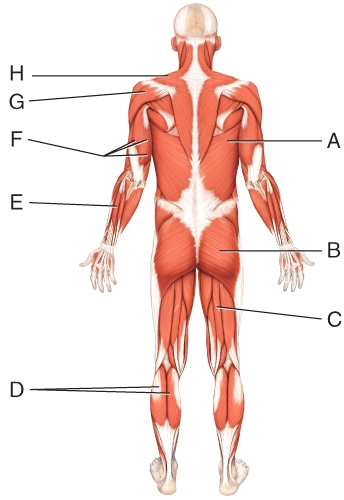
Which muscle in this figure produces the effort when you plantar flex to see over a taller person in front of your view??
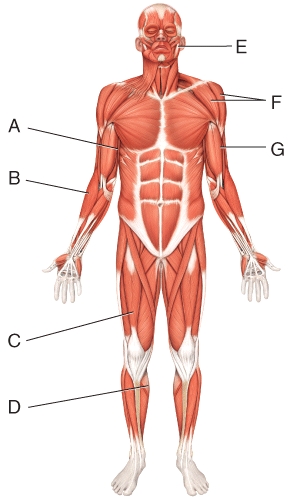
(Multiple Choice)
4.8/5 (85)
(85) The tendon of which muscle in this figure is the most commonly damaged in rotator cuff injuries?
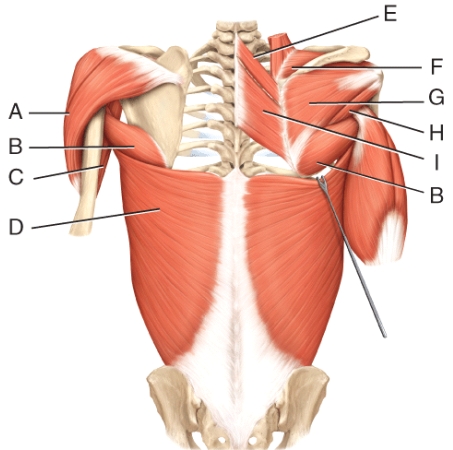
(Multiple Choice)
4.9/5 (77)
(77) 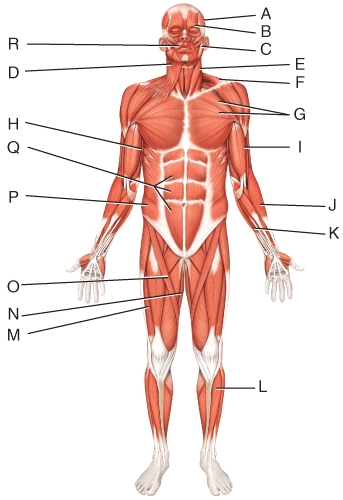
The rhomboid major is named for what characteristics? Select all that apply.
(Multiple Choice)
4.8/5 (81)
(81) What terms can be used to describe forearm muscle movements at the wrist but NOT on the fingers at the interphalangeal joints?
(Multiple Choice)
4.9/5 (79)
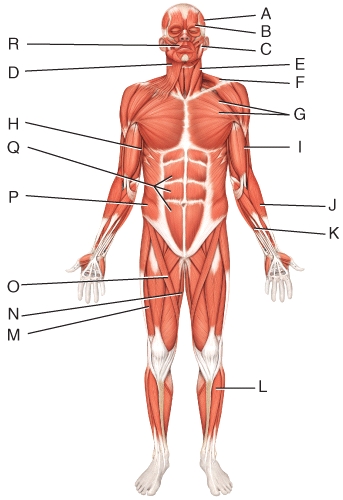
(79) Forcefully blowing through a trumpet would require contraction of which muscle?
(Multiple Choice)
5.0/5 (84)
(84) 
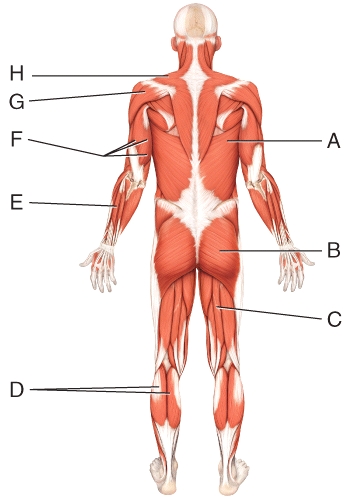
A woman complains of problems going up steps.Tests reveal hip extension weakness but no issues with hip flexion or knee flexion or extension.What muscle is most likely damaged?
(Multiple Choice)
5.0/5 (74)
(74) Which of these muscles flexes the thigh at the hip joint alone,but extends the knee working in a group?
(Multiple Choice)
4.8/5 (73)
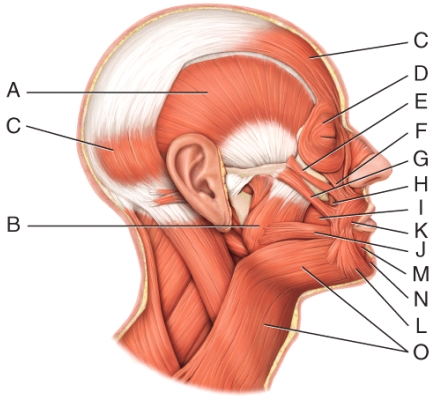
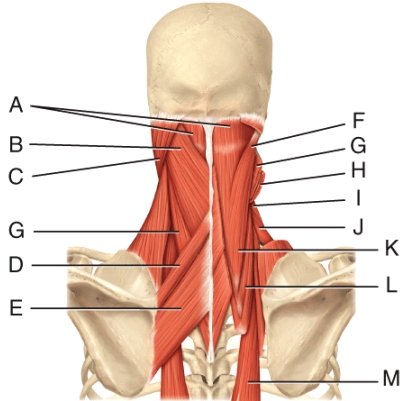
(73) Which muscle in this figure is innervated by a cranial nerve and can flex the cervical portion of the vertebral column?
(Multiple Choice)
4.9/5 (84)
(84) The muscle that serves as the "prime mover" during a movement is called the
(Multiple Choice)
4.7/5 (80)
(80) Your friend nods "yes" to you,going through flexion,extension and hyperextension.This movement at the fulcrum represents a
(Multiple Choice)
4.8/5 (84)
(84) The attachment of a muscle's tendon to the stationary bone is called the _____;the attachment of the muscle's other tendon to the movable bone is called the _____.
(Multiple Choice)
4.9/5 (80)
(80) 
Filters
- Essay(0)
- Multiple Choice(0)
- Short Answer(0)
- True False(0)
- Matching(0)