



 Chat with AI
Exam 9: Joints

Exam 1: An Introduction to the Human Body78 Questions
Exam 2: The Chemical Level of Organization81 Questions
Exam 3: The Cellular Level of Organization84 Questions
Exam 4: The Tissue Level of Organization64 Questions
Exam 5: The Integumentary System78 Questions
Exam 6: The Skeletal System: Bone Tissue77 Questions
Exam 7: The Skeletal System: the Axial Skeleton80 Questions
Exam 8: The Skeletal System: The Appendicular Skeleton82 Questions
Exam 9: Joints41 Questions
Exam 10: Muscular Tissue85 Questions
Exam 11: The Muscular System70 Questions
Exam 12: Nervous Tissue17 Questions
Exam 13: The Spinal Cord and Spinal Nerves74 Questions
Exam 14: The Brain and Cranial Nerves72 Questions
Exam 15: The Autonomic Nervous System64 Questions
Exam 16: Sensory, Motor, and Integrative Systems76 Questions
Exam 17: The Special Senses73 Questions
Exam 18: The Endocrine System84 Questions
Exam 19: The Cardiovascular System: the Blood83 Questions
Exam 20: The Cardiovascular System: the Heart82 Questions
Exam 21: The Cardiovascular System: Blood Vessels and Hemodynamics81 Questions
Exam 22: The Lymphatic System and Immunity80 Questions
Exam 23: The Respiratory System85 Questions
Exam 24: The Digestive System85 Questions
Exam 25: Metabolism and Nutrition85 Questions
Exam 26: The Urinary System84 Questions
Exam 27: Fluid, Electrolyte, and Acidbase Homeostasis57 Questions
Exam 28: The Reproductive Systems84 Questions
Exam 29: Development and Inheritance83 Questions
Select questions type


Rotation of the forearm occurs at [dropdown 1] and includes these [dropdown 2] special movements.
Dropdown 1 choices:
acromioclavicular
carpometacarpal
glenohumeral
radioulnar
radiocarpal
Dropdown 2 choices:
Dorsiflexion and plantar flexion
Elevation and depression
Eversion and inversion
Pronation and supination
Protraction and retraction
(Short Answer)
4.7/5  (84)
(84) What unique characteristics would a person who is "double-jointed" possess?
(Essay)
4.9/5 (88)
(88) The joint between the first rib and the manubrium of the sternum can be described by which term(s)? Select all that apply.
(Multiple Choice)
4.7/5 (70)
(70) Craniosacral therapy occurs when an individual manipulates the joints in the skull.What are the functional and structural classifications of the joints in the adult skull? Based on your knowledge of the joints in the adult skull,explain why it is not plausible that this manipulation would move the skull bones to influence the flow of cerebrospinal fluid around the brain.
(Essay)
5.0/5 (78)
(78) Studies have shown that ACL tears occur most frequently during the ovulatory phase in menstruating women.This example illustrates which factor affecting range of motion of a synovial joint?
(Multiple Choice)
4.8/5 (90)
(90) Nodding your head yes to answer a question occurs at the [dropdown 1] joint.Shaking your head no to answer a question occurs at the [dropdown 2].Both movements are occurring at a functionally classified [dropdown 3] joint.
Dropdown 1 & 2 choices:
atlanto-occipital
atlanto-axial
vertebrocostalsutural
sternocostal
Dropdown 3 choices:
amphiarthrosis
diarthrosis
synarthrosis
(Short Answer)
4.9/5 (80)
(80) List the three functional classifications of joints,and briefly describe the basis for the functional classification of joints.
(Essay)
4.8/5 (76)
(76) When you snap your thumb against your middle and forefinger,what motion is being performed?
(Multiple Choice)
4.9/5 (84)
(84) List the three structural categories of joints and briefly describe the criteria used for structural classification of joints.
(Essay)
4.8/5 (81)
(81) When a body builder flexes their biceps brachii,what motion is occurring?
(Multiple Choice)
4.8/5 (86)
(86) Lateral displacement of the jaw is prevented by [dropdown 1] ligament,and occurs in the [dropdown 2] compartment of the synovial cavity,during movement shown in [dropdown 3] panel.
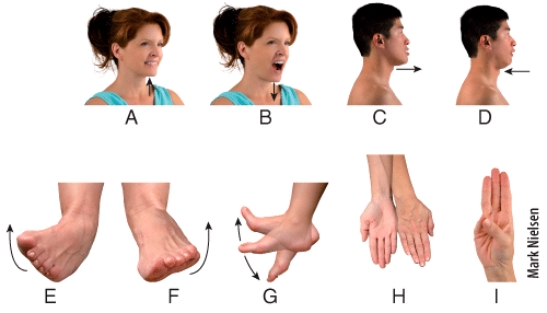 Dropdown 1 Choices:
lateral
sphenomandibular
stylomandibular
Dropdown 2 Choices:
inferior
superior
Dropdown 3 Choices:
A
C
E
F
Dropdown 1 Choices:
lateral
sphenomandibular
stylomandibular
Dropdown 2 Choices:
inferior
superior
Dropdown 3 Choices:
A
C
E
F (Short Answer)
4.9/5 (74)
(74) The olecranon bursae are associated with the - [dropdown 1] joint.Bursae function to [dropdown 2].
Dropdown 1 choices:
Coxal
Elbow
Glenohumeral
Talocrural
Tibiofemoral
Dropdown 2 choices:
Absorb shock and help bones fit together better
Distribute weight over a great contact surface
Reduce friction between muscles and bones
Wrap around tendons to reduce friction
(Short Answer)
4.8/5 (80)
(80) The joints between the first pair of ribs and the sternum are structurally classified as [dropdown 1].The sternocostal joints for the second through seventh pair of ribs are functionally classified as [dropdown 2].
Dropdown 1 choices:
cartilaginous
fibrous
synovial
Dropdown 2 choices:
amphiarthrosis
diarthrosis
synarthrosis
(Short Answer)
4.9/5 (74)
(74) The radial head articulating with the radial notch of the ulna represents what type of synovial joint?
(Multiple Choice)
4.8/5 (94)
(94) Inflammation of the synovial membrane is a common [dropdown 1] in [dropdown 2].Due to the chronic pain,it could lead to [dropdown 3].
Dropdown 1 choices:
Sign
Symptom
Dropdown 2 choices:
Gouty arthritis
Lyme disease
Osteoarthritis
Rheumatoid arthritis
Dropdown 3 choices:
decreased range of motion
increased deposition of urate crystals
increased range of motion
loosening of the tendons
muscle hypertrophy
(Short Answer)
4.8/5 (88)
(88) To peer over a fence,the calf muscles help you stand on your toes.What movement is being performed?
(Multiple Choice)
4.7/5 (68)
(68) The function of the ligament the line is pointing to is
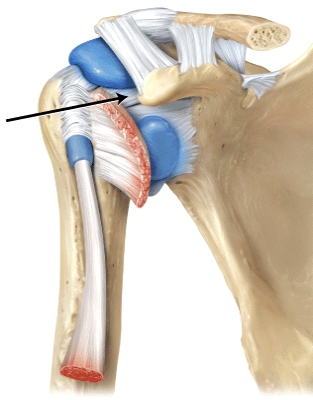 a)strengthens superior part of the articular capsule
b)joint stabilization when present
c)secures the long head of the biceps brachii
d)helps enlarge the glenoid cavity
a)strengthens superior part of the articular capsule
b)joint stabilization when present
c)secures the long head of the biceps brachii
d)helps enlarge the glenoid cavity (Short Answer)
4.9/5 (68)
(68) 
Filters
- Essay(0)
- Multiple Choice(0)
- Short Answer(0)
- True False(0)
- Matching(0)