



 Chat with AI
Exam 4: The Tissue Level of Organization

Exam 1: An Introduction to the Human Body78 Questions
Exam 2: The Chemical Level of Organization81 Questions
Exam 3: The Cellular Level of Organization84 Questions
Exam 4: The Tissue Level of Organization64 Questions
Exam 5: The Integumentary System78 Questions
Exam 6: The Skeletal System: Bone Tissue77 Questions
Exam 7: The Skeletal System: the Axial Skeleton80 Questions
Exam 8: The Skeletal System: The Appendicular Skeleton82 Questions
Exam 9: Joints41 Questions
Exam 10: Muscular Tissue85 Questions
Exam 11: The Muscular System70 Questions
Exam 12: Nervous Tissue17 Questions
Exam 13: The Spinal Cord and Spinal Nerves74 Questions
Exam 14: The Brain and Cranial Nerves72 Questions
Exam 15: The Autonomic Nervous System64 Questions
Exam 16: Sensory, Motor, and Integrative Systems76 Questions
Exam 17: The Special Senses73 Questions
Exam 18: The Endocrine System84 Questions
Exam 19: The Cardiovascular System: the Blood83 Questions
Exam 20: The Cardiovascular System: the Heart82 Questions
Exam 21: The Cardiovascular System: Blood Vessels and Hemodynamics81 Questions
Exam 22: The Lymphatic System and Immunity80 Questions
Exam 23: The Respiratory System85 Questions
Exam 24: The Digestive System85 Questions
Exam 25: Metabolism and Nutrition85 Questions
Exam 26: The Urinary System84 Questions
Exam 27: Fluid, Electrolyte, and Acidbase Homeostasis57 Questions
Exam 28: The Reproductive Systems84 Questions
Exam 29: Development and Inheritance83 Questions
Select questions type


Which epithelial tissue is found lining the kidney glomerulus,and performs blood filtration?
(Multiple Choice)
4.9/5  (77)
(77) Which epithelial tissue forms the most superficial layer of the skin?
(Multiple Choice)
4.8/5 (76)
(76) Which of the light micrographs in the figure below shows the type of epithelial tissue whose functions include filtration,diffusion,osmosis,and secretion in serous membranes?
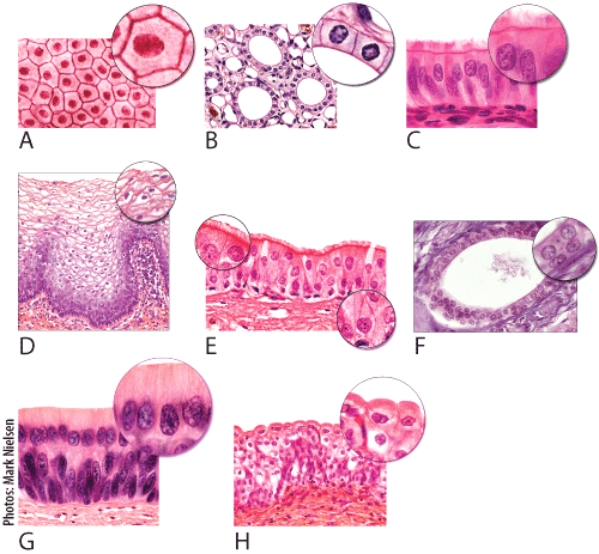
(Multiple Choice)
4.9/5 (67)
(67) Electrical signals called _____ travel along the plasma membrane of a neuron and stimulate the release of chemicals called _____ that are then used to communicate with other cells.
(Multiple Choice)
4.8/5 (83)
(83) The _______ component of connective tissue is found between the cells and fibers,and functions to support and bind cells in the tissue together?
(Multiple Choice)
4.7/5 (83)
(83) [___] glands are categorized by whether their ducts are branched or unbranched.
Dropdown Choices:
Multicellular exocrine
Unicellular endocrine
Unicellular exocrine
(Short Answer)
4.8/5 (79)
(79) Name and describe the types of cells commonly found in connective tissue.
(Essay)
4.9/5 (70)
(70) In the light micrograph,which two tissues contain gap junctions?
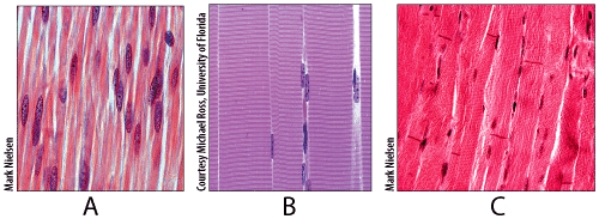
(Multiple Choice)
4.9/5 (82)
(82) In the figure shown,light micrograph [___] shows cartilage that is located in the epiphyseal plate.
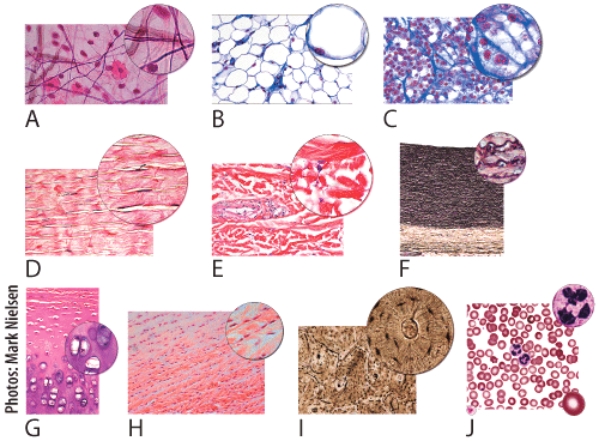 Dropdown choices:
A
B
C
D
E
F
G
H
I
J
Dropdown choices:
A
B
C
D
E
F
G
H
I
J (Short Answer)
4.9/5 (84)
(84) Support electrical excitable cells fround in the nervous system?
(Multiple Choice)
4.9/5 (66)
(66) Which polysaccharide is commonly found in the ground substance of connective tissues?
(Multiple Choice)
4.7/5 (67)
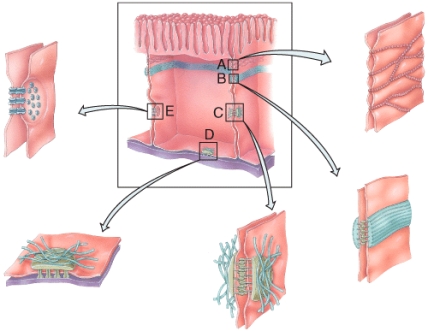
(67) In the diagram shown below,which cellular junction will prevent acidic stomach fluid from seeping into the connective tissue?
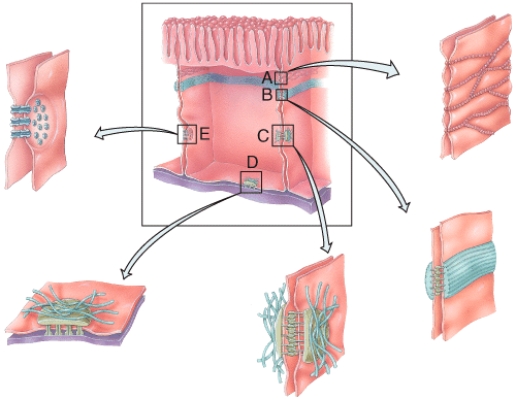
(Multiple Choice)
4.8/5 (78)
(78) ___________muscle pumps blood through the body and ________is located in the wall of blood vessels ?
(Multiple Choice)
4.8/5 (80)
(80) These types of cell junctions anchor adjacent cells together and resist their separation during contractile activities.
(Multiple Choice)
4.8/5 (69)
(69) In the diagram shown below,which cell junction uses keratin reinforce the stability of the cell?
(Multiple Choice)
4.8/5 (90)
(90) Due to the entire cell being secreted,[___] glands will produce the most viscous secretion.
Dropdown Choices:
apocrine
exocrine
holocrine
(Short Answer)
4.9/5 (78)
(78) 
Filters
- Essay(0)
- Multiple Choice(0)
- Short Answer(0)
- True False(0)
- Matching(0)