



 Chat with AI
Exam 21: Decision Analysis

Exam 1: Data and Statistics98 Questions
Exam 2: Descriptive Statistics: Tabular and Graphical Presentations64 Questions
Exam 3: Descriptive Statistics: Numerical Measures156 Questions
Exam 4: Introduction to Probability138 Questions
Exam 5: Discrete Probability Distributions122 Questions
Exam 6: Continuous Probability Distributions165 Questions
Exam 7: Sampling and Sampling Distributions131 Questions
Exam 8: Interval Estimation131 Questions
Exam 9: Hypothesis Tests133 Questions
Exam 10: Statistical Inference About Means and Proportions With Two Populations121 Questions
Exam 11: Inferences About Population Variances91 Questions
Exam 12: Tests of Goodness of Fit and Independence80 Questions
Exam 13: Analysis of Variance and Experimental Design113 Questions
Exam 14: Simple Linear Regression140 Questions
Exam 15: Multiple Regression106 Questions
Exam 16: Regression Analysis: Model Building75 Questions
Exam 17: Index Numbers52 Questions
Exam 18: Forecasting67 Questions
Exam 19: Nonparametric Methods81 Questions
Exam 20: Statistical Methods for Quality Control30 Questions
Exam 21: Decision Analysis65 Questions
Exam 22: Sample Survey63 Questions
Select questions type


A line or arc connecting the nodes of a decision tree is called a(n)
(Multiple Choice)
4.8/5  (77)
(77) Assume you are faced with the following decision alternatives and two states of nature.The probability of the occurrence of state of nature 1 is 0.35.The payoff table is shown below.
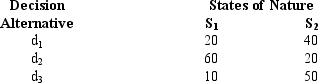 a.Determine the expected value of each alternative and indicate which decision alternative is the best.
b.Determine the expected value with perfect information about the states of nature.
c.Determine the expected value of perfect information.
a.Determine the expected value of each alternative and indicate which decision alternative is the best.
b.Determine the expected value with perfect information about the states of nature.
c.Determine the expected value of perfect information. (Essay)
4.9/5 (87)
(87) Exhibit 21-1
Below you are given a payoff table involving two states of nature and three decision alternatives.
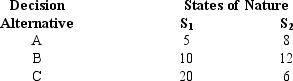 The probability of occurrence of S1 = 0.2.
-Refer to Exhibit 21-1.The expected monetary value of alternative A is
The probability of occurrence of S1 = 0.2.
-Refer to Exhibit 21-1.The expected monetary value of alternative A is (Multiple Choice)
4.8/5 (73)
(73) Suppose we are interested in investing in one of three investment opportunities: d1,d2,or d3.The following profit payoff table shows the profits (in thousands of dollars)under each of the 3 possible economic conditions-S1,S2,and S3.The probability of the occurrence of S1 is 0.1,and the probability of the occurrence of S2 is 0.3.
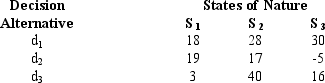 a.Determine the expected value of each alternative and indicate which decision alternative is the best.
b.Determine the expected value with perfect information about the states of nature.
c.Determine the expected value of perfect information.
a.Determine the expected value of each alternative and indicate which decision alternative is the best.
b.Determine the expected value with perfect information about the states of nature.
c.Determine the expected value of perfect information. (Essay)
4.7/5 (83)
(83) Exhibit 21-1
Below you are given a payoff table involving two states of nature and three decision alternatives.
The probability of occurrence of S1 = 0.2.
-Refer to Exhibit 21-1.The expected monetary value of the best alternative is
The probability of occurrence of S1 = 0.2.
-Refer to Exhibit 21-1.The expected monetary value of the best alternative is (Multiple Choice)
4.9/5 (84)
(84) 
Filters
- Essay(0)
- Multiple Choice(0)
- Short Answer(0)
- True False(0)
- Matching(0)