



 Chat with AI
Exam 21: Decision Analysis

Exam 1: Data and Statistics98 Questions
Exam 2: Descriptive Statistics: Tabular and Graphical Presentations64 Questions
Exam 3: Descriptive Statistics: Numerical Measures156 Questions
Exam 4: Introduction to Probability138 Questions
Exam 5: Discrete Probability Distributions122 Questions
Exam 6: Continuous Probability Distributions165 Questions
Exam 7: Sampling and Sampling Distributions131 Questions
Exam 8: Interval Estimation131 Questions
Exam 9: Hypothesis Tests133 Questions
Exam 10: Statistical Inference About Means and Proportions With Two Populations121 Questions
Exam 11: Inferences About Population Variances91 Questions
Exam 12: Tests of Goodness of Fit and Independence80 Questions
Exam 13: Analysis of Variance and Experimental Design113 Questions
Exam 14: Simple Linear Regression140 Questions
Exam 15: Multiple Regression106 Questions
Exam 16: Regression Analysis: Model Building75 Questions
Exam 17: Index Numbers52 Questions
Exam 18: Forecasting67 Questions
Exam 19: Nonparametric Methods81 Questions
Exam 20: Statistical Methods for Quality Control30 Questions
Exam 21: Decision Analysis65 Questions
Exam 22: Sample Survey63 Questions
Select questions type


The owner of a new gourmet kitchenware shop wishes to determine how many days and evenings to keep the shop open.The various payoffs (in $1,000s)are indicated in the table below.
 Assume the probabilities of the three states of nature are P(S1)= 0.60,P(S2)=0 .30,and P(S3)= 0.1.
a.Determine the expected value of each alternative and indicate which decision alternative is the best.
b.Determine the expected value with perfect information about the states of nature.
c.Determine the expected value of perfect information.
Assume the probabilities of the three states of nature are P(S1)= 0.60,P(S2)=0 .30,and P(S3)= 0.1.
a.Determine the expected value of each alternative and indicate which decision alternative is the best.
b.Determine the expected value with perfect information about the states of nature.
c.Determine the expected value of perfect information. (Essay)
4.8/5  (73)
(73) The Video Game Supply Company (VGS)is deciding whether to set production next year at 2,000,2,500,or 3,000 games.Demand could be low,medium,or high.Using historical data,VGS estimates the probabilities as 0.4 for low demand,0.3 for medium demand,and 0.3 for high demand.The following profit payoff table (in $100s)has been developed.
 a.Determine the expected value of each alternative and indicate what should be the production target.
b.Determine the expected value with perfect information about the states of nature.
c.Determine the expected value of perfect information.
a.Determine the expected value of each alternative and indicate what should be the production target.
b.Determine the expected value with perfect information about the states of nature.
c.Determine the expected value of perfect information. (Essay)
4.8/5 (90)
(90) Michael,Nancy,& Associates (MNA)produce color printers.The demand for their printers could be light,medium,or high with the following probabilities.
 The company has three production alternatives for the coming period.The payoffs (in millions of dollars)associated with the three alternatives are shown below.
 a.Compute the expected value of the three alternatives.Which alternative would you select,based on the expected values?
b.Compute the expected value with perfect information (i.e. ,expected value under certainty).
c.Compute the expected value of perfect information (EVPI).
The company has three production alternatives for the coming period.The payoffs (in millions of dollars)associated with the three alternatives are shown below.
a.Compute the expected value of the three alternatives.Which alternative would you select,based on the expected values?
b.Compute the expected value with perfect information (i.e. ,expected value under certainty).
c.Compute the expected value of perfect information (EVPI). (Essay)
4.9/5 (87)
(87) Below you are given a payoff table involving two states of nature and two decision alternatives.
 The probability of the occurrence of S1 is 0.3.
a.Compute the expected monetary value for each decision.Which decision is the best?
b.Compute the expected value of perfect information.
The probability of the occurrence of S1 is 0.3.
a.Compute the expected monetary value for each decision.Which decision is the best?
b.Compute the expected value of perfect information. (Essay)
4.9/5 (78)
(78) Assume you are faced with the following decision alternatives and two states of nature.The payoff table is shown below.
 The probability of state of nature 1 is P(s1)= 0.42.
a.Determine the expected value of each alternative.
b.Which decision is the optimal decision?
c.Determine the expected value with perfect information.
d.Compute the expected value of perfect information.
The probability of state of nature 1 is P(s1)= 0.42.
a.Determine the expected value of each alternative.
b.Which decision is the optimal decision?
c.Determine the expected value with perfect information.
d.Compute the expected value of perfect information. (Essay)
4.8/5 (79)
(79) The probability of the states of nature,after use of Bayes' theorem to adjust the prior probabilities based upon given indicator information,is called
(Multiple Choice)
4.9/5 (95)
(95) The following payoff table shows profits for two decision alternatives under three different states of nature.It is known that the probability of the occurrence of state of nature 1 is 0.1.
 a.What should the probabilities of states of natures 2 and 3 be so that the expected values of the two decision alternatives equal one another?
b.Determine the expected values.
a.What should the probabilities of states of natures 2 and 3 be so that the expected values of the two decision alternatives equal one another?
b.Determine the expected values. (Essay)
4.7/5 (89)
(89) A group of investors wants to open up a jewelry store in a new shopping center.The investors are trying to decide whether to stock the store with inexpensive jewelry,medium-priced jewelry,or expensive jewelry.The probability of their choice depends upon the economic conditions.The payoff table below gives the anticipated profits for different states of the economy.The probability of prosperity is 0.5.
 a.Determine the expected value of each alternative and indicate which decision alternative is the best.
b.Determine the expected value with perfect information about the states of nature.
c.Determine the expected value of perfect information.
a.Determine the expected value of each alternative and indicate which decision alternative is the best.
b.Determine the expected value with perfect information about the states of nature.
c.Determine the expected value of perfect information. (Essay)
4.7/5 (86)
(86) Exhibit 21-4
Below you are given a payoff table involving two states of nature and three decision alternatives.
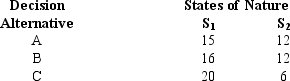 The probability of the occurrence of S1 = 0.3.
-Refer to Exhibit 21-4.The expected value of the best alternative is
The probability of the occurrence of S1 = 0.3.
-Refer to Exhibit 21-4.The expected value of the best alternative is (Multiple Choice)
4.9/5 (79)
(79) A decision criterion which weights the payoff for each decision by its probability of occurrence is known as the
(Multiple Choice)
4.8/5 (76)
(76) For a decision alternative,the weighted average of the payoffs is known as
(Multiple Choice)
5.0/5 (88)
(88) The probability of one event given the known outcome of a (possibly)related event is known as
(Multiple Choice)
4.9/5 (80)
(80) Exhibit 21-3
Below you are given a payoff table involving two states of nature and three decision alternatives.
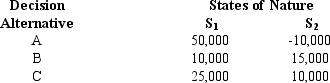 The probability of the occurrence of state of nature S1 is 0.4.
-Refer to Exhibit 21-3.The recommended decision based on the expected monetary value criterion is
The probability of the occurrence of state of nature S1 is 0.4.
-Refer to Exhibit 21-3.The recommended decision based on the expected monetary value criterion is (Multiple Choice)
4.9/5 (65)
(65) You are given the following payoff table.
 Assume the following probability information is given.
 a.Find the values of P(I1)and P(I2).
b.What are the values of P(S1|I1),P(S2|I1),P(S1|I2),and P(S2|I2)?
c.Use the decision tree approach and determine the optimal decision strategy.What is the expected value of the solution?
d.Determine the expected value of sample information.
Assume the following probability information is given.
a.Find the values of P(I1)and P(I2).
b.What are the values of P(S1|I1),P(S2|I1),P(S1|I2),and P(S2|I2)?
c.Use the decision tree approach and determine the optimal decision strategy.What is the expected value of the solution?
d.Determine the expected value of sample information. (Essay)
4.7/5 (84)
(84) An intersection or junction point of a decision tree is called a (n)
(Multiple Choice)
4.9/5 (62)
(62) Exhibit 21-1
Below you are given a payoff table involving two states of nature and three decision alternatives.
 The probability of occurrence of S1 = 0.2.
-Refer to Exhibit 21-1.The expected value of perfect information is
The probability of occurrence of S1 = 0.2.
-Refer to Exhibit 21-1.The expected value of perfect information is (Multiple Choice)
4.8/5 (78)
(78) Exhibit 21-5
Below you are given a payoff table involving three states of nature and three decision alternatives.
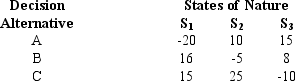 The probability of occurrence of S1 is 0.2 and the probability of occurrence of S2 is 0.3.
-Refer to Exhibit 21-5.The expected value of perfect information is
The probability of occurrence of S1 is 0.2 and the probability of occurrence of S2 is 0.3.
-Refer to Exhibit 21-5.The expected value of perfect information is (Multiple Choice)
4.8/5 (77)
(77) Exhibit 21-5
Below you are given a payoff table involving three states of nature and three decision alternatives.
The probability of occurrence of S1 is 0.2 and the probability of occurrence of S2 is 0.3.
-Refer to Exhibit 21-5.The expected monetary value of alternative C is
The probability of occurrence of S1 is 0.2 and the probability of occurrence of S2 is 0.3.
-Refer to Exhibit 21-5.The expected monetary value of alternative C is (Multiple Choice)
4.8/5 (91)
(91) A poll released this week found that in a random sample of registered voters,60% indicated that they think a female "will run" for the presidency,30% said a female "will not run," and 10% had "no opinion." When asked their opinions on whether or not a female would be elected,66% of those who said a female "will run" thought she could be elected;25% of those who thought a female "will not run" thought she could be elected;whereas,20% of those who had no opinion said that she could be elected.
a.What percentage of registered voters (in this sample)thought that a female could be elected?
b.Given that a person thought that a female could be elected,what is the probability that this person said a female "will not run" for the presidency?
c.Compute all the posterior probabilities.
(Essay)
4.8/5 (81)
(81) 
Filters
- Essay(0)
- Multiple Choice(0)
- Short Answer(0)
- True False(0)
- Matching(0)