



 Chat with AI
Exam 15: Working Capital and Current Assets Management

Exam 1: The Role of Managerial Finance134 Questions
Exam 2: The Financial Market Environment91 Questions
Exam 3: Financial Statements and Ratio Analysis208 Questions
Exam 4: Cash Flow and Financial Planning185 Questions
Exam 5: Time Value of Money173 Questions
Exam 6: Interest Rates and Bond Valuation224 Questions
Exam 7: Stock Valuation188 Questions
Exam 8: Risk and Return188 Questions
Exam 9: The Cost of Capital137 Questions
Exam 10: Capital Budgeting Techniques167 Questions
Exam 11: Capital Budgeting Cash Flows117 Questions
Exam 12: Risk and Refinements in Capital Budgeting106 Questions
Exam 13: Leverage and Capital Structure217 Questions
Exam 14: Payout Policy130 Questions
Exam 15: Working Capital and Current Assets Management336 Questions
Exam 16: Current Liabilities Management171 Questions
Exam 17: Hybrid and Derivative Securities185 Questions
Exam 18: Mergers, Lbos, Divestitures, and Business Failure191 Questions
Exam 19: International Managerial Finance108 Questions
Select questions type


Under an aggressive funding strategy, a firm funds its seasonal requirements with short-term debt and its permanent requirements with long-term debt.
(True/False)
4.9/5  (85)
(85) Table 15.1
Irish Air Services has determined several factors relative to its asset and financing mix.
(a) The firm earns 10 percent annually on its current assets.
(b) The firm earns 20 percent annually on its fixed assets.
(c) The firm pays 13 percent annually on current liabilities.
(d) The firm pays 17 percent annually on long-term funds.
(e) The firm's monthly current, fixed, and total asset requirements for the previous year are summarized in the table below: 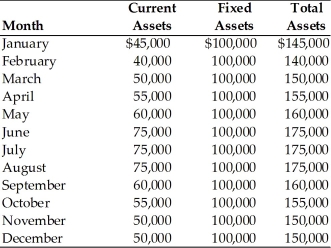 -The firm's initial ratio of current to total assets is ________. (See Table 15.1)
 (Multiple Choice)
4.8/5 (90)
(90) Table 15.2  The company earns 5 percent on current assets and 15 percent on fixed assets. The firm's current liabilities cost 7 percent to maintain and the average annual cost of long-term funds is 20 percent.
-If the firm was to shift $3,000 of current assets to fixed assets, the firm's net working capital would ________, and the risk of insolvency would ________, respectively. (See Table 15.2)
The company earns 5 percent on current assets and 15 percent on fixed assets. The firm's current liabilities cost 7 percent to maintain and the average annual cost of long-term funds is 20 percent.
-If the firm was to shift $3,000 of current assets to fixed assets, the firm's net working capital would ________, and the risk of insolvency would ________, respectively. (See Table 15.2) (Multiple Choice)
4.7/5 (92)
(92) Match each marketable security with its description.
(a) Eurodollar deposit
(b) Banker's acceptance
(c) Federal agency issue
(d) Commercial paper
(e) Repurchase agreement
(f) Treasury bill
(g) Money market mutual fund
(h) Negotiable certificate of deposit
(i) Treasury note
1. ________ A short term, unsecured promissory note issued by a corporation.
2. ________ An obligation of the U.S. Treasury with common maturities of 91 to 182 days.
3. ________ A portfolio of marketable securities.
4. ________ An arrangement whereby a bank or securities dealer sells specific marketable securities to a firm and agrees to purchase them in the future.
5. ________ An obligation of the U.S. Treasury with mutual maturities of between one and seven years.
6. ________ Negotiable instrument evidencing the deposit of a certain number of dollars in a commercial bank.
7. ________ An instrument issued by the Federal National Mortgage Association.
8. ________ Funds deposited in banks located outside the U.S. and denominated in U.S. dollars.
9. ________ Short term credit arrangement used by businesses to finance transactions with foreign countries or firms with unknown credit capacities.
(Essay)
4.9/5 (78)
(78) The General Chemical Company uses 150,000 gallons of hydro chloric acid per month. The cost of carrying the chemical in inventory is 50 cents per gallon per year, and the cost of ordering the chemical is $150 per order. The firm uses the chemical at a constant rate throughout the year. The chemical's economic order quantity is ________.
(Multiple Choice)
5.0/5 (75)
(75) The aggressive funding strategy is risky due to its minimum level of net working capital, high dependency on short-term sources of funds, and the changing short-term interest.
(True/False)
4.8/5 (75)
(75) A decrease in the current asset to total asset ratio will result in ________.
(Multiple Choice)
4.8/5 (77)
(77) Increasing the length of the credit period can increase sales, but both the investment in accounts receivable and bad debt expenses are likely to increase as well.
(True/False)
5.0/5 (80)
(80) The cost of marginal investment in accounts receivable can be calculated by finding the difference between the average investment in accounts receivable before and after the introduction of the changes in credit standards.
(True/False)
4.8/5 (78)
(78) The entire process resulting from a check issue and mail by a payer company to a payee company (i.e., mail float, processing float, and clearing float) is disbursement float to the payer company and is collection float to the payee company.
(True/False)
4.9/5 (82)
(82) The risk of the conservative funding requirements is low because of its high level of net working capital, and the fact that the strategy does not require a firm to use any of its limited short-term borrowing capacity.
(True/False)
4.7/5 (79)
(79) The cash conversion cycle of a firm is the length of time from the beginning of the production
process to the collection of cash from the sale of finished products.
(True/False)
4.8/5 (78)
(78) One of the components of a cash conversion cycle is the average collection period.
(True/False)
4.9/5 (64)
(64) The ________ of a firm is the amount of time required for a company to convert cash invested in its operations to cash received as a result of its operations.
(Multiple Choice)
4.9/5 (75)
(75) Table 15.1
Irish Air Services has determined several factors relative to its asset and financing mix.
(a) The firm earns 10 percent annually on its current assets.
(b) The firm earns 20 percent annually on its fixed assets.
(c) The firm pays 13 percent annually on current liabilities.
(d) The firm pays 17 percent annually on long-term funds.
(e) The firm's monthly current, fixed, and total asset requirements for the previous year are summarized in the table below:
-The firm's monthly permanent funds requirement is ________. (See Table 15.1)
-The firm's monthly permanent funds requirement is ________. (See Table 15.1) (Multiple Choice)
4.9/5 (66)
(66) A decrease in current assets and an increase in current liabilities will ________ net working capital, thereby ________ the risk of insolvency.
(Multiple Choice)
4.9/5 (82)
(82) Which of the following is true of the impact of cash flows on net working capital?
(Multiple Choice)
4.9/5 (80)
(80) 
Filters
- Essay(0)
- Multiple Choice(0)
- Short Answer(0)
- True False(0)
- Matching(0)