



 Chat with AI
Exam 15: Working Capital and Current Assets Management

Exam 1: The Role of Managerial Finance134 Questions
Exam 2: The Financial Market Environment91 Questions
Exam 3: Financial Statements and Ratio Analysis208 Questions
Exam 4: Cash Flow and Financial Planning185 Questions
Exam 5: Time Value of Money173 Questions
Exam 6: Interest Rates and Bond Valuation224 Questions
Exam 7: Stock Valuation188 Questions
Exam 8: Risk and Return188 Questions
Exam 9: The Cost of Capital137 Questions
Exam 10: Capital Budgeting Techniques167 Questions
Exam 11: Capital Budgeting Cash Flows117 Questions
Exam 12: Risk and Refinements in Capital Budgeting106 Questions
Exam 13: Leverage and Capital Structure217 Questions
Exam 14: Payout Policy130 Questions
Exam 15: Working Capital and Current Assets Management336 Questions
Exam 16: Current Liabilities Management171 Questions
Exam 17: Hybrid and Derivative Securities185 Questions
Exam 18: Mergers, Lbos, Divestitures, and Business Failure191 Questions
Exam 19: International Managerial Finance108 Questions
Select questions type


________ are short-term money market instruments that can be easily converted into cash.
(Multiple Choice)
4.9/5  (80)
(80) Studio San, a dealer in contemporary art, has forecasted its seasonal financing needs for the next six months as follows: 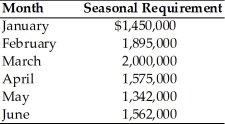 (a) The firm projects that short-term funds will cost 11 percent and long-term funds will cost 13 percent annually.
(b) The firm's permanent funds requirement is $500,000.
Calculate financing costs for the first six months using the aggressive and conservative strategies.
(a) The firm projects that short-term funds will cost 11 percent and long-term funds will cost 13 percent annually.
(b) The firm's permanent funds requirement is $500,000.
Calculate financing costs for the first six months using the aggressive and conservative strategies. (Essay)
4.9/5 (69)
(69) Table 15.7
Fizzy Animators, Inc. currently makes all sales on credit and offers no cash discount. The firm is considering a 3 percent cash discount for payment within 10 days. The firm's current average collection period is 90 days, sales are 400 films per year, selling price is $25,000 per film, variable cost per film is $18,750, and the average cost per film is $21,000. The firm expects that the change in credit terms will result in a minor increase in sales of 10 films per year, that 75 percent of the sales will take the discount, and the average collection period will drop to 30 days. The firm's bad debt expense is expected to become negligible under the proposed plan. The bad debt expense is currently 0.5 percent of sales. The firm's required return on equal-risk investments is 20 percent. (Assume a 360-day year.)
-What are the savings of marginal bad debts under the proposed plan? (See Table 15.7)
(Multiple Choice)
4.8/5 (79)
(79) A firm has arranged for a lockbox system to reduce collection time of accounts receivable. Currently the firm has an average collection period of 43 days, an average age of inventory of 50 days, and an average payment period of 10 days. The lockbox system will reduce the average collection period by 3 days by reducing processing, mail, and clearing float. The firm's cash conversion cycle ________.
(Multiple Choice)
4.8/5 (91)
(91) Taizhou Products uses 800 units of a product per year on a continuous basis. The product has carrying costs of $50 per unit per year and order costs of $300 per order. It takes 30 days to receive a shipment after an order is placed and the firm requires a safety stock of 5 days usage in inventory.
(a) Calculate the economic order quantity (EOQ).
(b) Determine the reorder point. (Assume a 360-day year.)
(Essay)
4.8/5 (82)
(82) An increase in current assets increases net working capital, thereby reducing the risk of insolvency.
(True/False)
4.8/5 (76)
(76) An increase in accounts receivable turnover due to an increase in collection efforts will decrease a firm's marginal investment in accounts receivable.
(True/False)
4.9/5 (80)
(80) Which of the following is true of a credit applicant's character?
(Multiple Choice)
4.7/5 (74)
(74) The objective for managing accounts receivable is to avoid credit sales as much as possible.
(True/False)
4.7/5 (85)
(85) Nongovernmental issues typically have slightly higher yields than government issues with similar maturities because ________.
(Multiple Choice)
4.8/5 (76)
(76) A firm is considering relaxing credit standards which will result in an increase in annual sales from $3 million to $3.75 million, a decrease in the cost of annual sales from $2,225,000 to $2,000,000, an increase in additional profit contribution from sales of $10,000, and an increase in the average collection period of 15 days, from 20 to 35 days. The bad debt loss is expected to increase from 1 percent to 1.5 percent of sales. The firm's required return on investments is 15 percent. The net result of the firm relaxing its credit standards is ________. (Assume a 360-day year.)
(Multiple Choice)
4.7/5 (88)
(88) Which of the following is true of maintaining appropriate inventory levels?
(Multiple Choice)
4.9/5 (72)
(72) If a firm increases its cash discount period, the firm's investment in accounts receivable due to non-discount takers now paying earlier is expected to decrease.
(True/False)
5.0/5 (67)
(67) A firm's credit standard is a procedure for ranking an applicant's overall credit strength, derived as a weighted average of scores on key financial and credit characteristics.
(True/False)
4.7/5 (74)
(74) 2/15 net 45 translates as 2 percent of the balance is due in 15 days; the remaining balance is due in 45 days.
(True/False)
4.9/5 (76)
(76) A firm may have a negative cash conversion cycle if it carries ________.
(Multiple Choice)
4.9/5 (75)
(75) Table 15.4
Bowring Ball Bearings has 10 different items in its inventory. The average number of units held in inventory and the average unit cost are listed for each item. The firm uses an ABC system of inventory control.  -Inventory items that belong in the A category include ________. (See Table 15.4)
 (Multiple Choice)
4.8/5 (77)
(77) When a firm decreases or cancels a cash discount, sales are expected to ________, the investment in accounts receivable is expected to ________, the bad debt expense is expected to ________, and the profit per unit is expected to ________.
(Multiple Choice)
4.9/5 (91)
(91) 
Filters
- Essay(0)
- Multiple Choice(0)
- Short Answer(0)
- True False(0)
- Matching(0)