



 Chat with AI
Exam 3: Financial Statements and Ratio Analysis

Exam 1: The Role of Managerial Finance134 Questions
Exam 2: The Financial Market Environment91 Questions
Exam 3: Financial Statements and Ratio Analysis208 Questions
Exam 4: Cash Flow and Financial Planning185 Questions
Exam 5: Time Value of Money173 Questions
Exam 6: Interest Rates and Bond Valuation224 Questions
Exam 7: Stock Valuation188 Questions
Exam 8: Risk and Return188 Questions
Exam 9: The Cost of Capital137 Questions
Exam 10: Capital Budgeting Techniques167 Questions
Exam 11: Capital Budgeting Cash Flows117 Questions
Exam 12: Risk and Refinements in Capital Budgeting106 Questions
Exam 13: Leverage and Capital Structure217 Questions
Exam 14: Payout Policy130 Questions
Exam 15: Working Capital and Current Assets Management336 Questions
Exam 16: Current Liabilities Management171 Questions
Exam 17: Hybrid and Derivative Securities185 Questions
Exam 18: Mergers, Lbos, Divestitures, and Business Failure191 Questions
Exam 19: International Managerial Finance108 Questions
Select questions type


The McCain-Feingold Act of 2002 was passed to eliminate many of the disclosure and conflict-of-interest problems of corporations.
(True/False)
4.9/5  (81)
(81) Retained earnings represent the cumulative total of all earnings, net of dividends, that have been retained and reinvested in the firm since its inception.
(True/False)
4.8/5 (67)
(67) Average payment period can be calculated as accounts payable divided by average purchases per day.
(True/False)
4.8/5 (92)
(92) The liquidity of a firm is measured by its ability to satisfy its short-term obligations as they come due.
(True/False)
4.8/5 (70)
(70) Average age of inventory is viewed as the average length of time inventory is held by a firm or as the average number of days' sales in inventory.
(True/False)
4.9/5 (91)
(91) Candy Corporation had pretax profits of $1.2 million, an average tax rate of 34 percent, and it paid preferred stock dividends of $50,000. There were 100,000 shares outstanding and no interest expense. What was Candy Corporation's earnings per share?
(Multiple Choice)
4.9/5 (79)
(79) Benchmarking is a type of cross-sectional analysis in which a firm's ratios are compared to a key competitor firm within the same industry, primarily to identify areas for improvement.
(True/False)
4.9/5 (91)
(91) If an inventory turnover is divided into 365, it becomes a measure of ________.
(Multiple Choice)
4.8/5 (77)
(77) Table 3.2
Dana Dairy Products Key Ratios  Income Statement
Dana Dairy Products
For the Year Ended December 31, 2013
 Balance Sheet
Dana Dairy Products
December 31, 2013
 -The current ratio for Dana Dairy Products in 2013 was ________. (See Table 3.2)
Income Statement
Dana Dairy Products
For the Year Ended December 31, 2013 Balance Sheet
Dana Dairy Products
December 31, 2013
-The current ratio for Dana Dairy Products in 2013 was ________. (See Table 3.2) (Multiple Choice)
4.8/5 (82)
(82) Table 3.1  Information (2013 values)
1. Sales totaled $110,000
2. The gross profit margin was 25 percent.
3. Inventory turnover was 3.0.
4. There are 360 days in the year.
5. The average collection period was 65 days.
6. The current ratio was 2.40.
7. The total asset turnover was 1.13.
8. The debt ratio was 53.8 percent.
-Notes payable for CEE in 2013 was ________. (See Table 3.1)
Information (2013 values)
1. Sales totaled $110,000
2. The gross profit margin was 25 percent.
3. Inventory turnover was 3.0.
4. There are 360 days in the year.
5. The average collection period was 65 days.
6. The current ratio was 2.40.
7. The total asset turnover was 1.13.
8. The debt ratio was 53.8 percent.
-Notes payable for CEE in 2013 was ________. (See Table 3.1) (Multiple Choice)
4.7/5 (86)
(86) The price/earnings (P/E) ratio represents the degree of confidence that investors have in a firm's future performance.
(True/False)
4.9/5 (76)
(76) The ________ ratio indicates the efficiency with which a firm uses its assets to generate sales.
(Multiple Choice)
4.9/5 (77)
(77) Table 3.1 Information (2013 values)
1. Sales totaled $110,000
2. The gross profit margin was 25 percent.
3. Inventory turnover was 3.0.
4. There are 360 days in the year.
5. The average collection period was 65 days.
6. The current ratio was 2.40.
7. The total asset turnover was 1.13.
8. The debt ratio was 53.8 percent.
-Accounts receivable for CEE in 2013 was ________. (See Table 3.1)
Information (2013 values)
1. Sales totaled $110,000
2. The gross profit margin was 25 percent.
3. Inventory turnover was 3.0.
4. There are 360 days in the year.
5. The average collection period was 65 days.
6. The current ratio was 2.40.
7. The total asset turnover was 1.13.
8. The debt ratio was 53.8 percent.
-Accounts receivable for CEE in 2013 was ________. (See Table 3.1) (Multiple Choice)
4.7/5 (77)
(77) Other things being equal, a decrease in total asset turnover will result in ________ in the return on total assets.
(Multiple Choice)
4.8/5 (78)
(78) Key Financial Data 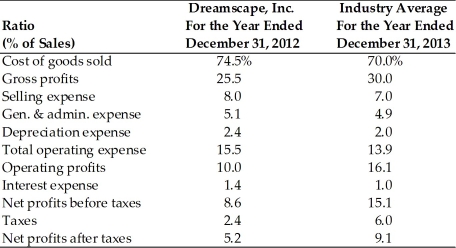 Income Statement, Dreamscape, Inc.
For the Year Ended December 31, 2013
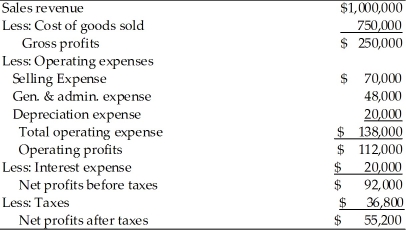 Prepare a common-size income statement for Dreamscape, Inc. for the year ended December 31, 2013. Evaluate the company's performance against industry average ratios and against last year's results.
Income Statement, Dreamscape, Inc.
For the Year Ended December 31, 2013 Prepare a common-size income statement for Dreamscape, Inc. for the year ended December 31, 2013. Evaluate the company's performance against industry average ratios and against last year's results. (Essay)
4.9/5 (71)
(71) The original price per share received by the firm on a single issue of common stock is equal to the sum of the common stock and paid-in capital in excess of par accounts divided by the number of shares outstanding.
(True/False)
5.0/5 (73)
(73) 
Filters
- Essay(0)
- Multiple Choice(0)
- Short Answer(0)
- True False(0)
- Matching(0)