



 Chat with AI
Exam 3: Accrual Accounting

Exam 1: Fundamentals of Financial Accounting Theory33 Questions
Exam 2: Conceptual Frameworks for Financial Reporting60 Questions
Exam 3: Accrual Accounting159 Questions
Exam 4: Revenue Recognition110 Questions
Exam 5: Cash and Receivables120 Questions
Exam 6: Inventories156 Questions
Exam 7: Financial Assets141 Questions
Exam 8: Property, Plant, and Equipment127 Questions
Exam 9: Intangible Assets, Goodwill, Mineral Resources, and Government Grants81 Questions
Exam 10: Applications of Fair Value to Non-Current Assets120 Questions
Select questions type


Which statement is incorrect about the cash flow statement?
(Multiple Choice)
4.9/5  (87)
(87) Hatcher Limited, a private company, was started on January 1, 2011. For the first year, the chief accountant prepared the financial statements and a local accountant completed the necessary review of these statements. However, for the year ended December 31, 2012, an external auditor was appointed. For each situation outlined below, determine the correct accounting treatment and prepare the corrected statements of comprehensive income for 2011 and 2012.
1)Long-term contracts: Hatcher used the completed contract method for revenue recognition in 2011. Management now believes that the percentage of completion method would be better. Income under the completed contract method for 2011 was $3,800,000 and for 2012 it was $3,600,000. If the percentage of completion method had been used, the incomes would have been $5,800,000 (2011)and $3,400,000 (2012).
2)Accounts receivable: The accounts receivable on December 31, 2011, included a $30,000 account which was not provided for but subsequently was written off during 2012 as the customer went bankrupt after the issuance of the financial statements. Hatcher would like to adjust 2011 for this oversight as it sees this as an error.
3)Machine depreciation: Hatcher has a machine that cost $500,000 and has been depreciated over an estimated useful life of 10 years. Upon reviewing the manufacturer's reports in 2012, management now firmly believes the machine will last a total of 15 years from date of purchase. They would like to change last year's depreciation charge based on this analysis. Depreciation expense of $50,000 has been recorded for 2012.
4)Building depreciation: The company's building (cost $5,000,000, estimated salvage value $0, useful life 20 years)was depreciated last year using the 10% declining-balance method. The company and auditor now agree that the straight-line method would be a more appropriate method to use. A depreciation provision of $450,000 has been made for 2012.
5)Inventories: The accountant last year failed to apply the lower of cost or net realizable value to ending inventory. Upon review, the inventory balance for last year should have been reduced by $250,000. The closing inventory allowance for this year-end should be $370,000. No entry has been made for this.
6)Warranties: Hatcher does not accrue for warranties; rather it records the warranty expense when amounts are paid. Hatcher provides a one-year warranty for defective goods. Payments to satisfy warranty claims in 2011 were $160,000, and $370,000 in 2012. Out of the $370,000 paid in 2012, $170,000 related to 2011 sales. A reasonable estimate of warranties payable at the end of 2012 is $270,000. 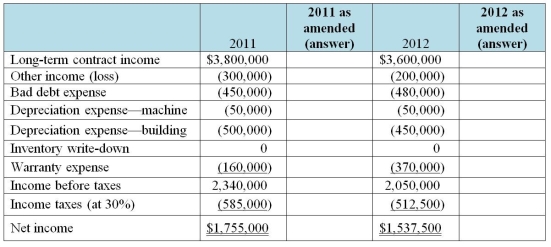
(Essay)
4.9/5 (78)
(78) Sing Songs Ltd. started operations on January 1, 2010. During its first year of operations, the company had a choice of accounting policies:
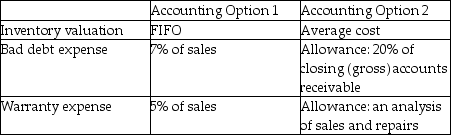 Explain why the net incomes would not be the same under both accounting options.
 (Essay)
4.9/5 (67)
(67) The following event occurred after the company's year-end but before the completion of the audit. For this subsequent event, determine whether the event:
•requires an adjustment to the year-end financial statements,
•requires note disclosure, or
•requires neither adjustment to recognized amounts nor disclosure.
A major client unexpectedly goes bankrupt and it is determined that you will get only 30% of the value of their account receivable as full and final settlement. (Justify your recommendation.)
(Essay)
4.9/5 (74)
(74) Sing Songs Ltd. started operations on January 1, 2010. During its first year of operations, the company had a choice of accounting policies:
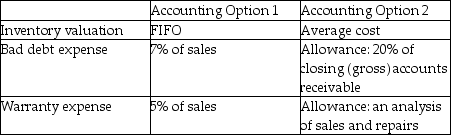 Using the information provided below, discuss whether the cumulative cash flows will be the same or different each accounting option.
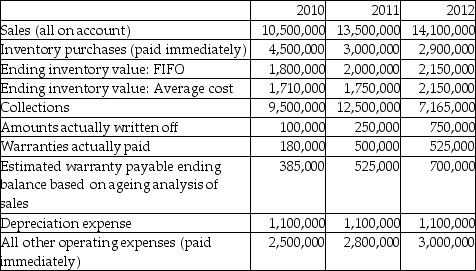
Using the information provided below, discuss whether the cumulative cash flows will be the same or different each accounting option.
(Essay)
4.9/5 (80)
(80) Which one of the following errors would cause a company's unadjusted trial balance to be out of balance?
(Multiple Choice)
4.8/5 (73)
(73) Sing Songs Ltd. started operations on January 1, 2010. During its first year of operations, the company had a choice of accounting policies:
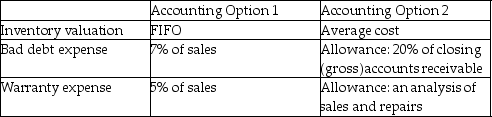 Using the following information about activities for 2010-2012, derive the net income for each year under both accounting options:
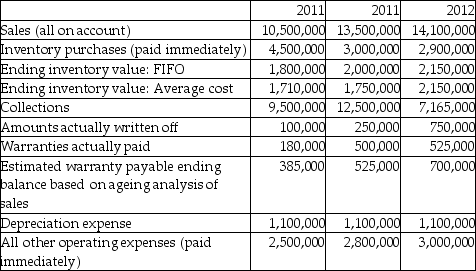
Using the following information about activities for 2010-2012, derive the net income for each year under both accounting options:
(Essay)
4.8/5 (90)
(90) Explain why companies prepare financial statements on an annual basis.
(Essay)
4.8/5 (95)
(95) The following entry was recorded by Hollow Inc.:  What is the effect on Hollow's financial statements?
 (Multiple Choice)
4.8/5 (79)
(79) Which statement is correct about expenses in the income statement?
(Multiple Choice)
5.0/5 (75)
(75) Which statement correctly explains the relationship between cash flows, accruals and reported earnings?
(Multiple Choice)
4.9/5 (76)
(76) What is the difference between accrual accounting and cash accounting?
(Essay)
4.9/5 (77)
(77) Which statement is not correct about expenses in the income statement?
(Multiple Choice)
4.8/5 (84)
(84) 
Filters
- Essay(0)
- Multiple Choice(0)
- Short Answer(0)
- True False(0)
- Matching(0)