



 Chat with AI
Exam 3: Accrual Accounting

Exam 1: Fundamentals of Financial Accounting Theory33 Questions
Exam 2: Conceptual Frameworks for Financial Reporting60 Questions
Exam 3: Accrual Accounting159 Questions
Exam 4: Revenue Recognition110 Questions
Exam 5: Cash and Receivables120 Questions
Exam 6: Inventories156 Questions
Exam 7: Financial Assets141 Questions
Exam 8: Property, Plant, and Equipment127 Questions
Exam 9: Intangible Assets, Goodwill, Mineral Resources, and Government Grants81 Questions
Exam 10: Applications of Fair Value to Non-Current Assets120 Questions
Select questions type


Which of the following would be accounted for as a change in accounting estimate? (More than one answer may be correct.)
A. A furniture maker decreases bad debts expense from 3% to 2% of credit sales.
B. A manufacturer determines that credit losses are becoming material due to deteriorating economic conditions. As a result, it decides to set up an allowance for doubtful accounts at 5% of amounts over 90 days.
C. A parking service estimates bad debts to be 10% of the value of parking violations issued. In the current year, it changes to estimating the allowance for bad debts to be equal to 20% of accounts 30 to 90 days and 50% of accounts over 90 days.
D. A shipbuilder changes its revenue recognition policy from the point of receipt by the customer to when the ship leaves the factory shipyard. This change results from a change in shipping policy from f.o.b. destination to f.o.b. shipping point. (Recall from introductory accounting that f.o.b. means "free on board," and it refers to the point at which ownership transfers from seller to buyer.)
E. An electronics retailer has never accrued for warranties or product guarantees. A new consumer protection law comes into effect, giving buyers of electronic products a guarantee against defects for 180 days after purchase and the ability to return defective products to the retailer.
F. A clothing company that has been operating for 20 years decides to obtain an external audit for the first time in order to meet the bank's demands. The audit firm recommends that management report inventories at the lower of cost and net realizable value, whereas the company has previously only tracked and reported inventory figures at cost.
(Short Answer)
4.9/5  (82)
(82) Which of the following is an example of an "operating" cash cycle?
(Multiple Choice)
4.8/5 (72)
(72) Hatcher Limited, a private company, was started on January 1, 2011. For the first year, the chief accountant prepared the financial statements and a local accountant completed the necessary review of these statements. However, for the year ended December 31, 2012, an external auditor was appointed. For each situation below, explain the recommended treatment for each of these matters in terms of whether they are errors, changes in accounting policy, or changes in estimate. Explain your conclusion.
1)Long-term contracts: Hatcher used the completed contract method for revenue recognition in 2011. Management now believes that the percentage of completion method would be better. Income under the completed contract method for 2011 was $3,800,000 and for 2012 it was $3,600,000. If the percentage of completion method had been used, the incomes would have been $5,800,000 (2011)and $3,400,000 (2012).
2)Accounts receivable: The accounts receivable on December 31, 2011, included a $30,000 account which was not provided for but subsequently was written off during 2012 as the customer went bankrupt after the issuance of the financial statements. Hatcher would like to adjust 2011 for this oversight as it sees this as an error.
3)Machine depreciation: Hatcher has a machine that cost $500,000 and has been depreciated over an estimated useful life of 10 years. Upon reviewing the manufacturer's reports in 2012, management now firmly believes the machine will last a total of 15 years from date of purchase. They would like to change last year's depreciation charge based on this analysis. Depreciation expense of $50,000 has been recorded for 2012.
4)Building depreciation: The company's building (cost $5,000,000, estimated salvage value $0, useful life 20 years)was depreciated last year using the 10% declining-balance method. The company and auditor now agree that the straight-line method would be a more appropriate method to use. A depreciation provision of $450,000 has been made for 2012.
5)Inventories: The accountant last year failed to apply the lower of cost or net realizable value to ending inventory. Upon review, the inventory balance for last year should have been reduced by $250,000. The closing inventory allowance for this year-end should be $370,000. No entry has been made for this.
6)Warranties: Hatcher does not accrue for warranties; rather it records the warranty expense when amounts are paid. Hatcher provides a one-year warranty for defective goods. Payments to satisfy warranty claims in 2011 were $160,000, and $370,000 in 2012. Out of the $370,000 paid in 2012, $170,000 related to 2011 sales. A reasonable estimate of warranties payable at the end of 2012 is $270,000. 
(Essay)
4.9/5 (82)
(82) Explain the meaning of the cash basis of accounting and the accrual basis of accounting. When is the cash basis appropriate? Why is the accrual basis used in financial reporting?
(Essay)
4.7/5 (78)
(78) What is meant by the "going concern assumption" in financial accounting? Explain the implications to financial accounting if the going concern assumption is not valid.
(Essay)
4.8/5 (92)
(92) What is meant by "quality of earnings"? Discuss if earnings quality should be assessed by comparing earnings to cash flows.
(Essay)
4.9/5 (80)
(80) IFRS identifies a number of criteria to determine whether a liability should be classified as current. A liability that satisfies any one of these criteria must be classified as current. For the following list of criteria, identify whether each one is relevant for the classification of a liability as current instead of non-current. 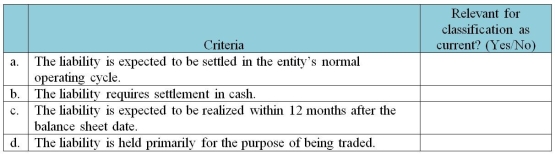
(Essay)
4.8/5 (82)
(82) A company's reported earnings are $1,000 and cash flows are $600. Based on economic conditions during the year, the company booked allowances of $250. As a result of contractual incentives, the company booked a further $150 in accruals. What is the total of the unbiased accruals and excessive accruals?
(Multiple Choice)
4.8/5 (71)
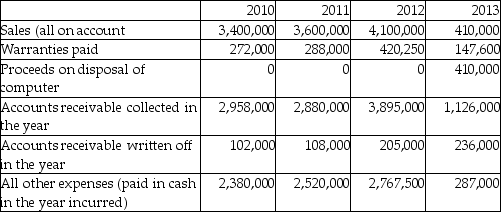
(71) Computer Consulting Limited was started in early 2010 and continued to operate until early 2013, when it was wound up due to disputes between the two principal shareholders. When it started, the company used these accounting policies:
1. Use straight-line depreciation for the firm's only asset, a computer which cost $1,100,000 and has an estimated useful life of four years.
2. Estimate warranty expense as 9% of sales.
3. Estimate bad debts expense as 5% of sales.
Derive the annual net cash flows for 2010 to 2012. For the year-end balance for 2013, assume accounts receivable, allowance for doubtful accounts, and the warranty accrual are $0, as the firm wound itself up during the year and all timing differences have been resolved.
(Essay)
4.7/5 (78)
(78) The method of depreciation was changed from the double-declining-balance method to the straight-line method in fiscal 2013. A machine was purchased on January 1, 2011, at a cost of $150,000. The machine has an estimated useful life of 10 years and a residual value of $9,000. What adjustment is needed for fiscal 2011?
(Multiple Choice)
4.8/5 (86)
(86) Which of the following is an example of an "investing" cash cycle?
(Multiple Choice)
4.8/5 (73)
(73) Sally Corp. received payment on a long-term receivable for $980,000. What effect does this transaction have on these accounts?
(Multiple Choice)
4.9/5 (75)
(75) What is the impact of overstating an accrued expense during the 2013 fiscal year?
(Multiple Choice)
4.8/5 (87)
(87) An adjusted trial balance for Soorya Industries Limited at December 31, 2011, follows.
Prepare a balance sheet at December 31, 2011, with items classified as current or non-current.

(Essay)
4.7/5 (74)
(74) 
Filters
- Essay(0)
- Multiple Choice(0)
- Short Answer(0)
- True False(0)
- Matching(0)