



 Chat with AI
Exam 11: Risk and Return in Capital Markets

Exam 1: Corporate Finance and the Financial Manager86 Questions
Exam 2: Introduction to Financial Statement Analysis108 Questions
Exam 3: Time Value of Money: an Introduction112 Questions
Exam 4: Time Value of Money: Valuing Cash Flow Streams67 Questions
Exam 5: Interest Rates110 Questions
Exam 6: Bonds107 Questions
Exam 7: Stock Valuation64 Questions
Exam 8: Investment Decision Rules122 Questions
Exam 9: Fundamentals of Capital Budgeting113 Questions
Exam 10: Stock Valuation: a Second Look48 Questions
Exam 11: Risk and Return in Capital Markets110 Questions
Exam 12: Systematic Risk and the Equity Risk Premium104 Questions
Exam 13: The Cost of Capital110 Questions
Exam 14: Raising Equity Capital107 Questions
Exam 15: Debt Financing101 Questions
Exam 16: Capital Structure109 Questions
Exam 17: Payout Policy110 Questions
Exam 18: Financial Modeling and Pro Forma Analysis95 Questions
Exam 19: Working Capital Management108 Questions
Exam 20: Short-Term Financial Planning110 Questions
Exam 21: Option Applications and Corporate Finance102 Questions
Exam 22: Mergers and Acquisitions47 Questions
Exam 23: International Corporate Finance108 Questions
Exam 24: Leasing46 Questions
Exam 25: Insurance and Risk Management38 Questions
Exam 26: Corporate Governance45 Questions
Select questions type


When investing for a long term, investors care about the volatility of ________ returns and not the volatility of ________ returns.
(Multiple Choice)
4.9/5  (77)
(77) Which of the following investments offered the highest overall return over the past eighty years?
(Multiple Choice)
4.7/5 (81)
(81) Fluctuations of a stock's return that are due to market-wide news representing common risk is the ________.
(Multiple Choice)
4.8/5 (67)
(67) Amazon.com stock prices gave a realized return of 15%, 15%, 15%, and 10% over four successive quarters. What is the annual realized return for Amazon.com for the year?
(Multiple Choice)
4.9/5 (79)
(79) In general, it is possible to eliminate ________ risk by holding a large portfolio of assets.
(Multiple Choice)
4.8/5 (86)
(86) Rational investors may be willing to choose an investment that has additional risk but does not offer additional reward.
(True/False)
4.7/5 (81)
(81) If asset A's return is exactly two times asset B's return, then following risk return tradeoff, the standard deviation of asset A should be ________ times the standard deviation of asset B.
(Multiple Choice)
4.9/5 (82)
(82) Consider the following average annual returns: 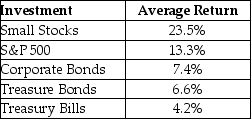 What is the excess return for Treasury bills?
 (Multiple Choice)
4.8/5 (94)
(94) What is the diversification achieved by an investor if he invests in Dell, IBM, and Microsoft?
(Essay)
4.8/5 (76)
(76) Historical evidence on the returns of large portfolios of stock and bonds shows that investments with higher volatility have rewarded investors with higher returns.
(True/False)
4.8/5 (88)
(88) The average annual return over the period 1926-2009 for small stocks is 21.2%, and the standard deviation of returns is 21.2%. Based on these numbers, what is a 95% confidence interval for 2010 returns?
(Multiple Choice)
4.9/5 (73)
(73) Consider an economy with two types of firms, S and I. S firms always move together, but I firms move independently of each other. For both types of firms there is a 60% probability that the firm will have a 20% return and a 40% probability that the firm will have a -30% return. The standard deviation for the return on a portfolio of 20 type I firms is closest to ________.
(Multiple Choice)
4.8/5 (82)
(82) The risk that is linked across outcomes is called ________.
(Multiple Choice)
4.9/5 (75)
(75) The average annual return for the S&P 500 from 1886 to 2006 is 5%, with a standard deviation of 15%. Based on these numbers, what is a 95% confidence interval for 2007's returns?
(Multiple Choice)
4.9/5 (79)
(79) As we increase the number of stocks in a portfolio, the standard deviation of returns of the portfolio ________.
(Multiple Choice)
4.8/5 (76)
(76) The average annual return for the S&P 500 from 1886 to 2006 is 9.5%, with a standard deviation of 18%. Based on these numbers, what is a 95% confidence interval for 2007's returns?
(Multiple Choice)
4.8/5 (84)
(84) What are the two components of realized return from a stock investment?
(Essay)
4.8/5 (70)
(70) 
Filters
- Essay(0)
- Multiple Choice(0)
- Short Answer(0)
- True False(0)
- Matching(0)