



 Chat with AI
Exam 14: Raising Equity Capital

Exam 1: Corporate Finance and the Financial Manager86 Questions
Exam 2: Introduction to Financial Statement Analysis108 Questions
Exam 3: Time Value of Money: an Introduction112 Questions
Exam 4: Time Value of Money: Valuing Cash Flow Streams67 Questions
Exam 5: Interest Rates110 Questions
Exam 6: Bonds107 Questions
Exam 7: Stock Valuation64 Questions
Exam 8: Investment Decision Rules122 Questions
Exam 9: Fundamentals of Capital Budgeting113 Questions
Exam 10: Stock Valuation: a Second Look48 Questions
Exam 11: Risk and Return in Capital Markets110 Questions
Exam 12: Systematic Risk and the Equity Risk Premium104 Questions
Exam 13: The Cost of Capital110 Questions
Exam 14: Raising Equity Capital107 Questions
Exam 15: Debt Financing101 Questions
Exam 16: Capital Structure109 Questions
Exam 17: Payout Policy110 Questions
Exam 18: Financial Modeling and Pro Forma Analysis95 Questions
Exam 19: Working Capital Management108 Questions
Exam 20: Short-Term Financial Planning110 Questions
Exam 21: Option Applications and Corporate Finance102 Questions
Exam 22: Mergers and Acquisitions47 Questions
Exam 23: International Corporate Finance108 Questions
Exam 24: Leasing46 Questions
Exam 25: Insurance and Risk Management38 Questions
Exam 26: Corporate Governance45 Questions
Select questions type


The announcement of an SEO usually raises a stock's price.

Free
(True/False)
4.9/5  (65)
(65) Correct Answer: Verified
False
The firm commitment process is the most common practice for IPOs in the United States.
Free
(True/False)
4.9/5 (87)
(87) Correct Answer:Verified
VerifiedTrue
Big Box retailing has a market capitalization of $500 million and 4 million shares outstanding. In order to finance its growth, the management of Big Box plans to raise further capital through a rights issue. All shareholders will be issued ten rights to purchase ten shares at a price of $1.00 per share. How much money will this raise, if all shareholders exercise their rights?
Free
(Multiple Choice)
5.0/5 (80)
(80) Correct Answer:Verified
VerifiedB
Highlander Homes stock trades at $31 per share and there are 50 million shares outstanding. The management would like to raise $300 million in an SEO, and current investors would like to sell $100 million of their own stock. If the underwriter charges 6% of gross proceeds, how many shares must it sell in the total (primary and secondary)offering?
(Multiple Choice)
4.9/5 (84)
(84) An entrepreneur founded his company using $200,000 of his own money, issuing himself 200,000 shares of stock. An angel investor bought an additional 100,000 shares for $150,000. The entrepreneur now sells another 400,000 shares of stock to a venture capitalist for$2 million. What is the post-money valuation of the company?
(Multiple Choice)
4.9/5 (71)
(71) Managers will try to protect their existing shareholders by selling new shares at a price that correctly values or overvalues their firm, leading investors to reason that the announcement of an SEO indicates that a company is over-valued.
(True/False)
4.7/5 (80)
(80) Jeremy founded a company. He issues 100,000 shares of series A stock for his own $100,000 investment. He then goes through three further rounds of investment, as shown below: Round Price Number of Shares
Series B $1.00 500,000
Series C $1.50 300,000
Series D $1.75 500,000
Which of the following is closest to the percentage of the company owned by the series D investors?
(Multiple Choice)
4.7/5 (74)
(74) What are the advantages of a rights offer over a cash offer when issuing new shares?
(Multiple Choice)
4.9/5 (84)
(84) You founded your own firm three years ago. You initially contributed $200,000 of your own money and in return you received 3 million shares of stock. Since then, you have sold an additional 2 million shares of stock to angel investors. You are now considering raising capital from a venture capital firm. This venture capital firm would invest $4 million and would receive 2 million newly issued shares in return. Assuming that this is the venture capitalist's first investment in your firm, what percentage of the firm will the venture capitalist own?
(Multiple Choice)
4.9/5 (70)
(70) Stock issued in an IPO usually trades significantly higher at the end of the first day of trading than the original IPO price.
(True/False)
4.9/5 (79)
(79) Braynerd Chemicals sells 40 million shares of stock in an SEO-25 million being primary shares issued by the company and 15 million being secondary shares sold by investors in the company. At the time of the sale, Braynerd's stock was selling at $21.00 per share. If the underwriter charges 5% of the gross proceeds as a fee, how much money was raised in the sale?
(Multiple Choice)
4.9/5 (77)
(77) Luther Industries is in the process of selling shares of stock in an auction IPO. At the end of the bidding period, Luther's investment bank has received the following bids: 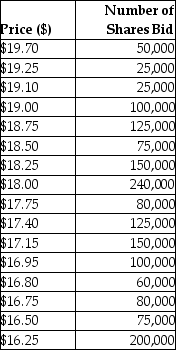 The proceeds from the IPO be if Luther is selling 1.25 million shares is closest to ________.
 (Multiple Choice)
4.9/5 (92)
(92) Simone founded her company using $200,000 of her own money, issuing herself 300,000 shares of stock. An angel investor bought an additional 100,000 shares for $150,000. She now sells another 400,000 shares of stock to a venture capitalist for $2 million. What percentage of the firm does Simone now own?
(Multiple Choice)
4.9/5 (83)
(83) The cost of issuing an IPO in the U.S. is higher than most other security issuance fees. A typical spread is ________.
(Multiple Choice)
4.7/5 (74)
(74) What is the difference between preferred stocks issued by a private company and a mature company?
(Essay)
4.9/5 (70)
(70) 
Filters
- Essay(0)
- Multiple Choice(0)
- Short Answer(0)
- True False(0)
- Matching(0)