



 Chat with AI
Exam 19: Working Capital Management

Exam 1: Corporate Finance and the Financial Manager86 Questions
Exam 2: Introduction to Financial Statement Analysis108 Questions
Exam 3: Time Value of Money: an Introduction112 Questions
Exam 4: Time Value of Money: Valuing Cash Flow Streams67 Questions
Exam 5: Interest Rates110 Questions
Exam 6: Bonds107 Questions
Exam 7: Stock Valuation64 Questions
Exam 8: Investment Decision Rules122 Questions
Exam 9: Fundamentals of Capital Budgeting113 Questions
Exam 10: Stock Valuation: a Second Look48 Questions
Exam 11: Risk and Return in Capital Markets110 Questions
Exam 12: Systematic Risk and the Equity Risk Premium104 Questions
Exam 13: The Cost of Capital110 Questions
Exam 14: Raising Equity Capital107 Questions
Exam 15: Debt Financing101 Questions
Exam 16: Capital Structure109 Questions
Exam 17: Payout Policy110 Questions
Exam 18: Financial Modeling and Pro Forma Analysis95 Questions
Exam 19: Working Capital Management108 Questions
Exam 20: Short-Term Financial Planning110 Questions
Exam 21: Option Applications and Corporate Finance102 Questions
Exam 22: Mergers and Acquisitions47 Questions
Exam 23: International Corporate Finance108 Questions
Exam 24: Leasing46 Questions
Exam 25: Insurance and Risk Management38 Questions
Exam 26: Corporate Governance45 Questions
Select questions type


A firm tries to extend its disbursement float in order to reduce its working capital needs. Which of the following is a risk that may be associated with this strategy, if it is taken too far?
(Multiple Choice)
4.9/5  (69)
(69) A firm currently sells its product with a 2% discount to customers who pay by cash or credit card when they purchase one of the firm's products; otherwise, the full price is due within 30 days. Forty percent of customers take advantage of the discount. The firm plans to drop the discount so the new terms will simply be net 30. In doing so it expects to sell 100 fewer units per month and all customers to pay at day 30. The firm currently sells 1000 units per month at a cost per unit of $45 and a selling price per unit of $80. If the firm's required return is 2%, what is the net present value (NPV)of making this change? (Assume that all 1,000 units are sold at the beginning of the month and the cost of producing the units is paid immediately.)
(Multiple Choice)
4.8/5 (73)
(73) Which of the following is NOT a motivation for holding cash?
(Multiple Choice)
4.8/5 (81)
(81) Which of the following is NOT a reason why a firm may typically choose not to stretch its accounts payable?
(Multiple Choice)
4.8/5 (74)
(74) Genovese Fine Foods, a manufacturer of foodstuffs, buys durham wheat flour on credit on June 1. It processes this flour to make pasta on June 6 and pays cash for the flour on June 15. On June 22 it sells the pasta to a chain of supermarkets, and on July 3 receives cash payment for this sale. What is the length of the cash cycle in this case?
(Multiple Choice)
4.9/5 (84)
(84) Bercraft Industries has an average accounts payable balance of $280,000. Its average annual cost of goods sold is $4,780,000. It receives terms of 1/20 net 40 from its suppliers. Is Bercraft managing its accounts payables well?
(Multiple Choice)
4.9/5 (86)
(86) Ally Manufacturing has an average accounts payable balance of $420,000. Its average annual cost of goods sold is $10,220,000. It receives terms of 2/15 net 30 from its suppliers. Is Ally managing its accounts payables well?
(Multiple Choice)
4.9/5 (79)
(79) Which of the following is/are direct costs associated with inventory?
I. Acquisition costs
II. Carrying costs
III. Order costs
(Multiple Choice)
4.9/5 (67)
(67) Use the table for the question(s)below.
Luther Industries had sales of $980 million and a cost of goods sold of $560 million in 2006.
A simplified balance sheet for the firm appears below:
Luther Industries
Balance Sheet
As of December 31, 2006
(millions of dollars) 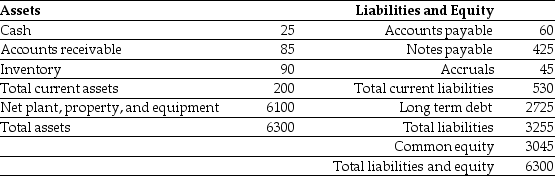 -Luther's Accounts Receivable days is closest to ________.
 (Multiple Choice)
4.8/5 (74)
(74) Your firm purchases goods from its supplier on terms of 2/10, net 40. The effective annual cost to your firm if it chooses not to take advantage of the trade discount offered and stretches the accounts payable to 60 days is closest to ________.
(Multiple Choice)
4.9/5 (99)
(99) A firm offers its customers 3/5 net 25. What is the cost of trade credit to a customer who chooses to pay on day 25?
(Multiple Choice)
4.8/5 (84)
(84) The level of cash a firm holds is irrelevant; it can never be short of cash since a firm is able to raise new money instantly at a fair rate, while it can never have surplus cash since the firm can invest excess cash at a fair rate to earn a net present value (NPV)of zero.
(True/False)
4.7/5 (71)
(71) What is the effective annual cost of credit terms of 3/15 net 30, if the firm stretches the accounts payable to 60 days?
(Multiple Choice)
4.9/5 (75)
(75) If a firm wishes to invest cash that might be needed at short notice in the very near future, they would be most likely to invest in which of the following securities?
(Multiple Choice)
4.9/5 (91)
(91) 
Filters
- Essay(0)
- Multiple Choice(0)
- Short Answer(0)
- True False(0)
- Matching(0)