



 Chat with AI
Exam 4: Time Value of Money: Valuing Cash Flow Streams

Exam 1: Corporate Finance and the Financial Manager86 Questions
Exam 2: Introduction to Financial Statement Analysis108 Questions
Exam 3: Time Value of Money: an Introduction112 Questions
Exam 4: Time Value of Money: Valuing Cash Flow Streams67 Questions
Exam 5: Interest Rates110 Questions
Exam 6: Bonds107 Questions
Exam 7: Stock Valuation64 Questions
Exam 8: Investment Decision Rules122 Questions
Exam 9: Fundamentals of Capital Budgeting113 Questions
Exam 10: Stock Valuation: a Second Look48 Questions
Exam 11: Risk and Return in Capital Markets110 Questions
Exam 12: Systematic Risk and the Equity Risk Premium104 Questions
Exam 13: The Cost of Capital110 Questions
Exam 14: Raising Equity Capital107 Questions
Exam 15: Debt Financing101 Questions
Exam 16: Capital Structure109 Questions
Exam 17: Payout Policy110 Questions
Exam 18: Financial Modeling and Pro Forma Analysis95 Questions
Exam 19: Working Capital Management108 Questions
Exam 20: Short-Term Financial Planning110 Questions
Exam 21: Option Applications and Corporate Finance102 Questions
Exam 22: Mergers and Acquisitions47 Questions
Exam 23: International Corporate Finance108 Questions
Exam 24: Leasing46 Questions
Exam 25: Insurance and Risk Management38 Questions
Exam 26: Corporate Governance45 Questions
Select questions type


A rich donor gives a hospital $1,040,000 one year from today. Each year after that, the hospital will receive a payment 6% larger than the previous payment, with the last payment occurring in ten years' time. What is the present value (PV)of this donation, given that the interest rate is 11%?
(Multiple Choice)
4.9/5  (80)
(80) Matthew wants to take out a loan to buy a car. He calculates that he can make repayments of $5000 per year. If he can get a four-year loan with an interest rate of 7.9%, what is the maximum price he can pay for the car?
(Multiple Choice)
4.8/5 (80)
(80) You are offered an investment opportunity that costs you $28,000, has a net present value (NPV)of $2278, lasts for three years, has interest rate of 10%, and produces the following cash flows: 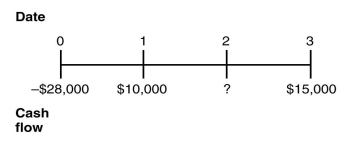 The missing cash flow from year 2 is closest to ________.
 (Multiple Choice)
4.9/5 (85)
(85) You are given two choices of investments, Investment A and Investment B. Both investments have the same future cash flows. Investment A has a discount rate of 4%, and Investment B has a discount rate of 5%. Which of the following is true?
(Multiple Choice)
4.9/5 (85)
(85) What is the present value (PV)of an investment that will pay $500 in one year's time, and $500 every year after that, when the interest rate is 10%?
(Multiple Choice)
4.7/5 (85)
(85) A perpetuity will pay $900 per year, starting five years after the perpetuity is purchased. What is the present value (PV)of this perpetuity on the date that it is purchased, given that the interest rate is 11%?
(Multiple Choice)
4.9/5 (79)
(79) Which of the following investments has a higher present value, assuming the same (strictly positive)interest rate applies to both investments? 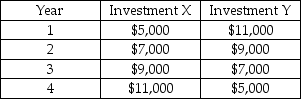
(Multiple Choice)
4.8/5 (80)
(80) 
Filters
- Essay(0)
- Multiple Choice(0)
- Short Answer(0)
- True False(0)
- Matching(0)