



 Chat with AI
Exam 13: Comparative Forms of Doing Business

Exam 1: Understanding and Working With the Federal Tax Law72 Questions
Exam 2: Corporations: Introduction and Operating Rules103 Questions
Exam 3: Corporations: Special Situations76 Questions
Exam 4: Corporations: Organization and Capital Structure91 Questions
Exam 5: Corporations: Earnings and Profits and Dividend Distributions82 Questions
Exam 6: Corporations: Redemptions and Liquidations107 Questions
Exam 7: Corporations: Reorganizations138 Questions
Exam 8: Consolidated Tax Returns143 Questions
Exam 9: Taxation of International Transactions142 Questions
Exam 10: Partnerships: Formation, operation, and Basis71 Questions
Exam 11: Partnerships: Distributions, transfer of Interests, and Terminations84 Questions
Exam 12: S Corporations161 Questions
Exam 13: Comparative Forms of Doing Business139 Questions
Exam 14: Exempt Entities159 Questions
Exam 15: Multistate Corporate Taxation169 Questions
Exam 16: Tax Practice and Ethics147 Questions
Exam 17: The Federal Gift and Estate Taxes199 Questions
Exam 18: Family Tax Planning168 Questions
Exam 19: Income Taxation of Trusts and Estates155 Questions
Select questions type


Aaron purchases a building for $500,000 which is going to be used by his wholly-owned corporation.Which of the following statements are correct?
(Multiple Choice)
5.0/5  (73)
(73) Owners make contributions to an entity in exchange for an ownership interest.Less stringent statutory requirements must be satisfied in the case of a limited liability company (LLC)than for an S corporation in order to postpone the recognition of a realized gain.
(True/False)
4.8/5 (64)
(64) Match the following tax attributes with the different forms. A particular attribute may apply to more than one entity form.
a.Ability of all owners to have limited liability.
b.Ability to pass tax attributes through to the owners.
c.Right of all owners to participate in the management of the business.
d.Number of owners is limited.
e.Ability to have multiple owners.
-S corporation.
(Short Answer)
4.8/5 (75)
(75) Match the following tax attributes with the different forms. A particular attribute may apply to more than one entity form.
a.Ability of all owners to have limited liability.
b.Ability to pass tax attributes through to the owners.
c.Right of all owners to participate in the management of the business.
d.Number of owners is limited.
e.Ability to have multiple owners.
-Sole proprietorship.
(Short Answer)
4.9/5 (83)
(83) If the IRS reclassifies debt as equity under § 385,the repayment of the debt by the corporation to the shareholder is treated as a dividend,assuming adequate E & P.
(True/False)
4.9/5 (91)
(91) Match the following statements:
a.For the corporate taxpayer, are taxed using the regular tax rates.
b.Must be capitalized, but can be amortized over 180 months.
c.For the corporate taxpayer, the rate is 20%.
d.For the corporate taxpayer, cannot be deducted at all in the current tax year.
e.For the corporate taxpayer, limited to 10% of taxable income before certain deductions.
-Net capital loss.
(Short Answer)
4.7/5 (89)
(89) Bev and Cabel each own one-half of the stock of Finch,Inc.,a C corporation.Each shareholder has a stock basis of $225,000.Finch has accumulated E & P of $600,000.Finch's taxable income for the current year is $100,000,and it distributes $180,000 to each shareholder.Bev's stock basis at the end of the year is:
(Multiple Choice)
4.8/5 (95)
(95) Steve and Karen are going to establish a business entity.They expect the business to be very successful in the long-run,but project losses of approximately $100,000 for each of the first five years.Due to potential environmental concerns,limited liability is a requisite for the owners.Which form of business entity should they select?
(Multiple Choice)
4.8/5 (89)
(89) Bev and Cabel each own one-half of the stock of Finch,Inc.,an S Corporation.Each shareholder has a stock basis of $225,000.Finch has no accumulated E & P.Finch's taxable income for the current year is $100,000,and it distributes $180,000 to each shareholder.Bev's stock basis at the end of the year is:
(Multiple Choice)
4.9/5 (77)
(77) Thrush,Inc.,provides group-term life insurance of $50,000 for all of its employees.The total cost of such coverage is $15,000.Wren,Inc.,does not provide such coverage.Instead,it increases the employees' salaries by $15,000 so the employees can purchase such coverage if they choose to do so.The corporations are in the 34% tax bracket,and the shareholders are in the 28% tax bracket.Compare the effects of the two different fringe benefit policies on the corporations and on the employees.
(Essay)
4.8/5 (84)
(84) An S corporation is not subject to the AMT,but its shareholders are in that the S corporation's AMT adjustments and preferences are passed through to them.
(True/False)
5.0/5 (84)
(84) Rebecca and Stan each own a 50% interest in a business entity.Rebecca contributed $200,000 for her ownership interest and Stan contributed land worth $200,000 (adjusted basis of $150,000).Several months after the formation of the entity,the land is sold for $220,000.
(Multiple Choice)
4.8/5 (87)
(87) Match the following statements:
a.For the corporate taxpayer, are taxed using the regular tax rates.
b.Must be capitalized, but can be amortized over 180 months.
c.For the corporate taxpayer, the rate is 20%.
d.For the corporate taxpayer, cannot be deducted at all in the current tax year.
e.For the corporate taxpayer, limited to 10% of taxable income before certain deductions.
-Net capital gain.
(Short Answer)
4.8/5 (81)
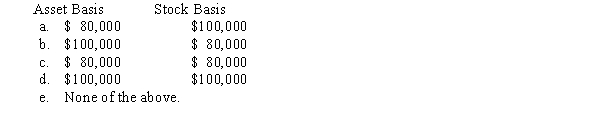
(81) Alanna contributes property with an adjusted basis of $80,000 and a fair market value of $100,000 to a newly formed business entity.If the entity is a partnership and the transaction qualifies under § 721,the partnership's basis for the property and the partner's basis for the partnership interest are:
(Short Answer)
4.9/5 (61)
(61) The legal form of Amy and Beth's business entity is an LLC.Under the check-the-box Regulations,what options are available to them for Federal income tax purposes? Which option would you normally recommend?
(Essay)
4.7/5 (84)
(84) A disadvantage of corporations (both C corporations and S corporations)is that they are subject to double taxation on their earnings.
(True/False)
4.7/5 (78)
(78) Match the following statements:
a.For the corporate taxpayer, are taxed using the regular tax rates.
b.Must be capitalized, but can be amortized over 180 months.
c.For the corporate taxpayer, the rate is 20%.
d.For the corporate taxpayer, cannot be deducted at all in the current tax year.
e.For the corporate taxpayer, limited to 10% of taxable income before certain deductions.
-Organization costs.
(Short Answer)
4.8/5 (91)
(91) Beige,Inc.,has 3,000 shares of stock authorized and 1,000 shares outstanding.The shares are owned by Sam (600 shares)and Lois (400 shares).Sam's adjusted basis for his stock is $60,000 and Lois' adjusted basis for her stock is $40,000.Beige's earnings and profits are $300,000.Beige redeems 200 of Lois' shares for $100,000.Determine the amount of Lois' recognized gain (1)if she is Sam's mother and (2)if they are unrelated.
(Multiple Choice)
4.9/5 (92)
(92) Lisa is considering investing $25,000 in a limited partnership which is raising additional capital.According to the prospectus,for the past 10-year period the average earnings have been 15% and for the past 5-year period the average earnings have been 8%.Lisa is in the 33% tax bracket.
a. List some factors Lisa should consider in making a decision on the potential investment.
b. Assuming the partnership finances its activities with equity rather than debt, what is the maximum cash flow benefit Lisa can receive if the partnership generates losses?
(Essay)
4.8/5 (74)
(74) 
Filters
- Essay(0)
- Multiple Choice(0)
- Short Answer(0)
- True False(0)
- Matching(0)