



 Chat with AI
Exam 14: Chemical Kinetics

Exam 1: Introduction: Matter, energy, and Measurement163 Questions
Exam 2: Atoms, molecules, and Ions249 Questions
Exam 3: Chemical Reactions and Reaction Stoichiometry178 Questions
Exam 4: Reactions in Aqueous Solution178 Questions
Exam 5: Thermochemistry154 Questions
Exam 6: Electronic Structure of Atoms186 Questions
Exam 7: Periodic Properties of the Elements176 Questions
Exam 8: Basic Concepts of Chemical Bonding146 Questions
Exam 9: Molecular Geometry and Bonding Theories183 Questions
Exam 10: Gases175 Questions
Exam 11: Liquids and Intermolecular Forces124 Questions
Exam 12: Solids and Modern Materials84 Questions
Exam 13: Properties of Solutions160 Questions
Exam 14: Chemical Kinetics134 Questions
Exam 15: Chemical Equilibrium97 Questions
Exam 16: Acid-Base Equilibria139 Questions
Exam 17: Additional Aspects of Aqueous Equilibria116 Questions
Exam 18: Chemistry of the Environment126 Questions
Exam 19: Chemical Thermodynamics125 Questions
Exam 20: Electrochemistry113 Questions
Exam 21: Nuclear Chemistry178 Questions
Exam 22: Chemistry of the Nonmetals194 Questions
Exam 23: Transition Metals and Coordination Chemistry165 Questions
Exam 24: The Chemistry of Life: Organic and Biological Chemistry131 Questions
Select questions type


At elevated temperatures,nitrogen dioxide decomposes to nitrogen oxide and oxygen: NO2 (g)→ NO (g)+  O2 (g)
The reaction is second order in NO2 with a rate constant of 0.543 M-1s-1at
 If the initial [NO2] is
 it will take ________ s for the concentration to drop to

O2 (g)
The reaction is second order in NO2 with a rate constant of 0.543 M-1s-1at If the initial [NO2] is it will take ________ s for the concentration to drop to (Multiple Choice)
4.8/5  (81)
(81) The graph shown below depicts the relationship between concentration and time for the following chemical reaction.  The slope of this line is equal to ________.
 (Multiple Choice)
4.9/5 (92)
(92) The overall reaction order is the sum of the orders of each reactant in the rate law.
(True/False)
4.8/5 (72)
(72) The rate of disappearance of HBr in the gas phase reaction 2HBr (g)→ H2 (g)+ Br2 (g)
Is 0.140 M  at 150 °C.The rate of reaction is ________ M
 .
at 150 °C.The rate of reaction is ________ M . (Multiple Choice)
4.8/5 (66)
(66) The instantaneous rate of a reaction can be read directly from the graph of molarity versus time at any point on the graph.
(True/False)
4.8/5 (83)
(83) The combustion of ethylene proceeds by the reaction C2H4 (g)+ 3O2 (g)→ 2CO2 (g)+ 2H2O (g)
When the rate of disappearance of O2 is 0.13 M  ,the rate of disappearance of C2H4 is ________

,the rate of disappearance of C2H4 is ________ (Multiple Choice)
4.8/5 (88)
(88) In general,as activation energy increases,reaction rate ________.
(Multiple Choice)
4.9/5 (83)
(83) At elevated temperatures,methylisonitrile (CH3NC)isomerizes to acetonitrile (CH3CN): CH3NC (g)→ CH3CN (g)
At the start of an experiment,there are 0.200 mol of reactant and 0 mol of product in the reaction vessel.After 25 min,0.121 mol of reactant (CH3NC)remain.There are ________ mol of product (CH3CN)in the reaction vessel.
(Multiple Choice)
4.8/5 (81)
(81) What is the magnitude of the rate constant for the reaction?
(Multiple Choice)
4.8/5 (80)
(80) The reaction A → B is first order in [A].Consider the following data. 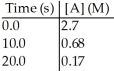 The rate constant for this reaction is ________
 .
The rate constant for this reaction is ________ . (Multiple Choice)
4.8/5 (92)
(92) As the temperature of a reaction is increased,the rate of the reaction increases because the ________.
(Multiple Choice)
4.7/5 (79)
(79) The reaction 2NOBr (g)→ 2 NO (g)+ Br2 (g)
Is a second-order reaction with a rate constant of 0.80 M-1s-1 at 11 °C.If the initial concentration of NOBr is 0.0440 M,the concentration of NOBr after 6.0 seconds is ________.
(Multiple Choice)
4.7/5 (81)
(81) The half-life for a first order rate law depends on the starting concentration.
(True/False)
4.9/5 (71)
(71) At elevated temperatures,methylisonitrile (CH3NC)isomerizes to acetonitrile (CH3CN): CH3NC (g)→ CH3CN (g)
The reaction is first order in methylisonitrile.The attached graph shows data for the reaction obtained at 198.9 °C. 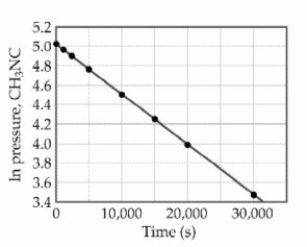 What is the rate constant (s-1)for the reaction?
 (Multiple Choice)
4.8/5 (87)
(87) It was determined experimentally that the reaction rate doubled when the concentration of B was doubled in the following reaction: A + B → C
The reaction is ________ order in B.
(Multiple Choice)
4.7/5 (94)
(94) Which energy difference in the energy profile below corresponds to the activation energy for the forward reaction? 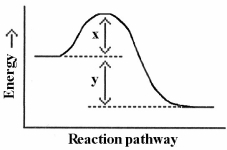
(Multiple Choice)
5.0/5 (87)
(87) The overall reaction below is ________ and the elementary reaction is considered ________. AB → A + B
(Multiple Choice)
5.0/5 (79)
(79) 
Filters
- Essay(0)
- Multiple Choice(0)
- Short Answer(0)
- True False(0)
- Matching(0)