



 Chat with AI
Exam 6: Work and Energy

Exam 1: Introduction and Mathematical Concepts70 Questions
Exam 2: Kinematics in One Dimension103 Questions
Exam 3: Kinematics in Two Dimensions68 Questions
Exam 4: Forces and Newtons Laws of Motion103 Questions
Exam 5: Dynamics of Uniform Circular Motion59 Questions
Exam 6: Work and Energy78 Questions
Exam 7: Impulse and Momentum66 Questions
Exam 8: Rotational Kinematics55 Questions
Exam 9: Rotational Dynamics57 Questions
Exam 10: Simple Harmonic Motion and Elasticity63 Questions
Exam 11: Fluids65 Questions
Exam 12: Temperature and Heat66 Questions
Exam 13: The Transfer of Heat42 Questions
Exam 14: The Ideal Gas Law and Kinetic Theory55 Questions
Exam 15: Thermodynamics79 Questions
Exam 16: Waves and Sound67 Questions
Exam 17: The Principle of Linear Superposition and Interference Phenomena46 Questions
Exam 18: Electric Forces and Electric Fields61 Questions
Exam 19: Electric Potential Energy and the Electric Potential70 Questions
Exam 20: Electric Circuits100 Questions
Exam 21: Magnetic Forces and Magnetic Fields66 Questions
Exam 22: Electromagnetic Induction71 Questions
Exam 23: Alternating Current Circuits84 Questions
Exam 24: Electromagnetic Waves66 Questions
Exam 25: The Refl Ection of Light: Mirrors43 Questions
Exam 26: The Refraction of Light: Lenses and Optical Instruments102 Questions
Exam 27: Interference and the Wave Nature of Light57 Questions
Exam 28: Special Relativity63 Questions
Exam 29: Particles and Waves54 Questions
Exam 30: The Nature of the Atom74 Questions
Exam 31: Nuclear Physics and Radioactivity37 Questions
Exam 32: Ionizing Radiation, Nuclear Energy, and Elementary Particles45 Questions
Select questions type


A 12.5-kg crate slides along a horizontal frictionless surface at a constant speed of 4.0 m/s. The crate then slides down a frictionless incline and across a second horizontal surface as shown in the figure. 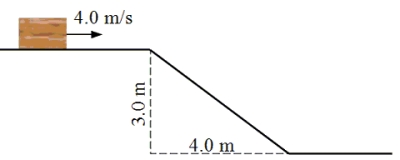 -What is the kinetic energy of the crate as it slides on the upper surface?
 (Multiple Choice)
4.9/5  (92)
(92) A pebble rolls off the roof of Science Hall and falls vertically. Just before it reaches the ground, the pebble's speed is 17 m/s. Neglect air resistance and determine the height of Science Hall.
(Multiple Choice)
4.9/5 (66)
(66) A physics student shoves a 0.50-kg block from the bottom of a frictionless 30.0° inclined plane. The student performs 4.0 J of work and the block slides a distance s along the incline before it stops. Determine the value of s. 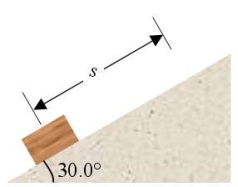
(Multiple Choice)
4.9/5 (88)
(88) Julie carries an 8.0-kg suitcase as she walks 18 m along a horizontal walkway to her hotel room at a constant speed of 1.5 m/s. How much work does Julie do in carrying her suitcase?
(Multiple Choice)
4.7/5 (84)
(84) A 5.00-kg block of ice is sliding across a frozen pond at 2.00 m/s. A 7.60-N force is applied in the direction of motion. After the ice block slides 15.0 m, the force is removed. The work done by the applied force is
(Multiple Choice)
4.8/5 (82)
(82) A 1.0-kg ball on the end of a string is whirled at a constant speed of 2.0 m/s in a horizontal circle of radius 1.5 m. What is the work done by the centripetal force during one revolution?
(Multiple Choice)
5.0/5 (83)
(83) A top fuel dragster with a mass of 500.0 kg starts from rest and completes a quarter mile (402 m) race in a time of 5.0 s. The dragster's final speed is 130 m/s. Neglecting friction, what average power was needed to produce this final speed?
(Multiple Choice)
4.9/5 (82)
(82) An escalator is 30.0 meters long and slants at 30.0° relative to the horizontal. If it moves at 1.00 m/s, at what rate does it do work in lifting a 50.0-kg woman from the bottom to the top of the escalator?
(Multiple Choice)
4.9/5 (78)
(78) Complete the following statement: Work may be expressed using all of the following units except
(Multiple Choice)
4.7/5 (86)
(86) Two balls of equal size are dropped from the same height from the roof of a building. One ball has twice the mass of the other. When the balls reach the ground, how do the kinetic energies of the two balls compare?
(Multiple Choice)
4.8/5 (73)
(73) An experimental 1500-kg car travels at a constant speed of 22 m/s around a circular test track that is 80 m across. What is the kinetic energy of the car?
(Multiple Choice)
4.7/5 (70)
(70) A 0.50-kg ball on the end of a rope is moving in a vertical circle of radius 3.0 m near the surface of the Earth where the acceleration due to gravity, g, is 9.8 m/s2. Point A is at the top of the circle; C is at the bottom. Points B and D are exactly halfway between A and C. 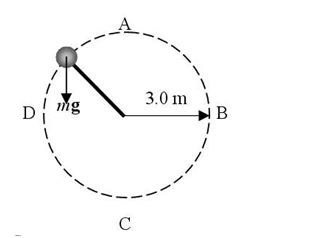 -Which one of the following statements concerning the tension in the rope is true?
 (Multiple Choice)
4.8/5 (91)
(91) What power is needed to lift a 49-kg person a vertical distance of 5.0 m in 20.0 s?
(Multiple Choice)
4.9/5 (83)
(83) A force with a magnitude of 25 N and directed at an angle of 37° above the horizontal is used to move a 10-kg crate along a horizontal surface at constant velocity. How much work is done by this force in moving the crate a distance of 15 m?
(Multiple Choice)
4.9/5 (78)
(78) What coefficient of friction would be required to keep the crate moving at constant speed under the action of the 325-N force?
(Multiple Choice)
4.7/5 (78)
(78) A 325-N force accelerates a 50.0-kg crate from rest along a horizontal frictionless surface for a distance of 20.0 m as shown in the figure. 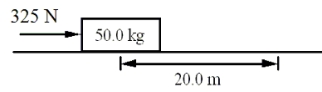 -What is the final speed of the crate?
 (Multiple Choice)
4.9/5 (67)
(67) The amount of energy needed to power a 0.10-kW bulb for one minute would be just sufficient to lift a 1.0-kg object through a vertical distance of
(Multiple Choice)
4.8/5 (81)
(81) A bicyclist is traveling at a speed of 20.0 m/s as he approaches the bottom of a hill. He decides to coast up the hill and stops upon reaching the top. Neglecting friction, determine the vertical height of the hill.
(Multiple Choice)
4.9/5 (73)
(73) Which one of the following situations is an example of an object with a non-zero kinetic energy?
(Multiple Choice)
4.9/5 (72)
(72) 
Filters
- Essay(0)
- Multiple Choice(0)
- Short Answer(0)
- True False(0)
- Matching(0)