



 Chat with AI
Exam 6: Work and Energy

Exam 1: Introduction and Mathematical Concepts70 Questions
Exam 2: Kinematics in One Dimension103 Questions
Exam 3: Kinematics in Two Dimensions68 Questions
Exam 4: Forces and Newtons Laws of Motion103 Questions
Exam 5: Dynamics of Uniform Circular Motion59 Questions
Exam 6: Work and Energy78 Questions
Exam 7: Impulse and Momentum66 Questions
Exam 8: Rotational Kinematics55 Questions
Exam 9: Rotational Dynamics57 Questions
Exam 10: Simple Harmonic Motion and Elasticity63 Questions
Exam 11: Fluids65 Questions
Exam 12: Temperature and Heat66 Questions
Exam 13: The Transfer of Heat42 Questions
Exam 14: The Ideal Gas Law and Kinetic Theory55 Questions
Exam 15: Thermodynamics79 Questions
Exam 16: Waves and Sound67 Questions
Exam 17: The Principle of Linear Superposition and Interference Phenomena46 Questions
Exam 18: Electric Forces and Electric Fields61 Questions
Exam 19: Electric Potential Energy and the Electric Potential70 Questions
Exam 20: Electric Circuits100 Questions
Exam 21: Magnetic Forces and Magnetic Fields66 Questions
Exam 22: Electromagnetic Induction71 Questions
Exam 23: Alternating Current Circuits84 Questions
Exam 24: Electromagnetic Waves66 Questions
Exam 25: The Refl Ection of Light: Mirrors43 Questions
Exam 26: The Refraction of Light: Lenses and Optical Instruments102 Questions
Exam 27: Interference and the Wave Nature of Light57 Questions
Exam 28: Special Relativity63 Questions
Exam 29: Particles and Waves54 Questions
Exam 30: The Nature of the Atom74 Questions
Exam 31: Nuclear Physics and Radioactivity37 Questions
Exam 32: Ionizing Radiation, Nuclear Energy, and Elementary Particles45 Questions
Select questions type


A 51-kg woman runs up a flight of stairs in 5.0 s. Her net upward displacement is 5.0 m. Approximately, what average power did the woman exert while she was running?
(Multiple Choice)
4.9/5  (83)
(83) A 12.5-kg crate slides along a horizontal frictionless surface at a constant speed of 4.0 m/s. The crate then slides down a frictionless incline and across a second horizontal surface as shown in the figure. 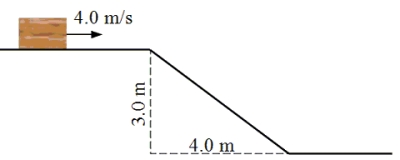 -What is the speed of the crate when it arrives at the lower surface?
 (Multiple Choice)
4.8/5 (87)
(87) The kinetic energy of a car is 8 × 10⁶ J as it travels along a horizontal road. How much work is required to stop the car in 10 s?
(Multiple Choice)
5.0/5 (84)
(84) Which one of the following statements concerning kinetic energy is true?
(Multiple Choice)
4.8/5 (79)
(79) An engineer is asked to design a playground slide such that the speed a child reaches at the bottom does not exceed 6.0 m/s. Determine the maximum height that the slide can be.
(Multiple Choice)
4.8/5 (100)
(100) In which one of the following systems is there a decrease in gravitational potential energy?
(Multiple Choice)
5.0/5 (81)
(81) A car is traveling at 7.0 m/s when the driver applies the brakes. The car moves 1.5 m before it comes to a complete stop. If the car had been moving at 14 m/s, how far would it have continued to move after the brakes were applied? Assume the braking force in both cases is constant and the same.
(Multiple Choice)
4.8/5 (71)
(71) Which one of the following choices is an example of a non-conservative force?
(Multiple Choice)
4.9/5 (82)
(82) A block of mass m is released from rest at a height R above a horizontal surface. The acceleration due to gravity is g. The block slides along the inside of a frictionless circular hoop of radius R. 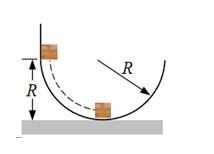 -What is the magnitude of the normal force exerted on the block by the hoop when the block reaches the bottom of the hoop?
 (Multiple Choice)
4.9/5 (76)
(76) The force component acting on an object along the displacement varies with the displacement s as shown in the graph. Determine the work done on the object as it travels from s = 0.0 to 12 m. 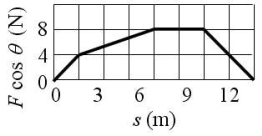
(Multiple Choice)
4.7/5 (86)
(86) Which one of the following choices is an example of a conservative force?
(Multiple Choice)
4.8/5 (76)
(76) The kinetic energy of a car is 8 × 10⁶ J as it travels along a horizontal road. How much power is required to stop the car in 10 s?
(Multiple Choice)
4.9/5 (78)
(78) A concrete block is pulled 7.0 m across a frictionless surface by means of a rope. The tension in the rope is 40 N; and the net work done on the block is 247 J. What angle does the rope make with the horizontal? 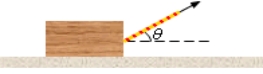
(Multiple Choice)
4.9/5 (83)
(83) A 325-N force accelerates a 50.0-kg crate from rest along a horizontal frictionless surface for a distance of 20.0 m as shown in the figure. 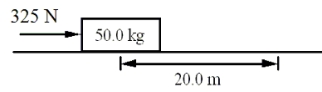 -How much work is done on the crate?
 (Multiple Choice)
4.8/5 (80)
(80) A motorist driving a 1000-kg car wishes to increase her speed from 20 m/s to 30 m/s in 5 s. Determine the horsepower required to accomplish this increase. Neglect friction.
(Multiple Choice)
4.7/5 (67)
(67) A 12.5-kg crate slides along a horizontal frictionless surface at a constant speed of 4.0 m/s. The crate then slides down a frictionless incline and across a second horizontal surface as shown in the figure.
-What minimum coefficient of kinetic friction is required to bring the crate to a stop over a distance of 5.0 m along the lower surface?
-What minimum coefficient of kinetic friction is required to bring the crate to a stop over a distance of 5.0 m along the lower surface? (Multiple Choice)
4.8/5 (73)
(73) A 2.0-kg projectile is fired with initial velocity components vox = 30 m/s and voy = 40 m/s from a point on the earth's surface. Neglect any effects due to air resistance.
-How much work was done in firing the projectile?
(Multiple Choice)
4.9/5 (81)
(81) The initial velocity of a 4.0-kg box is 11 m/s, due west. After the box slides 4.0 m horizontally, its speed is 1.5 m/s. Determine the magnitude and the direction of the non-conservative force acting on the box as it slides.
(Multiple Choice)
4.7/5 (74)
(74) Two boxes are connected to each other as shown. The system is released from rest and the 1.00-kg box falls through a distance of 1.00 m. The surface of the table is frictionless. What is the kinetic energy of box B just before it reaches the floor? 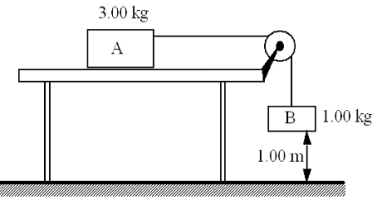
(Multiple Choice)
4.7/5 (71)
(71) 
Filters
- Essay(0)
- Multiple Choice(0)
- Short Answer(0)
- True False(0)
- Matching(0)