



 Chat with AI
Exam 16: Waves and Sound

Exam 1: Introduction and Mathematical Concepts70 Questions
Exam 2: Kinematics in One Dimension103 Questions
Exam 3: Kinematics in Two Dimensions68 Questions
Exam 4: Forces and Newtons Laws of Motion103 Questions
Exam 5: Dynamics of Uniform Circular Motion59 Questions
Exam 6: Work and Energy78 Questions
Exam 7: Impulse and Momentum66 Questions
Exam 8: Rotational Kinematics55 Questions
Exam 9: Rotational Dynamics57 Questions
Exam 10: Simple Harmonic Motion and Elasticity63 Questions
Exam 11: Fluids65 Questions
Exam 12: Temperature and Heat66 Questions
Exam 13: The Transfer of Heat42 Questions
Exam 14: The Ideal Gas Law and Kinetic Theory55 Questions
Exam 15: Thermodynamics79 Questions
Exam 16: Waves and Sound67 Questions
Exam 17: The Principle of Linear Superposition and Interference Phenomena46 Questions
Exam 18: Electric Forces and Electric Fields61 Questions
Exam 19: Electric Potential Energy and the Electric Potential70 Questions
Exam 20: Electric Circuits100 Questions
Exam 21: Magnetic Forces and Magnetic Fields66 Questions
Exam 22: Electromagnetic Induction71 Questions
Exam 23: Alternating Current Circuits84 Questions
Exam 24: Electromagnetic Waves66 Questions
Exam 25: The Refl Ection of Light: Mirrors43 Questions
Exam 26: The Refraction of Light: Lenses and Optical Instruments102 Questions
Exam 27: Interference and the Wave Nature of Light57 Questions
Exam 28: Special Relativity63 Questions
Exam 29: Particles and Waves54 Questions
Exam 30: The Nature of the Atom74 Questions
Exam 31: Nuclear Physics and Radioactivity37 Questions
Exam 32: Ionizing Radiation, Nuclear Energy, and Elementary Particles45 Questions
Select questions type


The car in the drawing is moving to the left at 35 m/s. The car's horn continuously emits a 2.20 × 10² Hz sound. The figure also shows the first two regions of compression of the emitted sound waves. The speed of sound is 343 m/s. 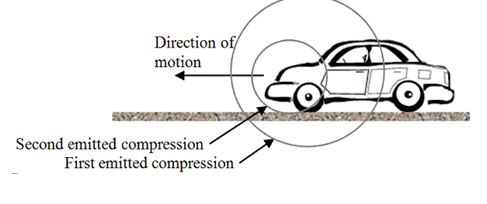 -What is the frequency heard by a stationary observer standing in front of the car?
 (Multiple Choice)
4.8/5  (67)
(67) The tension in a taut rope is increased by a factor of 9. How does the speed of wave pulses on the rope change, if at all?
(Multiple Choice)
4.8/5 (80)
(80) A periodic transverse wave is established on a string such that there are exactly two cycles traveling along a 3.0-m section of the string. The crests move at 20.0 m/s.
-How long does it take a particle at the top of a crest to reach the bottom of an adjacent trough?
(Multiple Choice)
5.0/5 (74)
(74) The displacement of a vibrating string versus position along the string is shown in the figure. The periodic waves have a speed of 10.0 cm/s. A and B are two points on the string. 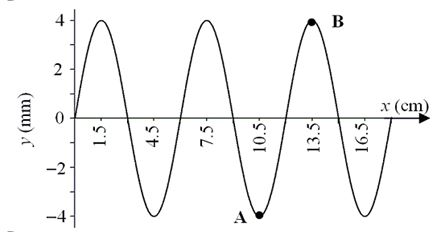 -What is the wavelength of the wave?
 (Multiple Choice)
4.9/5 (82)
(82) The speaker and two microphones shown in the figure are arranged inside a sealed container filled with neon gas. The wires from the microphones are connected to an oscilloscope (not shown). The signal from the microphones is monitored beginning at time t = 0 s when a sound pulse is emitted from the speaker. The pulse is picked up by microphone 1 at t1 = 1.150 × 10⁻² s and by microphone 2 at t2 = 1.610 × 10⁻² s. What is the speed of sound in neon gas? 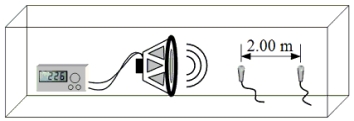
(Multiple Choice)
4.7/5 (71)
(71) Which one of the following statements concerning waves is false?
(Multiple Choice)
4.9/5 (73)
(73) A transverse periodic wave described by the expression 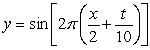 (where y and x are in meters and t is in seconds) is established on a string. Which one of the following statements concerning this wave is false?
 (Multiple Choice)
4.8/5 (86)
(86) 
Filters
- Essay(0)
- Multiple Choice(0)
- Short Answer(0)
- True False(0)
- Matching(0)