



 Chat with AI
Exam 16: Waves and Sound

Exam 1: Introduction and Mathematical Concepts70 Questions
Exam 2: Kinematics in One Dimension103 Questions
Exam 3: Kinematics in Two Dimensions68 Questions
Exam 4: Forces and Newtons Laws of Motion103 Questions
Exam 5: Dynamics of Uniform Circular Motion59 Questions
Exam 6: Work and Energy78 Questions
Exam 7: Impulse and Momentum66 Questions
Exam 8: Rotational Kinematics55 Questions
Exam 9: Rotational Dynamics57 Questions
Exam 10: Simple Harmonic Motion and Elasticity63 Questions
Exam 11: Fluids65 Questions
Exam 12: Temperature and Heat66 Questions
Exam 13: The Transfer of Heat42 Questions
Exam 14: The Ideal Gas Law and Kinetic Theory55 Questions
Exam 15: Thermodynamics79 Questions
Exam 16: Waves and Sound67 Questions
Exam 17: The Principle of Linear Superposition and Interference Phenomena46 Questions
Exam 18: Electric Forces and Electric Fields61 Questions
Exam 19: Electric Potential Energy and the Electric Potential70 Questions
Exam 20: Electric Circuits100 Questions
Exam 21: Magnetic Forces and Magnetic Fields66 Questions
Exam 22: Electromagnetic Induction71 Questions
Exam 23: Alternating Current Circuits84 Questions
Exam 24: Electromagnetic Waves66 Questions
Exam 25: The Refl Ection of Light: Mirrors43 Questions
Exam 26: The Refraction of Light: Lenses and Optical Instruments102 Questions
Exam 27: Interference and the Wave Nature of Light57 Questions
Exam 28: Special Relativity63 Questions
Exam 29: Particles and Waves54 Questions
Exam 30: The Nature of the Atom74 Questions
Exam 31: Nuclear Physics and Radioactivity37 Questions
Exam 32: Ionizing Radiation, Nuclear Energy, and Elementary Particles45 Questions
Select questions type


A wave moves at a constant speed along a string. Which one of the following statements is false concerning the motion of particles in the string?
(Multiple Choice)
4.8/5  (78)
(78) The displacement of a vibrating string versus position along the string is shown in the figure. The periodic waves have a speed of 10.0 cm/s. A and B are two points on the string. 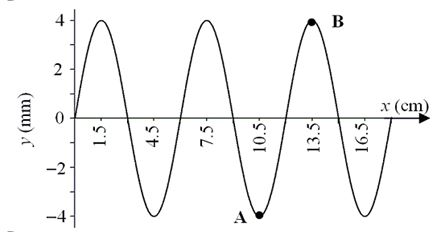 -What is the frequency of the wave?
 (Multiple Choice)
4.9/5 (75)
(75) The intensity of a spherical wave 2.5 m from the source is 120 W/m2. What is the intensity at a point 9.0 m away from the source?
(Multiple Choice)
4.9/5 (68)
(68) When one person was talking in a small room, the sound intensity level was 60 dB everywhere within the room. Then, there were 14 people talking in similar manner simultaneously in the room, what was the resulting sound intensity level?
(Multiple Choice)
4.9/5 (98)
(98) The speed of sound in a certain metal block is 2.00 × 10³ m/s. The graph shows the amplitude (in meters) of a wave traveling through the block versus time (in milliseconds). What is the wavelength of this wave? 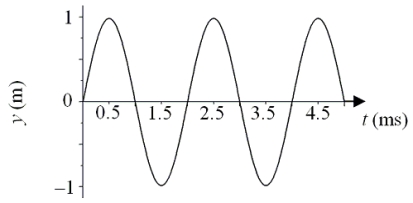
(Multiple Choice)
4.9/5 (84)
(84) The displacement of a vibrating string versus position along the string is shown in the figure. The periodic waves have a speed of 10.0 cm/s. A and B are two points on the string.
-What is the amplitude of the wave?
-What is the amplitude of the wave? (Multiple Choice)
4.9/5 (80)
(80) A wave has an amplitude of 0.35 m, a frequency of 1.05 × 10⁶ Hz, and travels in the positive x direction at the speed of light, 3.00 × 10⁸ m/s. Which one of the following equations correctly represents this wave?
(Multiple Choice)
4.7/5 (77)
(77) A transverse wave is traveling in the -x direction on a string that has a linear density of 0.011 kg/m. The tension in the string is 7.4 N. The amplitude of the wave is 0.017 m; and its wavelength is 1.5 m. Which one of the following is the correct equation for the displacement of a particle from its equilibrium position?
(Multiple Choice)
4.9/5 (80)
(80) A steel wire of mass 0.400 kg and length 0.640 m supports a 102-kg block. The wire is struck exactly at its midpoint causing a small displacement. How long does it take the peak of this displacement to reach the top of the wire? 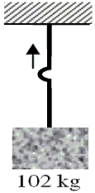
(Multiple Choice)
4.9/5 (82)
(82) A source moving through water at 10.0 m/s generates water waves with a frequency of 5.0 Hz. The speed of these water waves relative to the water surface is 20.0 m/s. The source approaches an observer who is at rest in the water. What wavelength would be measured for these waves by the stationary observer?
(Multiple Choice)
4.9/5 (72)
(72) A periodic transverse wave is established on a string such that there are exactly two cycles traveling along a 3.0-m section of the string. The crests move at 20.0 m/s.
-How could the speed of the wave be increased?
(Multiple Choice)
4.8/5 (77)
(77) The displacement of a vibrating string versus position along the string is shown in the figure. The periodic waves have a speed of 10.0 cm/s. A and B are two points on the string.
-What is the difference in phase between the points A and B?
-What is the difference in phase between the points A and B? (Multiple Choice)
5.0/5 (73)
(73) The Young's modulus of aluminum (density = 2700 kg/m3) is 6.9 × 10¹⁰ N/m2. Determine the speed of sound in an aluminum rod.
(Multiple Choice)
4.9/5 (68)
(68) The diagram shows the various positions of a child in motion on a swing. Somewhere in front of the child a stationary whistle is blowing. 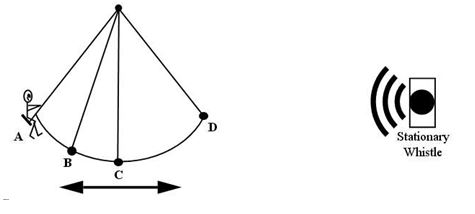 -At which position(s) will the child hear the lowest frequency for the sound from the whistle?
 (Multiple Choice)
4.8/5 (86)
(86) A periodic traveling wave is generated on a string of linear density 8.0 × 10⁻⁴ kg/m. Figure A shows the displacements of the particles in the string as a function of the position x along the string at t = 0 s. Figure B shows the displacement of the particle at x = 0 m as a function of time. The particle positions are measured from the left end of the string (x = 0 m) and the wave pulses move to the right. 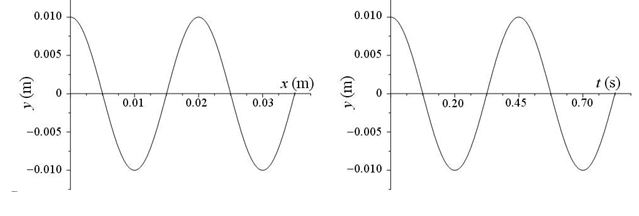 -What is the wavelength of the wave?
 (Multiple Choice)
4.9/5 (81)
(81) A periodic transverse wave is established on a string such that there are exactly two cycles traveling along a 3.0-m section of the string. The crests move at 20.0 m/s.
-What is the frequency of the wave?
(Multiple Choice)
5.0/5 (79)
(79) The car in the drawing is moving to the left at 35 m/s. The car's horn continuously emits a 2.20 × 10² Hz sound. The figure also shows the first two regions of compression of the emitted sound waves. The speed of sound is 343 m/s. 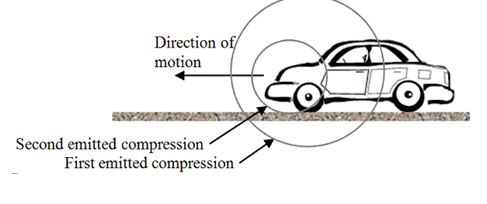 -What is the wavelength of the sound in the direction of motion of the car?
 (Multiple Choice)
4.8/5 (75)
(75) A stationary railroad whistle is sounded. An echo is heard 5.0 seconds later by the train's engineer. If the speed of sound is 343 m/s, how far away is the reflecting surface?
(Multiple Choice)
4.7/5 (92)
(92) Two children setup a "telephone" by placing a long, slender aluminum (Y = 6.9 × 10¹⁰ N/m2) rod that has a length of 6.1-m between their two houses. To communicate, a child taps a coded message on one end. How long do the sound waves take to reach the other end? Note: the density of aluminum is 2700 kg/m3.
(Multiple Choice)
4.8/5 (80)
(80) 
Filters
- Essay(0)
- Multiple Choice(0)
- Short Answer(0)
- True False(0)
- Matching(0)