



 Chat with AI
Exam 18: Electric Forces and Electric Fields

Exam 1: Introduction and Mathematical Concepts70 Questions
Exam 2: Kinematics in One Dimension103 Questions
Exam 3: Kinematics in Two Dimensions68 Questions
Exam 4: Forces and Newtons Laws of Motion103 Questions
Exam 5: Dynamics of Uniform Circular Motion59 Questions
Exam 6: Work and Energy78 Questions
Exam 7: Impulse and Momentum66 Questions
Exam 8: Rotational Kinematics55 Questions
Exam 9: Rotational Dynamics57 Questions
Exam 10: Simple Harmonic Motion and Elasticity63 Questions
Exam 11: Fluids65 Questions
Exam 12: Temperature and Heat66 Questions
Exam 13: The Transfer of Heat42 Questions
Exam 14: The Ideal Gas Law and Kinetic Theory55 Questions
Exam 15: Thermodynamics79 Questions
Exam 16: Waves and Sound67 Questions
Exam 17: The Principle of Linear Superposition and Interference Phenomena46 Questions
Exam 18: Electric Forces and Electric Fields61 Questions
Exam 19: Electric Potential Energy and the Electric Potential70 Questions
Exam 20: Electric Circuits100 Questions
Exam 21: Magnetic Forces and Magnetic Fields66 Questions
Exam 22: Electromagnetic Induction71 Questions
Exam 23: Alternating Current Circuits84 Questions
Exam 24: Electromagnetic Waves66 Questions
Exam 25: The Refl Ection of Light: Mirrors43 Questions
Exam 26: The Refraction of Light: Lenses and Optical Instruments102 Questions
Exam 27: Interference and the Wave Nature of Light57 Questions
Exam 28: Special Relativity63 Questions
Exam 29: Particles and Waves54 Questions
Exam 30: The Nature of the Atom74 Questions
Exam 31: Nuclear Physics and Radioactivity37 Questions
Exam 32: Ionizing Radiation, Nuclear Energy, and Elementary Particles45 Questions
Select questions type


In Frame 1, two identical conducting spheres, A and B, carry equal amounts of excess charge that have the same sign. The spheres are separated by a distance d; and sphere A exerts an electrostatic force on sphere B that has a magnitude F. A third sphere, C, which is handled only by an insulating rod, is introduced in Frame 2. Sphere C is identical to A and B except that it is initially uncharged. Sphere C is touched first to sphere A, in Frame 2, and then to sphere B, in Frame 3, and is finally removed in Frame 4. 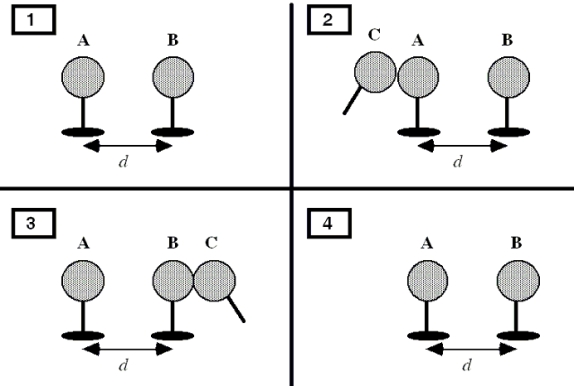 Determine the magnitude of the electrostatic force that sphere A exerts on sphere B in Frame 4.
 (Multiple Choice)
4.8/5  (75)
(75) A small sphere of mass 2.5 × 10⁻⁵ kg carries a total charge of 6.0 × 10⁻⁸ C. The sphere hangs from a silk thread between two large parallel conducting plates. The excess charge on each plate is equal in magnitude, but opposite in sign. If the thread makes an angle of 30° with the positive plate as shown, what is the magnitude of the charge density on each plate? 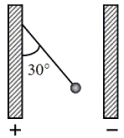
(Multiple Choice)
4.9/5 (74)
(74) Complete the following statement: When a glass rod is rubbed with silk cloth, the rod becomes positively charged as
(Multiple Choice)
4.8/5 (92)
(92) Each of three objects has a net charge. Objects A and B attract one another. Objects B and C also attract one another, but objects A and C repel one another. Which one of the following table entries is a possible combination of the signs of the net charges on these three objects? 
(Multiple Choice)
4.7/5 (73)
(73) What is the electric flux passing through a Gaussian surface that surrounds a +0.075 C point charge?
(Multiple Choice)
4.8/5 (62)
(62) At what separation will two charges, each of magnitude 6.0 C, exert a force of 0.70 N on each other?
(Multiple Choice)
4.8/5 (72)
(72) Five styrofoam balls are suspended from insulating threads. Several experiments are performed on the balls; and the following observations are made: 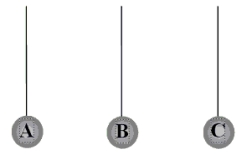
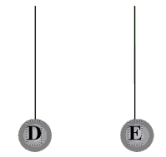
 What are the charges, if any, on each ball?

What are the charges, if any, on each ball? (Multiple Choice)
4.8/5 (90)
(90) Four point charges, each of the same magnitude, with varying signs are arranged at the corners of a square as shown. Which of the arrows labeled A, B, C, and D gives the correct direction of the net force that acts on the charge at the upper right corner? 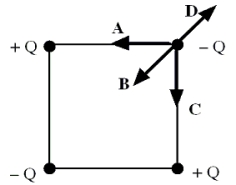
(Multiple Choice)
4.9/5 (83)
(83) A circular loop of wire with a diameter of 0.626 m is rotated in a uniform electric field to a position where the electric flux through the loop is a maximum. At this position, the electric flux is 7.50 × 10⁵ N.m2/C. Determine the magnitude of the electric field.
(Multiple Choice)
4.9/5 (71)
(71) An aluminum nail has an excess charge of +3.2 µC. How many electrons must be added to the nail to make it electrically neutral?
(Multiple Choice)
4.8/5 (80)
(80) A solid, conducting sphere of radius a carries an excess charge of +6 µC. This sphere is located at the center of a hollow, conducting sphere with an inner radius of b and an outer radius of c as shown. The hollow sphere also carries a total excess charge of +6 µC. 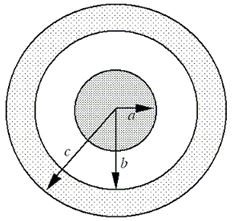 -Which one of the following figures shows a qualitatively accurate sketch of the electric field lines in and around this system?
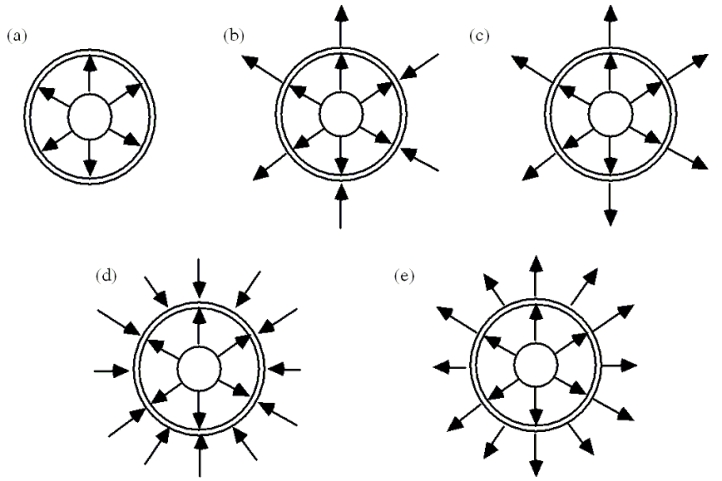
-Which one of the following figures shows a qualitatively accurate sketch of the electric field lines in and around this system? (Multiple Choice)
4.8/5 (88)
(88) A helium nucleus is located between the plates of a parallel-plate capacitor as shown. The nucleus has a charge of +2e and a mass of 6.6 × 10⁻²⁷ kg. What is the magnitude of the electric field such that the electric force exactly balances the weight of the helium nucleus so that it remains stationary? 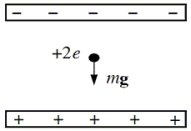
(Multiple Choice)
4.8/5 (72)
(72) Three charges are located along the x axis as shown in the drawing. The mass of the -1.2 µC is 4.0 × 10⁻⁹ kg. Determine the magnitude and direction of the acceleration of the -1.2 µC charge when it is allowed to move if the other two charges remain fixed. 
(Multiple Choice)
4.8/5 (86)
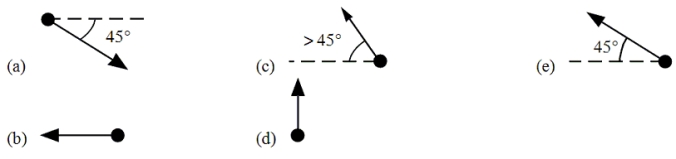
(86) Four point charges are held fixed at the corners of a square as shown in the figure. Which of the five arrows shown below most accurately shows the direction of the net force on the charge -Q due to the presence of the three other charges? 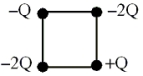
(Multiple Choice)
4.8/5 (80)
(80) A -4.0-µC charge is located 0.45 m to the left of a +6.0-µC charge. What is the magnitude and direction of the electrostatic force on the positive charge?
(Multiple Choice)
4.9/5 (74)
(74) An electric dipole is released from rest in a uniform electric field with the orientation shown. Which entry in the table below correctly describes the net torque and the net force on the dipole? 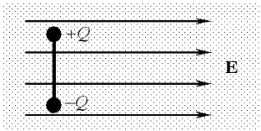

(Multiple Choice)
4.8/5 (77)
(77) At which point (or points) is the electric field zero N/C for the two point charges shown on the x axis? 
(Multiple Choice)
4.9/5 (84)
(84) Two identical conducting spheres carry charges of +5.0 C and -1.0 C, respectively. The centers of the spheres are initially separated by a distance L. The two spheres are brought together so that they are in contact. The spheres are then returned to their original separation L. What is the ratio of the magnitude of the electric force on either sphere after the spheres are touched to that before they were touched?
(Multiple Choice)
4.8/5 (81)
(81) Determine the ratio of the electrostatic force to the gravitational force between a proton and an electron, FE/FG. Note: k = 8.99 × 10⁹ N-m2/C2; G = 6.672 × 10⁻¹¹ N-m2/kg2; me = 9.109 × 10⁻³¹ kg; and mp = 1.672 × 10⁻²⁷ kg.
(Multiple Choice)
4.8/5 (70)
(70) The figure shows a parallel plate capacitor. The surface charge density on each plate is 8.8 × 10⁻⁸ C/m2. The point P is located 1.0 × 10⁻⁵ m away from the positive plate. 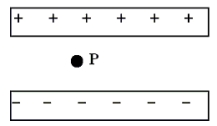 -Which one of the following statements concerning the direction of the electric field between the plates is true?
 (Multiple Choice)
4.8/5 (72)
(72) 
Filters
- Essay(0)
- Multiple Choice(0)
- Short Answer(0)
- True False(0)
- Matching(0)