



 Chat with AI
Exam 18: Electric Forces and Electric Fields

Exam 1: Introduction and Mathematical Concepts70 Questions
Exam 2: Kinematics in One Dimension103 Questions
Exam 3: Kinematics in Two Dimensions68 Questions
Exam 4: Forces and Newtons Laws of Motion103 Questions
Exam 5: Dynamics of Uniform Circular Motion59 Questions
Exam 6: Work and Energy78 Questions
Exam 7: Impulse and Momentum66 Questions
Exam 8: Rotational Kinematics55 Questions
Exam 9: Rotational Dynamics57 Questions
Exam 10: Simple Harmonic Motion and Elasticity63 Questions
Exam 11: Fluids65 Questions
Exam 12: Temperature and Heat66 Questions
Exam 13: The Transfer of Heat42 Questions
Exam 14: The Ideal Gas Law and Kinetic Theory55 Questions
Exam 15: Thermodynamics79 Questions
Exam 16: Waves and Sound67 Questions
Exam 17: The Principle of Linear Superposition and Interference Phenomena46 Questions
Exam 18: Electric Forces and Electric Fields61 Questions
Exam 19: Electric Potential Energy and the Electric Potential70 Questions
Exam 20: Electric Circuits100 Questions
Exam 21: Magnetic Forces and Magnetic Fields66 Questions
Exam 22: Electromagnetic Induction71 Questions
Exam 23: Alternating Current Circuits84 Questions
Exam 24: Electromagnetic Waves66 Questions
Exam 25: The Refl Ection of Light: Mirrors43 Questions
Exam 26: The Refraction of Light: Lenses and Optical Instruments102 Questions
Exam 27: Interference and the Wave Nature of Light57 Questions
Exam 28: Special Relativity63 Questions
Exam 29: Particles and Waves54 Questions
Exam 30: The Nature of the Atom74 Questions
Exam 31: Nuclear Physics and Radioactivity37 Questions
Exam 32: Ionizing Radiation, Nuclear Energy, and Elementary Particles45 Questions
Select questions type


The figure shows a parallel plate capacitor. The surface charge density on each plate is 8.8 × 10⁻⁸ C/m2. The point P is located 1.0 × 10⁻⁵ m away from the positive plate. 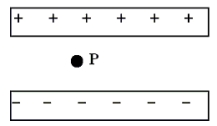 -If a +2.0 × 10⁻⁵ C point charge is placed at P, what is the force exerted on it?
 (Multiple Choice)
4.7/5  (83)
(83) The magnitude of the electric field at a distance of two meters from a negative point charge is E. What is the magnitude of the electric field at the same location if the magnitude of the charge is doubled?
(Multiple Choice)
4.9/5 (77)
(77) Five particles are shot from the left into a region that contains a uniform electric field. The numbered lines show the paths taken by the five particles. A negatively charged particle with a charge -3Q follows path 2 while it moves through this field. Do not consider any effects due to gravity. 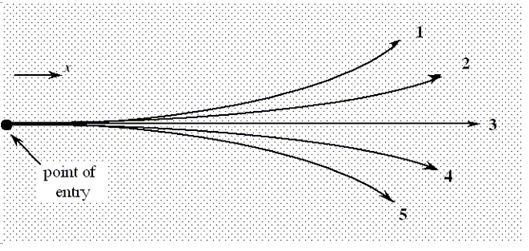 -Which path would be followed by a helium atom (an electrically neutral particle)?
 (Multiple Choice)
4.8/5 (83)
(83) Which one of the following statements is true concerning the strength of the electric field between two oppositely charged parallel plates?
(Multiple Choice)
4.9/5 (91)
(91) Which one of the following statements best explains why tiny bits of paper are attracted to a charged rubber rod?
(Multiple Choice)
4.8/5 (77)
(77) Five particles are shot from the left into a region that contains a uniform electric field. The numbered lines show the paths taken by the five particles. A negatively charged particle with a charge -3Q follows path 2 while it moves through this field. Do not consider any effects due to gravity.
-Which path would be followed by a charge +6Q?
-Which path would be followed by a charge +6Q? (Multiple Choice)
4.7/5 (84)
(84) A solid, conducting sphere of radius a carries an excess charge of +6 µC. This sphere is located at the center of a hollow, conducting sphere with an inner radius of b and an outer radius of c as shown. The hollow sphere also carries a total excess charge of +6 µC. 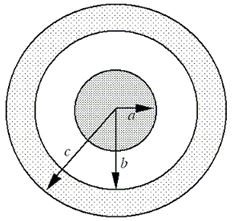 -Determine the excess charge on the outer surface of the outer sphere (a distance c from the center of the system).
 (Multiple Choice)
4.9/5 (75)
(75) A charge Q exerts a 1.2 N force on another charge q. If the distance between the charges is doubled, what is the magnitude of the force exerted on Q by q?
(Multiple Choice)
4.9/5 (76)
(76) A total charge of -6.50 µC is uniformly distributed within a sphere that has a radius of 0.150 m. What is the magnitude and direction of the electric field at 0.300 m from the surface of the sphere?
(Multiple Choice)
4.7/5 (81)
(81) Five particles are shot from the left into a region that contains a uniform electric field. The numbered lines show the paths taken by the five particles. A negatively charged particle with a charge -3Q follows path 2 while it moves through this field. Do not consider any effects due to gravity.
-In which direction does the electric field point?
-In which direction does the electric field point? (Multiple Choice)
5.0/5 (68)
(68) A uniform electric field with a magnitude of 125 000 N/C passes through a rectangle with sides of 2.50 m and 5.00 m. The angle between the electric field vector and the vector normal to the rectangular plane is 65.0°. What is the electric flux through the rectangle?
(Multiple Choice)
4.7/5 (85)
(85) A rigid electric dipole is free to move in the electric field represented in the figure. Which one of the following phrases most accurately describes the initial motion of the dipole if it is released from rest in the position shown? 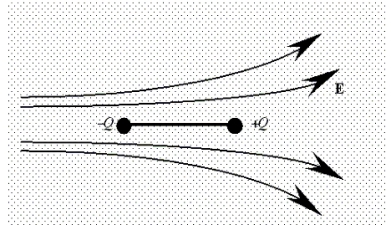
(Multiple Choice)
4.9/5 (93)
(93) A cubical Gaussian surface is placed in a uniform electric field as shown in the figure. The length of each edge of the cube is 1.0 m. The uniform electric field has a magnitude of 5.0 × 10⁸ N/C and passes through the left and right sides of the cube perpendicular to the surface. What is the total electric flux that passes through the cubical Gaussian surface? 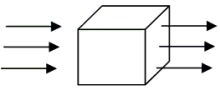
(Multiple Choice)
4.8/5 (90)
(90) Consider three identical metal spheres, A, B, and C. Sphere A carries a charge of -2.0 µC; sphere B carries a charge of -6.0 µC; and sphere C carries a charge of +4.0 µC. Spheres A and B are touched together and then separated. Spheres B and C are then touched and separated. Does sphere C end up with an excess or a deficiency of electrons and how many electrons is it?
(Multiple Choice)
4.8/5 (85)
(85) Two uncharged, conducting spheres, A and B, are held at rest on insulating stands and are in contact. A positively charged rod is brought near sphere A as suggested in the figure. While the rod is in place, someone moves sphere B away from A. How will the spheres be charged, if at all? 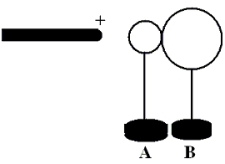

(Multiple Choice)
4.8/5 (65)
(65) What is the magnitude and direction of the electric force on a -3.0 µC charge at a point where the electric field is 2800 N/C and is directed along the +y axis.
(Multiple Choice)
4.8/5 (72)
(72) Three charges are positioned as indicated in the figure. What are the horizontal and vertical components of the net force exerted on the +15 µC charge by the +11 µC and +13 µC charges? 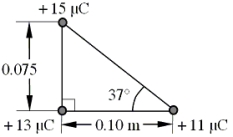

(Multiple Choice)
4.7/5 (65)
(65) The figure shows the electric field lines in the vicinity of two point charges. Which one of the following statements concerning this situation is true? 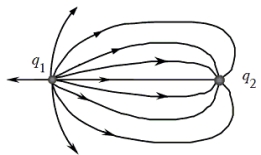
(Multiple Choice)
4.9/5 (76)
(76) Two point charges, A and B, lie along a line separated by a distance L. The point x is the midpoint of their separation.  -Which combination of charges would yield the greatest repulsive force between the charges?
 (Multiple Choice)
4.7/5 (72)
(72) Which one of the following statements is true concerning the magnitude of the electric field at a point in space?
(Multiple Choice)
4.8/5 (73)
(73) 
Filters
- Essay(0)
- Multiple Choice(0)
- Short Answer(0)
- True False(0)
- Matching(0)