



 Chat with AI
Exam 20: Electric Circuits

Exam 1: Introduction and Mathematical Concepts70 Questions
Exam 2: Kinematics in One Dimension103 Questions
Exam 3: Kinematics in Two Dimensions68 Questions
Exam 4: Forces and Newtons Laws of Motion103 Questions
Exam 5: Dynamics of Uniform Circular Motion59 Questions
Exam 6: Work and Energy78 Questions
Exam 7: Impulse and Momentum66 Questions
Exam 8: Rotational Kinematics55 Questions
Exam 9: Rotational Dynamics57 Questions
Exam 10: Simple Harmonic Motion and Elasticity63 Questions
Exam 11: Fluids65 Questions
Exam 12: Temperature and Heat66 Questions
Exam 13: The Transfer of Heat42 Questions
Exam 14: The Ideal Gas Law and Kinetic Theory55 Questions
Exam 15: Thermodynamics79 Questions
Exam 16: Waves and Sound67 Questions
Exam 17: The Principle of Linear Superposition and Interference Phenomena46 Questions
Exam 18: Electric Forces and Electric Fields61 Questions
Exam 19: Electric Potential Energy and the Electric Potential70 Questions
Exam 20: Electric Circuits100 Questions
Exam 21: Magnetic Forces and Magnetic Fields66 Questions
Exam 22: Electromagnetic Induction71 Questions
Exam 23: Alternating Current Circuits84 Questions
Exam 24: Electromagnetic Waves66 Questions
Exam 25: The Refl Ection of Light: Mirrors43 Questions
Exam 26: The Refraction of Light: Lenses and Optical Instruments102 Questions
Exam 27: Interference and the Wave Nature of Light57 Questions
Exam 28: Special Relativity63 Questions
Exam 29: Particles and Waves54 Questions
Exam 30: The Nature of the Atom74 Questions
Exam 31: Nuclear Physics and Radioactivity37 Questions
Exam 32: Ionizing Radiation, Nuclear Energy, and Elementary Particles45 Questions
Select questions type


A 10.0-µF capacitor is charged so that the potential difference between its plates is 10.0 V.
A 5.0-µF capacitor is similarly charged so that the potential difference between its plates is 5.0 V.
The two charged capacitors are then connected to each other in parallel with positive plate connected to positive plate and negative plate connected to negative plate.
-What is the final potential difference across the plates of the capacitors when they are connected in parallel?
(Multiple Choice)
4.7/5  (95)
(95) The figure shows a simple RC circuit consisting of a 10.0-µF capacitor in series with a resistor. Initially, the switch is open as suggested in the figure. The capacitor has been charged so that the potential difference between its plates is 100.0 V. At t = 0 s, the switch is closed. The capacitor discharges exponentially so that 2.0 s after the switch is closed, the potential difference between the capacitor plates is 37 V. In other words, in 2.0 s the potential difference between the capacitor plates is reduced to 37 % of its original value.  -Determine the numerical value of the resistance R.
 (Multiple Choice)
4.9/5 (64)
(64) Five resistors are connected as shown in the diagram. The potential difference between points A and B is 15 V. 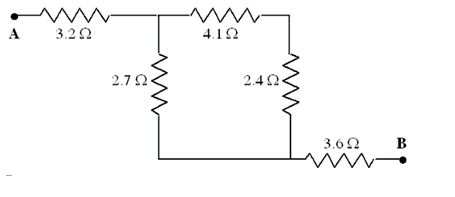 -What amount of energy is dissipated in the 2.7- resistor in 9.0 seconds?
 (Multiple Choice)
4.9/5 (79)
(79) The resistivity of a silver wire with a radius of 5.04 × 10⁻⁴ m is 1.59 × 10⁻⁸ . m. If the length of the wire is 3.00 m, what is the resistance of the wire?
(Multiple Choice)
4.9/5 (82)
(82) Three resistors and two 10.0-V batteries are arranged as shown in the circuit diagram. Which one of the following entries in the table is correct? 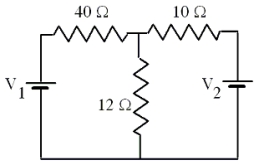

(Multiple Choice)
4.9/5 (74)
(74) A 10.0-µF capacitor is charged so that the potential difference between its plates is 10.0 V.
A 5.0-µF capacitor is similarly charged so that the potential difference between its plates is 5.0 V.
The two charged capacitors are then connected to each other in parallel with positive plate connected to positive plate and negative plate connected to negative plate.
-How much charge flows from one capacitor to the other when the capacitors are connected?
(Multiple Choice)
4.8/5 (79)
(79) Which one of the following quantities can be converted to kilowatt . hours (kWh)?
(Multiple Choice)
4.8/5 (78)
(78) A resistor dissipates 1.5 W when it is connected to a battery with a potential difference of 12 V. What is the resistance of the resistor?
(Multiple Choice)
4.7/5 (93)
(93) Five resistors are connected as shown in the diagram. The potential difference between points A and B is 25 V. 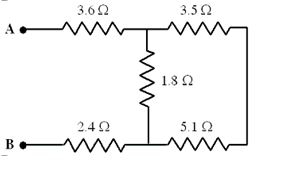 -What is the equivalent resistance between the points A and B?
 (Multiple Choice)
4.9/5 (83)
(83) Three resistors are connected as shown in the figure. The potential difference between points A and B is 26 V. 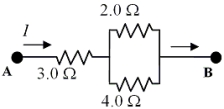 -What is the equivalent resistance between the points A and B?
 (Multiple Choice)
4.9/5 (83)
(83) The figure shows a circuit. The switch S can be closed on either point A or C, but not both at the same time. Use the following quantities:
V1 = V2 = 12 V
R1 = R4 = 1.0
R2 = R3 = 2.0  -Determine the current through R4 when the switch S is closed on C.
 (Multiple Choice)
4.8/5 (71)
(71) Jason's circuit has a 24- resistor that is connected in series to two 12- resistors that are connected in parallel. JoAnna's circuit has three identical resistors wired in parallel. If the equivalent resistance of Jason's circuit is the same as that of JoAnna's circuit, determine the value of JoAnna's resistors.
(Multiple Choice)
4.9/5 (80)
(80) When a 1500-W hair dryer is in use, the current passing through the dryer may be represented as I = (17.7A) sin (120 t). What is the rms current for this circuit?
(Multiple Choice)
4.8/5 (68)
(68) Which one of the following statements concerning superconductors is false?
(Multiple Choice)
4.9/5 (78)
(78) Three resistors are connected as shown in the figure. The potential difference between points A and B is 26 V.
-How much current flows through the 2- resistor?
-How much current flows through the 2- resistor? (Multiple Choice)
4.9/5 (85)
(85) A battery supplies a total charge of 5.0 C to a circuit that consists of a series combination of two identical capacitors, each with capacitance C. Determine the charge on either capacitor.
(Multiple Choice)
4.8/5 (76)
(76) The characteristics of five wires are given in the table. 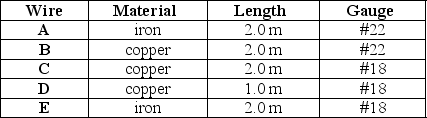 The gauge is a measure of the diameter of the wire; and #18 corresponds to a diameter of 1.2 × 10⁻³ m; and #22 corresponds to a diameter of 6.4 × 10⁻⁴ m. The resistivity of iron is 9.7 × 10⁻⁸ . m; and the value for copper is 1.72 × 10⁻⁸ . m.
-Of the five wires, which one has the smallest resistance?
The gauge is a measure of the diameter of the wire; and #18 corresponds to a diameter of 1.2 × 10⁻³ m; and #22 corresponds to a diameter of 6.4 × 10⁻⁴ m. The resistivity of iron is 9.7 × 10⁻⁸ . m; and the value for copper is 1.72 × 10⁻⁸ . m.
-Of the five wires, which one has the smallest resistance? (Multiple Choice)
4.9/5 (81)
(81) A 220- resistor is connected across an ac voltage source V = (150 V) sin [2 (60 Hz)t]. What is the average power delivered to this circuit?
(Multiple Choice)
4.8/5 (79)
(79) Four resistors and a 6-V battery are arranged as shown in the circuit diagram. 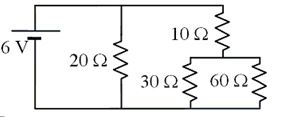 -Determine the equivalent resistance for this circuit.
 (Multiple Choice)
4.7/5 (71)
(71) The figure shows variation of the current through the heating element with time in an iron when it is plugged into a standard 120 V, 60 Hz outlet. 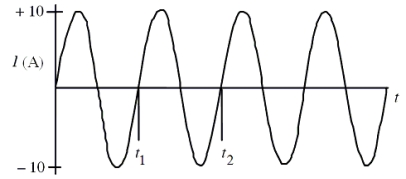 -What is the approximate average power dissipated in the iron?
 (Multiple Choice)
4.8/5 (86)
(86) 
Filters
- Essay(0)
- Multiple Choice(0)
- Short Answer(0)
- True False(0)
- Matching(0)