



 Chat with AI
Exam 20: Electric Circuits

Exam 1: Introduction and Mathematical Concepts70 Questions
Exam 2: Kinematics in One Dimension103 Questions
Exam 3: Kinematics in Two Dimensions68 Questions
Exam 4: Forces and Newtons Laws of Motion103 Questions
Exam 5: Dynamics of Uniform Circular Motion59 Questions
Exam 6: Work and Energy78 Questions
Exam 7: Impulse and Momentum66 Questions
Exam 8: Rotational Kinematics55 Questions
Exam 9: Rotational Dynamics57 Questions
Exam 10: Simple Harmonic Motion and Elasticity63 Questions
Exam 11: Fluids65 Questions
Exam 12: Temperature and Heat66 Questions
Exam 13: The Transfer of Heat42 Questions
Exam 14: The Ideal Gas Law and Kinetic Theory55 Questions
Exam 15: Thermodynamics79 Questions
Exam 16: Waves and Sound67 Questions
Exam 17: The Principle of Linear Superposition and Interference Phenomena46 Questions
Exam 18: Electric Forces and Electric Fields61 Questions
Exam 19: Electric Potential Energy and the Electric Potential70 Questions
Exam 20: Electric Circuits100 Questions
Exam 21: Magnetic Forces and Magnetic Fields66 Questions
Exam 22: Electromagnetic Induction71 Questions
Exam 23: Alternating Current Circuits84 Questions
Exam 24: Electromagnetic Waves66 Questions
Exam 25: The Refl Ection of Light: Mirrors43 Questions
Exam 26: The Refraction of Light: Lenses and Optical Instruments102 Questions
Exam 27: Interference and the Wave Nature of Light57 Questions
Exam 28: Special Relativity63 Questions
Exam 29: Particles and Waves54 Questions
Exam 30: The Nature of the Atom74 Questions
Exam 31: Nuclear Physics and Radioactivity37 Questions
Exam 32: Ionizing Radiation, Nuclear Energy, and Elementary Particles45 Questions
Select questions type


An ac current has an rms value of 3.54 A. Determine the peak value of the current.
(Multiple Choice)
4.9/5  (90)
(90) An uncharged 5.0-µF capacitor and a resistor are connected in series to a 12-V battery and an open switch to form a simple RC circuit. The switch is closed at t = 0 s. The time constant of the circuit is 4.0 s.
-What is the charge remaining on either plate after one time constant has elapsed?
(Multiple Choice)
4.8/5 (89)
(89) What is the equivalent capacitance of the combination of capacitors shown in the circuit? 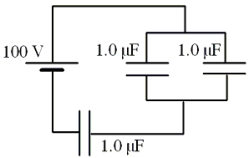
(Multiple Choice)
4.8/5 (75)
(75) An uncharged 5.0-µF capacitor and a resistor are connected in series to a 12-V battery and an open switch to form a simple RC circuit. The switch is closed at t = 0 s. The time constant of the circuit is 4.0 s.
-Determine the value of the resistance R.
(Multiple Choice)
4.9/5 (70)
(70) The current through a certain heater wire is found to be fairly independent of its temperature. If the current through the heater wire is doubled, the amount of energy delivered by the heater in a given time interval will
(Multiple Choice)
4.9/5 (81)
(81) When a light bulb is connected to a 4.5 V battery, a current of 0.12 A passes through the bulb filament. What is the resistance of the filament?
(Multiple Choice)
5.0/5 (77)
(77) Three 15- and two 25- light bulbs and a 24 V battery are connected in a series circuit. What is the current that passes through each bulb?
(Multiple Choice)
4.8/5 (75)
(75) Five resistors are connected as shown in the diagram. The potential difference between points A and B is 25 V. 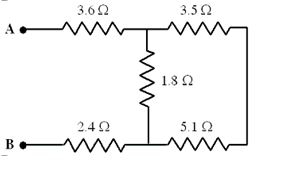 -How much energy is dissipated in the 1.8- resistor in 4.0 seconds?
 (Multiple Choice)
4.8/5 (76)
(76) Two wires, A and B, and a variable resistor, R, are connected in series to a battery. Which one of the following results will occur if the resistance of R is increased?
(Multiple Choice)
4.9/5 (78)
(78) Which one of the following situations results in a conventional electric current that flows northward?
(Multiple Choice)
4.7/5 (87)
(87) How many electrons flow through a battery that delivers a current of 3.0 A for 12 s?
(Multiple Choice)
4.9/5 (75)
(75) Three parallel plate capacitors, each having a capacitance of 1.0 µF are connected in parallel. The potential difference across the combination is 100 V. What is the equivalent capacitance of this combination?
(Multiple Choice)
4.8/5 (81)
(81) The figure shows a simple RC circuit consisting of a 100.0-V battery in series with a 10.0-µF capacitor and a resistor. Initially, the switch S is open and the capacitor is uncharged. Two seconds after the switch is closed, the voltage across the resistor is 37 V. 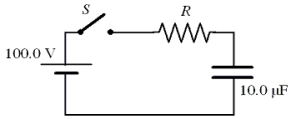 -Determine the numerical value of the resistance R.
 (Multiple Choice)
4.8/5 (76)
(76) Three resistors are connected in a circuit as shown. Using Kirchhoff's rules, determine the current in one of the 16- resistors. 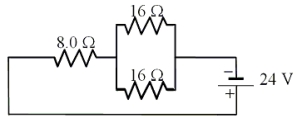
(Multiple Choice)
4.8/5 (74)
(74) A physics student performed an experiment in which the potential difference V between the ends of a long straight wire was varied. The current I in the wire was measured at each value of the potential difference with an ammeter and the results of the experiment are shown in the table. 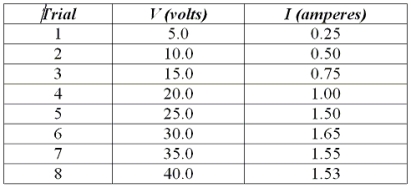 Which one of the following statements is the best conclusion based on the data?
 (Multiple Choice)
4.8/5 (76)
(76) The figure shows variation of the current through the heating element with time in an iron when it is plugged into a standard 120 V, 60 Hz outlet. 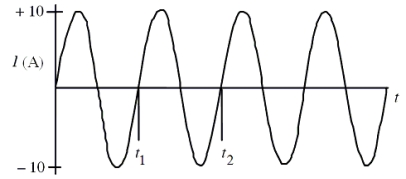 -What is the rms value of the current in this circuit?
 (Multiple Choice)
4.8/5 (81)
(81) Three resistors, 50- , 120- , 180- , are connected in series in a circuit. What is the equivalent resistance of this combination of resistors?
(Multiple Choice)
4.7/5 (81)
(81) An RC circuit consists of a resistor with resistance 1.0 k , a 120-V battery, and two capacitors, C1 and C2, with capacitances of 20.0 µF and 60.0 µF, respectively. Initially, the capacitors are uncharged; and the switch is closed at t = 0 s.
-Determine the total charge on both capacitors two time constants after the switch is closed.
(Multiple Choice)
4.8/5 (79)
(79) Complete the following statement: The electromotive force is
(Multiple Choice)
4.9/5 (80)
(80) A simple RC circuit consists of a 1- F capacitor in series with a 2800- resistor, a 6-V battery, and an open switch. Initially, the capacitor is uncharged. How long after the switch is closed will the voltage across the capacitor be 4.1 V?
(Multiple Choice)
4.9/5 (76)
(76) 
Filters
- Essay(0)
- Multiple Choice(0)
- Short Answer(0)
- True False(0)
- Matching(0)