



 Chat with AI
Exam 2: Cost Behaviour

Exam 1: A: Basic Cost Management Concepts239 Questions
Exam 1: B: Basic Cost Management Concepts32 Questions
Exam 2: Cost Behaviour122 Questions
Exam 3: Cost-Volume-Profit Analysis107 Questions
Exam 4: Job-Order Costing Systems102 Questions
Exam 5: Process Costing132 Questions
Exam 6: Activity-Based Costing164 Questions
Exam 7: Allocating Costs of Support Departments and Joint Products137 Questions
Exam 8: Budgeting for Planning and Control154 Questions
Exam 9: Standard Costing: a Functional-Based Control Approach86 Questions
Exam 10: Responsibility Accounting,performance Evaluation,and Transfer Pricing110 Questions
Exam 11: Tactical Decision Making100 Questions
Exam 12: Pricing and Profitability Analysis102 Questions
Exam 13: Strategic Cost Management120 Questions
Exam 14: Activity-Based Management116 Questions
Exam 15: The Balanced Scorecard: Strategic-Based Control94 Questions
Exam 16: Quality and Environmental Cost Management157 Questions
Exam 17: Lean Accounting and Productivity Measurement138 Questions
Exam 18: Inventory Management: Economic Order Quantity,jit,and the Theory of Constraints97 Questions
Select questions type


Innova,Inc.,is beginning the production of a new product.Management believes that 500 labour hours will be required to complete the new unit.An 80 percent incremental unit-time learning curve model for direct labour hours is assumed to be valid.Assume the q = -0.3219.Data on costs are as follows:
Direct materials \ 50,000 per unit Direct labour \ 20 per direct labour hour Variable manufacturing overhead \ 30 per direct labour hour
a.Set up a table with columns for cumulative number of units showing the cumulative total time in hours using the incremental unit-time learning curve.Complete the table for 1,2,3,and 4 units given the individual unit time for the nth unit as 500,400,351,and 320 for 1 to 4 units respectively.
b.Set up a similar table assuming a 90 percent with the incremental unit-time learning curve with the individual unit time for the nth unit as 500,450,430,405 for 1 to 4 units respectively.
c.What is the difference in variable cost of producing four units?
(Essay)
4.9/5  (75)
(75) The following information was available about supplies cost for the second quarter of the year: Month Production Volume Supplies Cost April 700 \ 3,185 May 1,600 7,100 June 600 2,700 Using the high-low method,what is the estimate of supplies cost at 1,000 units of production?
(Multiple Choice)
5.0/5 (87)
(87) What does a steep slope in the variable cost line indicate?
(Multiple Choice)
4.8/5 (80)
(80) The following computer printout estimated overhead costs using multiple regression:
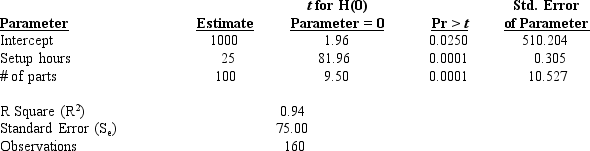 During the year the company used 1,000 setup hours and 500 parts.
-Refer to the figure.What is the predicted overhead cost?
During the year the company used 1,000 setup hours and 500 parts.
-Refer to the figure.What is the predicted overhead cost? (Multiple Choice)
4.9/5 (90)
(90) When the volume of activity increases within the relevant range,how does the fixed cost per unit respond?
(Multiple Choice)
4.7/5 (94)
(94) The following data were obtained from the books of Thomas Company:
Manth Overhead Costs Direct Labour Hours 1 \ 14 3 2 18 5 3 25 7 4 12 4 5 26 6 2 The normal equations are
=a\SigmaX+b\Sigma \SigmaY=an+b\SigmaX Use a computer or calculator to prepare the following:
a.Plot the data for overhead cost as a function of direct labour hours using the scatterplot method.
b.Compute the fixed and variable components of the overhead costs using the high-low method.
c.Compute the fixed and variable components of the overhead costs using the least-squares method.
d.Discuss the strengths and weaknesses of the three different cost estimation techniques used in parts a,b,and
(Essay)
4.8/5 (80)
(80) The following computer printout estimated overhead costs using regression:
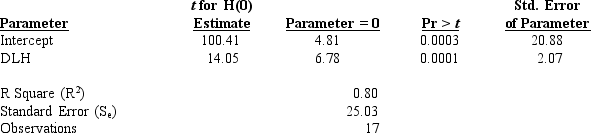 Degrees Degrees of of Freedom 90\% 95\% 99\% Freedom 90\% 95\% 99\% 1 6.314 12.708 63.657 11 1.796 2.201 3.106 2 2.920 4.303 9.925 12 1.782 2.179 3.055 3 2.353 3.182 5.841 13 1.771 2.160 3.055 4 2.132 2.776 4.604 14 1.761 2.145 3.012 5 2.015 2.571 4.032 15 1.753 2.131 2.947 6 1.943 2.447 3.707 16 1.746 2.120 2.921 7 1.895 2.365 3.499 17 1.740 2.110 2.898 8 1.860 2.306 3.355 18 1.734 2.101 2.878 9 1.833 2.262 3.250 19 1.729 2.093 2.861 10 1.812 2.228 3.169 20 1.725 2.086 2.845 During the last accounting period 10,000 DLH were worked.
-Refer to the figure.What is the t-value for a 90 percent confidence level?
Degrees Degrees of of Freedom 90\% 95\% 99\% Freedom 90\% 95\% 99\% 1 6.314 12.708 63.657 11 1.796 2.201 3.106 2 2.920 4.303 9.925 12 1.782 2.179 3.055 3 2.353 3.182 5.841 13 1.771 2.160 3.055 4 2.132 2.776 4.604 14 1.761 2.145 3.012 5 2.015 2.571 4.032 15 1.753 2.131 2.947 6 1.943 2.447 3.707 16 1.746 2.120 2.921 7 1.895 2.365 3.499 17 1.740 2.110 2.898 8 1.860 2.306 3.355 18 1.734 2.101 2.878 9 1.833 2.262 3.250 19 1.729 2.093 2.861 10 1.812 2.228 3.169 20 1.725 2.086 2.845 During the last accounting period 10,000 DLH were worked.
-Refer to the figure.What is the t-value for a 90 percent confidence level? (Multiple Choice)
4.9/5 (84)
(84) Which activity driver explains changes in costs as factors other than changes in units produced?
(Multiple Choice)
4.7/5 (73)
(73) What is characteristic of the scatterplot method of cost estimation?
(Multiple Choice)
4.8/5 (91)
(91) The following computer printout estimated overhead costs using linear regression: 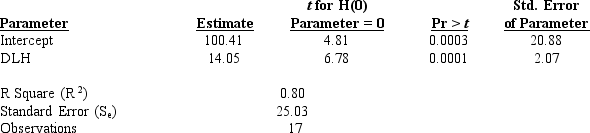 Table of Selected Values: t Distribution
Degrees of Freedom 90\% 95\% 99\% 15 1.753 2.131 2.947 16 1.746 2.120 2.921 17 1.740 2.110 2.898 18 1.734 2.101 2.878 19 1.729 2.093 2.861 What is the interval around Y if 95 percent confidence is desired?
Table of Selected Values: t Distribution
Degrees of Freedom 90\% 95\% 99\% 15 1.753 2.131 2.947 16 1.746 2.120 2.921 17 1.740 2.110 2.898 18 1.734 2.101 2.878 19 1.729 2.093 2.861 What is the interval around Y if 95 percent confidence is desired? (Multiple Choice)
4.9/5 (89)
(89) Lee Corporation manufactures and sells party items. The following representative direct labour hours and production costs are provided for a four-month period:
Month Direct Labour Hours Production January 3,600 \ 15,000 February 4,800 17,500 March 6,000 20,000 April 4,800 17,500 Total 19.200 \ 70.000 Let a = Fixed production costs per month
b = Variable production costs per direct labour hour
n = Number of months
X = Direct labour hours per month
Y = Total monthly production costs
s = Summation
-Refer to the figure.How can the monthly production cost be expressed?
(Multiple Choice)
4.8/5 (64)
(64) Which of the following is an advantage of using the scatterplot method over the high-low method to estimate costs?
(Multiple Choice)
4.8/5 (91)
(91) If at a given volume total costs and fixed costs are known,how are the variable costs per unit computed?
(Multiple Choice)
4.8/5 (67)
(67) If an automobile manufacturer changes from skilled labour to computer-controlled assembly procedures,of what use is the past data?
(Multiple Choice)
4.8/5 (77)
(77) Which of the following would be an example of a unit-based cost driver?
(Multiple Choice)
4.9/5 (80)
(80) 
Filters
- Essay(0)
- Multiple Choice(0)
- Short Answer(0)
- True False(0)
- Matching(0)