



 Chat with AI
Exam 13: Budgeting and Standard Cost Systems

Exam 1: The Role of Accounting in Business100 Questions
Exam 2: Basic Accounting Concepts91 Questions
Exam 3: Accrual Accounting Concepts115 Questions
Exam 4: Accounting for Merchandising Businesses145 Questions
Exam 5: Sarbanes-Oxley, internal Control, and Cash112 Questions
Exam 6: Receivables and Inventories105 Questions
Exam 7: Fixed Assets and Intangible Assets90 Questions
Exam 8: Liabilities and Stockholders Equity133 Questions
Exam 9: Financial Statement Analysis69 Questions
Exam 10: Accounting Systems for Manufacturing Businesses119 Questions
Exam 11: Cost Behavior and Cost-Volume-Profit Analysis140 Questions
Exam 12: Differential Analysis and Product Pricing102 Questions
Exam 13: Budgeting and Standard Cost Systems169 Questions
Exam 14: Performance Evaluation for Decentralized Operations137 Questions
Exam 15: Capital Investment Analysis103 Questions
Select questions type


A budget performance report compares actual results with the budgeted amounts and reports differences for possible investigation.
(True/False)
4.7/5  (79)
(79) If the standard to produce a given amount of product is 2,000 units of direct materials at $12 and the actual was 1,600 units at $13,the direct materials quantity variance was $4,800 favorable.
(True/False)
4.8/5 (78)
(78) The standard factory overhead rate is $7.50 per machine hour ($6.20 for variable factory overhead and $1.30 for fixed factory overhead)based on 100% capacity of 80,000 machine hours.The standard cost and the actual cost of factory overhead for the production of 15,000 units during August were as follows:
(Multiple Choice)
4.9/5 (79)
(79) The sales budget is the starting point for preparation of the direct labor cost budget.
(True/False)
4.8/5 (85)
(85) If the standard to produce a given amount of product is 12,000 hours at a factory overhead rate of $5 ($3 fixed,$2 variable),actual variable factory overhead was $26,400,actual fixed factory overhead was $45,000,and 100% of productive capacity is 15,000 hours,the volume variance was $9,000 favorable.
(True/False)
4.9/5 (73)
(73) Refer to the information provided for Efficient Corporation.The total direct labor variance is:
(Multiple Choice)
4.9/5 (80)
(80) The standard costs and actual costs for direct materials,direct labor,and factory overhead for the manufacture of 2,500 units of product are as follows:
(Multiple Choice)
4.8/5 (78)
(78) Supervisor salaries and indirect factory wages would normally appear in the direct labor cost budget.
(True/False)
4.9/5 (69)
(69) Standards are more widely used for nonmanufacturing expenses than for manufacturing costs.
(True/False)
4.9/5 (83)
(83) Supervisor salaries,maintenance,and indirect factory wages would normally appear in the factory overhead cost budget.
(True/False)
5.0/5 (84)
(84) Which of the following would not lend itself to applying direct labor variances?
(Multiple Choice)
4.8/5 (76)
(76) The capital expenditure budget summarizes future plans for acquisition of fixed assets.
(True/False)
4.8/5 (82)
(82) Refer to the information provided for Frogue Company.The direct materials cost variance is:
(Multiple Choice)
4.8/5 (65)
(65) The master budget of a small manufacturer would normally include all component budgets that impact the financial statements.
(True/False)
5.0/5 (85)
(85) If the price paid per unit differs from the standard price per unit for direct materials,the variance is termed:
(Multiple Choice)
4.8/5 (85)
(85) Budgetary slack can be avoided if lower and mid-level managers are requested to support all of their spending requirements with specific operational plans.
(True/False)
4.8/5 (82)
(82) An unfavorable cost variance occurs when budgeted cost at actual volumes exceeds actual cost.
(True/False)
4.9/5 (75)
(75) Microgen Company static budget for 12,000 units of production includes $48,000 for direct materials,$36,000 for direct labor,utilities of $6,000,and supervisor salaries of $18,000.A flexible budget for 14,000 units of production would show:
(Multiple Choice)
4.9/5 (88)
(88) Brown Inc.'s production budget for Product X for the year ended December 31 is as follows:
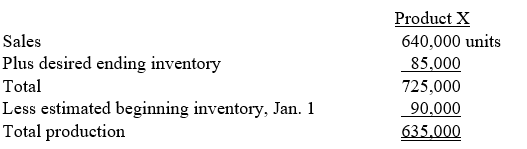 In Brown's production operations, Materials A, B, and C are required to make Product X. The quantities of direct materials expected to be used for each unit of product are as follows:
Product X
Material A .50 pound per unit
Material B 1.00 pound per unit
Material C 1.20 pound per unit
The prices of direct materials are as follows:
Material A $0.60 per pound
Material B $1.70 per pound
Material C $1.50 per pound
Prepare a direct materials purchases budget for Product X.
In Brown's production operations, Materials A, B, and C are required to make Product X. The quantities of direct materials expected to be used for each unit of product are as follows:
Product X
Material A .50 pound per unit
Material B 1.00 pound per unit
Material C 1.20 pound per unit
The prices of direct materials are as follows:
Material A $0.60 per pound
Material B $1.70 per pound
Material C $1.50 per pound
Prepare a direct materials purchases budget for Product X.
(Essay)
4.9/5 (83)
(83) 
Filters
- Essay(0)
- Multiple Choice(0)
- Short Answer(0)
- True False(0)
- Matching(0)