



 Chat with AI
Exam 12: The Purchasing Process

Exam 1: Introduction to Accounting Information Systems122 Questions
Exam 2: Enterprise Systems141 Questions
Exam 3: Electronic Business E-Business-Systems121 Questions
Exam 4: Documenting Information Systems124 Questions
Exam 5: Database Management Systems175 Questions
Exam 6: Relational Databases and SQL102 Questions
Exam 7: Controlling Information Systems: Introduction to Enterprise Risk Management and Internal Control159 Questions
Exam 8: Controlling Information Systems: Introduction to Pervasive Controls159 Questions
Exam 9: Controlling Information Systems: Business Process and Application Controls134 Questions
Exam 10: The Order Entrysales Oesprocess133 Questions
Exam 11: The Billingaccounts Receivablecash Receipts Barcrprocess134 Questions
Exam 12: The Purchasing Process140 Questions
Exam 13: The Accounts Payablecash Disbursements Apcdprocess118 Questions
Exam 14: The Human Resources Process Hrmanagement and Payroll Processes121 Questions
Exam 15: Integrated Production Processes IPP118 Questions
Exam 16: The General Ledger and Business Reporting Glbrprocess106 Questions
Exam 17: Acquiring and Implementing Accounting Information Systems206 Questions
Select questions type


To prevent duplicate purchase requests and to allow the requesting department to ensure that a purchase order has been created,the purchasing department should ______________________________.
(Essay)
4.7/5  (85)
(85) The ______________________________ is a compilation of open purchase orders that includes the status of each item on order.
(Essay)
4.9/5 (80)
(80) The purchase requisition is sent from the inventory control department to the purchasing department.
(True/False)
4.8/5 (89)
(89) ______________________________ is a technique for ranking inventory items in a group based on the value,activity,sales,or other relevant metric for the items..
(Essay)
4.8/5 (79)
(79) According to the context diagram for the purchasing process,when a purchase order is sent to the purchaser,the vendor responds by sending the goods along with a packing slip.
(True/False)
4.8/5 (85)
(85) E-procurement is the use of information technology to automate significant portions of the procurement process.
(True/False)
4.7/5 (72)
(72) A paperless system would eliminate documents and forms as the medium for conducting business transactions.
(True/False)
5.0/5 (77)
(77) The connections from the suppliers of merchandise and raw materials through to an organization's customers,including the flow of information,materials,and services,are its supply chain.
(True/False)
4.8/5 (80)
(80) According to the context diagram for the purchasing process,when a purchase order is sent to the vendor,the vendor responds by sending the goods along with a(n)______________________________.
(Essay)
4.8/5 (75)
(75) When data on the inventory record indicate a need to replenish the stock,the inventory system prepares a(n)______________________________.
(Essay)
4.7/5 (84)
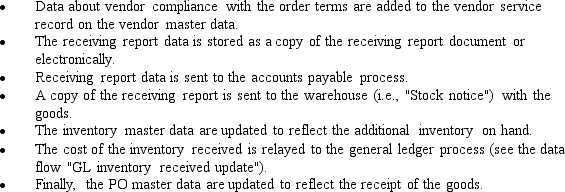
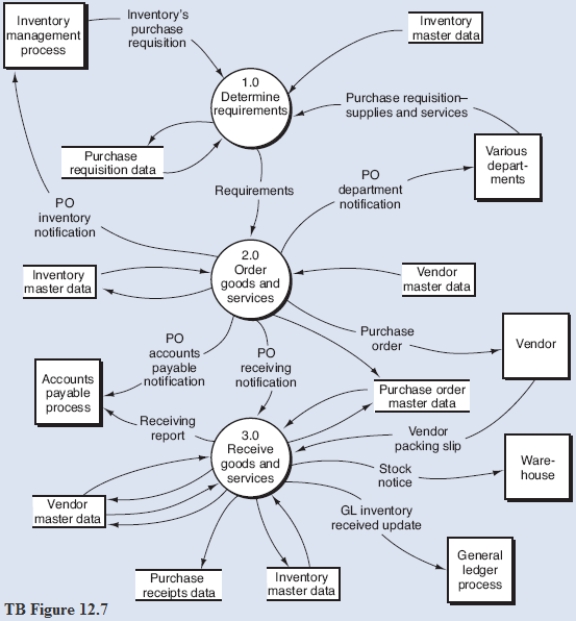
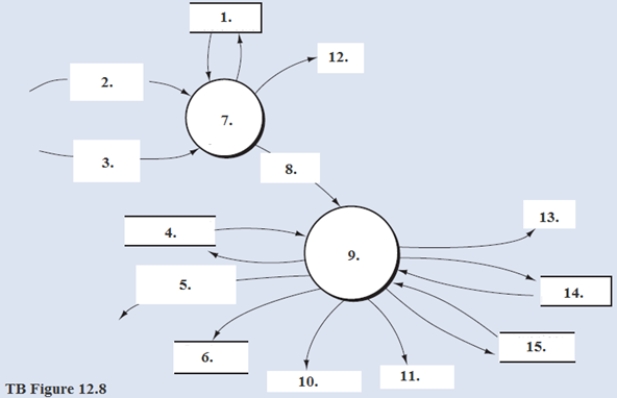
(84) Below is a narrative describing the "Receive goods and services" portion (bubble 3.0)of the purchasing process described in Chapter 12.
Narrative Description
The vendor packing slip,which accompanies the purchased inventory from the vendor and identifies the shipment,triggers the receiving process.As indicated by bubble 3.1 of the figure,goods arriving at the receiving department are inspected and counted,and these data are matched against the vendor packing slip and the "PO receiving notification" (i.e. ,the blind copy of the PO).Nonconforming goods are denoted by the reject stub out of process 3.1.Notation of rejected goods is added to the vendor service record in the vendor master data.After the count and condition of the goods has been obtained,process 3.1 completes the receiving report by noting the quantity received.Once annotated with the quantity received,the PO receiving notification becomes a receiving report,which is the document used to record merchandise receipts.
Process 3.2 compares the receiving report data to the information stored in the PO master data-a process that often is automatically completed by the information system.Bubble 3.2 also reflects the following activities:
 Required:
Using the DFD in TB Figure 12.7 and the narrative description above,identify the words that belong in items 1 to 15 of Diagram 3.0 (TB Figure 12.8).
Required:
Using the DFD in TB Figure 12.7 and the narrative description above,identify the words that belong in items 1 to 15 of Diagram 3.0 (TB Figure 12.8).
(Essay)
5.0/5 (79)
(79) The document used to record merchandise receipts is called a purchasing report.
(True/False)
4.8/5 (80)
(80) Whereas a receiving report normally indicates that goods have been received,some organizations use a(n)______________________________ to acknowledge formally the satisfactory completion of a service contract.
(Essay)
4.9/5 (90)
(90) With ______________________________ a vendor obtains a buyer's current sales,demand,and inventory data in real time and replenishes the buyer's inventory.
(Essay)
5.0/5 (85)
(85) The purchase receipts data is an event data store with each record reflecting a receipt of goods and services.
(True/False)
4.7/5 (91)
(91) ______________________________ is the use of information technology to automate significant portions of the procurement process.
(Essay)
4.8/5 (78)
(78) Collaborative processes across the supply chain using a set of processes and technology models are called Collaborative Planning,Forecasting,and Replenishment (CPFR).
(True/False)
4.8/5 (63)
(63) Outputs of a purchasing process normally might include all of the following except:
(Multiple Choice)
4.9/5 (79)
(79) As used in the purchasing process chapter,the term ______________________________ refers to raw materials,merchandise,supplies,fixed assets,or intangible assets.
(Essay)
4.8/5 (71)
(71) Issues related to the purchasing function,such as kickbacks,bribes,conflicts of interest,and the like are often addressed by ____.
(Multiple Choice)
4.7/5 (76)
(76) 
Filters
- Essay(0)
- Multiple Choice(0)
- Short Answer(0)
- True False(0)
- Matching(0)