



 Chat with AI
Exam 10: Capital Markets and the Pricing of Risk

Exam 1: The Corporation38 Questions
Exam 2: Introduction to Financial Statement Analysis103 Questions
Exam 3: Financial Decision Making and the Law of One Price89 Questions
Exam 4: The Time Value of Money91 Questions
Exam 5: Interest Rates68 Questions
Exam 6: Valuing Bonds115 Questions
Exam 7: Investment Decision Rules86 Questions
Exam 8: Fundamentals of Capital Budgeting95 Questions
Exam 9: Valuing Stocks96 Questions
Exam 10: Capital Markets and the Pricing of Risk103 Questions
Exam 11: Optimal Portfolio Choice and the Capital Asset Pricing Model134 Questions
Exam 12: Estimating the Cost of Capital104 Questions
Exam 13: Investor Behavior and Capital Market Efficiency77 Questions
Exam 14: Capital Structure in a Perfect Market99 Questions
Exam 15: Debt and Taxes95 Questions
Exam 16: Financial Distress,managerial Incentives,and Information111 Questions
Exam 17: Payout Policy96 Questions
Exam 18: Capital Budgeting and Valuation With Leverage99 Questions
Exam 19: Valuation and Financial Modeling: a Case Study49 Questions
Exam 20: Financial Options57 Questions
Exam 21: Option Valuation43 Questions
Exam 22: Real Options64 Questions
Exam 23: Raising Equity Capital52 Questions
Exam 24: Debt Financing54 Questions
Exam 25: Leasing46 Questions
Exam 26: Working Capital Management48 Questions
Exam 27: Short-Term Financial Planning47 Questions
Exam 28: Mergers and Acquisitions59 Questions
Exam 29: Corporate Governance46 Questions
Exam 30: Risk Management53 Questions
Exam 31: International Corporate Finance45 Questions
Select questions type


Use the table for the question(s)below.
Consider the following realized annual returns:  -Suppose that you want to use the 10 year historical average return on the Index to forecast the expected future return on the Index.The 95% confidence interval for your estimate of the expect return is closest to:
 (Multiple Choice)
4.8/5  (78)
(78) Use the table for the question(s)below.
Consider the following three individuals portfolios consisting of investments in four stocks: 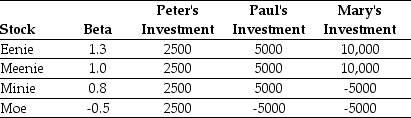 -Which of the following statements is FALSE?
 (Multiple Choice)
4.8/5 (72)
(72) Use the table for the question(s)below.
Consider the following three individuals portfolios consisting of investments in four stocks:
-Which of the following statements is FALSE?
-Which of the following statements is FALSE? (Multiple Choice)
4.7/5 (69)
(69) 
Filters
- Essay(0)
- Multiple Choice(0)
- Short Answer(0)
- True False(0)
- Matching(0)