



 Chat with AI
Exam 3: Financial Decision Making and the Law of One Price

Exam 1: The Corporation38 Questions
Exam 2: Introduction to Financial Statement Analysis103 Questions
Exam 3: Financial Decision Making and the Law of One Price89 Questions
Exam 4: The Time Value of Money91 Questions
Exam 5: Interest Rates68 Questions
Exam 6: Valuing Bonds115 Questions
Exam 7: Investment Decision Rules86 Questions
Exam 8: Fundamentals of Capital Budgeting95 Questions
Exam 9: Valuing Stocks96 Questions
Exam 10: Capital Markets and the Pricing of Risk103 Questions
Exam 11: Optimal Portfolio Choice and the Capital Asset Pricing Model134 Questions
Exam 12: Estimating the Cost of Capital104 Questions
Exam 13: Investor Behavior and Capital Market Efficiency77 Questions
Exam 14: Capital Structure in a Perfect Market99 Questions
Exam 15: Debt and Taxes95 Questions
Exam 16: Financial Distress,managerial Incentives,and Information111 Questions
Exam 17: Payout Policy96 Questions
Exam 18: Capital Budgeting and Valuation With Leverage99 Questions
Exam 19: Valuation and Financial Modeling: a Case Study49 Questions
Exam 20: Financial Options57 Questions
Exam 21: Option Valuation43 Questions
Exam 22: Real Options64 Questions
Exam 23: Raising Equity Capital52 Questions
Exam 24: Debt Financing54 Questions
Exam 25: Leasing46 Questions
Exam 26: Working Capital Management48 Questions
Exam 27: Short-Term Financial Planning47 Questions
Exam 28: Mergers and Acquisitions59 Questions
Exam 29: Corporate Governance46 Questions
Exam 30: Risk Management53 Questions
Exam 31: International Corporate Finance45 Questions
Select questions type


Use the information for the question(s)below.
An independent film maker is considering producing a new movie.The initial cost for making this movie will be $20 million today.Once the movie is completed,in one year,the movie will be sold to a major studio for $25 million.Rather than paying for the $20 million investment entirely using its own cash,the film maker is considering raising additional funds by issuing a security that will pay investors $11 million in one year.Suppose the risk-free rate of interest is 10%.
-Without issuing the new security,the NPV for this project is closest to what amount? Should the film maker make the investment?
(Multiple Choice)
4.9/5  (70)
(70) Use the information for the question(s)below.
An exchange traded fund (ETF)is a security that represents a portfolio of individual stocks.Consider an ETF for which each share represents a portfolio of two shares of International Business Machines (IBM),three shares of Merck (MRK),and three shares of Citigroup Inc.(C).Suppose the current market price of each individual stock are shown below: 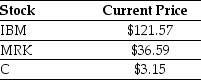 -The price per share of the ETF in a normal market is closest to:
 (Multiple Choice)
4.8/5 (83)
(83) You are offered an investment opportunity in which you will receive $23,750 today in exchange for paying $25,000 in one year.Suppose the risk-free interest rate is 6% per year.Should you take this project? The NPV for this project is closest to:
(Multiple Choice)
4.8/5 (74)
(74) If the discount rate is 15%,the alternative with the lowest NPV is:
(Multiple Choice)
4.9/5 (67)
(67) Which of the following statements regarding arbitrage and security prices is INCORRECT?
(Multiple Choice)
4.8/5 (67)
(67) A project that you are considering today is expected to provide benefits worth $168,000 in one year.If the risk-free rate of interest (rf)is 4.5%,then the value of the benefits of this project today are closest to:
(Multiple Choice)
4.9/5 (87)
(87) If we use future value rather than present value to decide whether to make an investment:
(Multiple Choice)
4.8/5 (90)
(90) Use the table for the question(s)below. 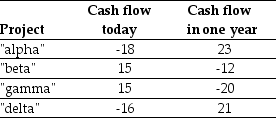 -Assume that the risk-free interest rate is 10%.Rank each of the four projects from most desirable to least desirable based upon NPV.Which project would you invest in first? Are there any projects that you wouldn't invest in?
 (Essay)
4.9/5 (77)
(77) 
Filters
- Essay(0)
- Multiple Choice(0)
- Short Answer(0)
- True False(0)
- Matching(0)