



 Chat with AI
Exam 16: Photosynthesis

Exam 1: The Scope of Biochemistry17 Questions
Exam 2: The Matrix of Life: Weak Interactions in an Aqueous Environment25 Questions
Exam 3: The Energetics of Life25 Questions
Exam 4: Nucleic Acids28 Questions
Exam 5: Introduction to Proteins: the Primary Level of Protein Structure25 Questions
Exam 6: The Three-Dimensional Structure of Proteins24 Questions
Exam 7: Protein Function and Evolution27 Questions
Exam 8: Contractile Proteins and Molecular Motors19 Questions
Exam 9: Carbohydrates: Sugars, Saccharides, Glycans28 Questions
Exam 10: Lipids, Membranes and Cellular Transport25 Questions
Exam 11: Enzymes: Biological Catalysts24 Questions
Exam 12: Chemical Logic of Metabolism25 Questions
Exam 13: Carbohydrate Metabolism: Glycolysis, Gluconeogenesis, Glycogen Metabolism, and the Pentose Phosphate Pathway41 Questions
Exam 14: Citric Acid Cycle and Glyoxylate Cycle25 Questions
Exam 15: Electron Transport, Oxidative Phosphorylation, and Oxygen Metabolism24 Questions
Exam 16: Photosynthesis26 Questions
Exam 17: Lipid Metabolism I: Fatty Acids, Triacylglycerols, and Lipoproteins26 Questions
Exam 18: Interorgan and Intracellular Coordination of Energy Metabolism in Vertebrates22 Questions
Exam 19: Lipid Metabolism Ii: Membrane Lipids, Steroids, Isoprenoids, and Eicosanoids25 Questions
Exam 20: Metabolism of Nitrogenous Compounds I: Principles of Biosynthesis, Utilization, and Turnover25 Questions
Exam 21: Metabolism of Nitogenous Compounds II: Amino Acids, Porphyrins, and Neurotransmitters25 Questions
Exam 22: Nucleotide Metabolism25 Questions
Exam 23: Mechanisms of Signal Transduction24 Questions
Exam 24: Genes, Genomes and Chromosomes25 Questions
Exam 25: DNA Replication25 Questions
Exam 26: DNA Restructuring: Repair, Recombination, Rearrangement, Amplification25 Questions
Exam 27: Information Readout: Transcription and Post-Transcriptional Processing25 Questions
Exam 28: Information Decoding: Translation and Post-Translational Protein Processing28 Questions
Exam 29: Regulation of Gene Expression25 Questions
Select questions type


In C4 plants, CO2 in the mesophyll cell reacts with _________ to form oxaloacetate while in the bundle sheath cell, _________ undergoes decarboxylation to pyruvate.
(Multiple Choice)
4.8/5  (79)
(79) Which of the following correctly identifies the proton pumping in the two-photosystem light reactions?
(Multiple Choice)
4.8/5 (75)
(75) Which of the following best describes photosynthesis in purple photosynthetic bacteria?
(Multiple Choice)
4.9/5 (83)
(83) Which of the following would have an inhibitory effect upon rubisco?
(Multiple Choice)
4.9/5 (88)
(88) If the following 14C labeled molecules served as substrates for rubisco (the labeled carbons are indicated with *), where would the 14C labels end up in the immediate product(s)of the reaction? Draw the product(s), clearly showing which atom(s)would be labeled. 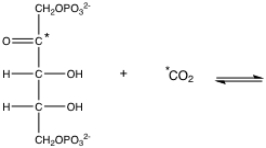
(Essay)
5.0/5 (79)
(79) The regeneration phase of the dark reactions are best considered in terms of regenerating 6 molecules of ribulose-1,5-bisphosphate, a process that requires 6 ATP. Considering the number of photons required for production of ATP in the light reactions, on average, how many photons must be absorbed for each molecule of ribulose-1,5-bisphosphate regenerated?
(Multiple Choice)
4.7/5 (70)
(70) 
Filters
- Essay(0)
- Multiple Choice(0)
- Short Answer(0)
- True False(0)
- Matching(0)